Preserving Family History: A Gentle Guide to Recording the Stories That Matter
Somewhere in your family, there is a story that only one person still remembers — the reason a grandmother left her hometown, the nickname a great-uncle earned, the recipe nobody ever wrote down. Family history is built from small, specific details like these. The good news is that you do not need to be a trained researcher to save them. You need curiosity, a little consistency, and a way to keep what you gather from scattering.
This guide offers a calm, practical approach to recording your family history, starting this week with the people and memories already within reach.
Why Family History Feels Urgent — and Why That Can Help
Many people begin exploring their ancestors after a loss, once certain questions can no longer be asked directly. That sense of urgency is real, but it can work in your favor rather than freeze you. The memories that survive are rarely the ones someone preserved flawlessly. They are the ones someone bothered to write down, record, or retell.
Try thinking of your project as gathering rather than researching. That single word shift lowers the pressure. You are not building a finished monument. You are collecting fragments — a voice, a date, a photograph with three unlabeled faces — and giving them a home where they can be revisited and shared.
Start With the Stories Already in the Room
The richest source of family stories is usually sitting across the table. Before you open a genealogy database or order a DNA kit, spend an hour with the relative who tells the longest anecdotes. Let them lead the conversation, and simply keep up.
Record one voice at a time
Group conversations are lively, but they are hard to transcribe and easy to lose. When you want a story on the record, ask for a one-on-one chat — in person, by phone, or over a video call — and always ask permission to record. A phone's voice memo app is more than enough.
Then label the file immediatelywith the speaker's name, your name, and the date. Future you, listening back two years from now, will be grateful you took those ten seconds.
Ask about ordinary days, not just milestones
Weddings, moves, and migrations matter. But the texture of a life lives in the everyday. What did the kitchen smell like on Sunday mornings? What was the walk to school like? What did people do on a rainy afternoon before television? Answers to questions like these turn ancestors into people rather than entries in a family tree.
Questions That Unlock Family Stories
Keep a short list on your phone so you never sit in awkward silence. These openers work well with almost anyone:
- What is the earliest thing you remember about your childhood home?
- Who in the family did you feel closest to, and why?
- What did your parents do for work, and how did that shape your week?
- Was there a family saying, song, or meal that meant "we're home"?
- What is something you were told about our ancestors that you still wonder about?
- What was the happiest year of your life so far, and what made it that way?
- What do you hope your grandchildren remember about you?
Follow the emotion, not the checklist. If an answer opens a door, walk through it and let your plan wait.
Build Your Family Tree Without Chasing Perfection
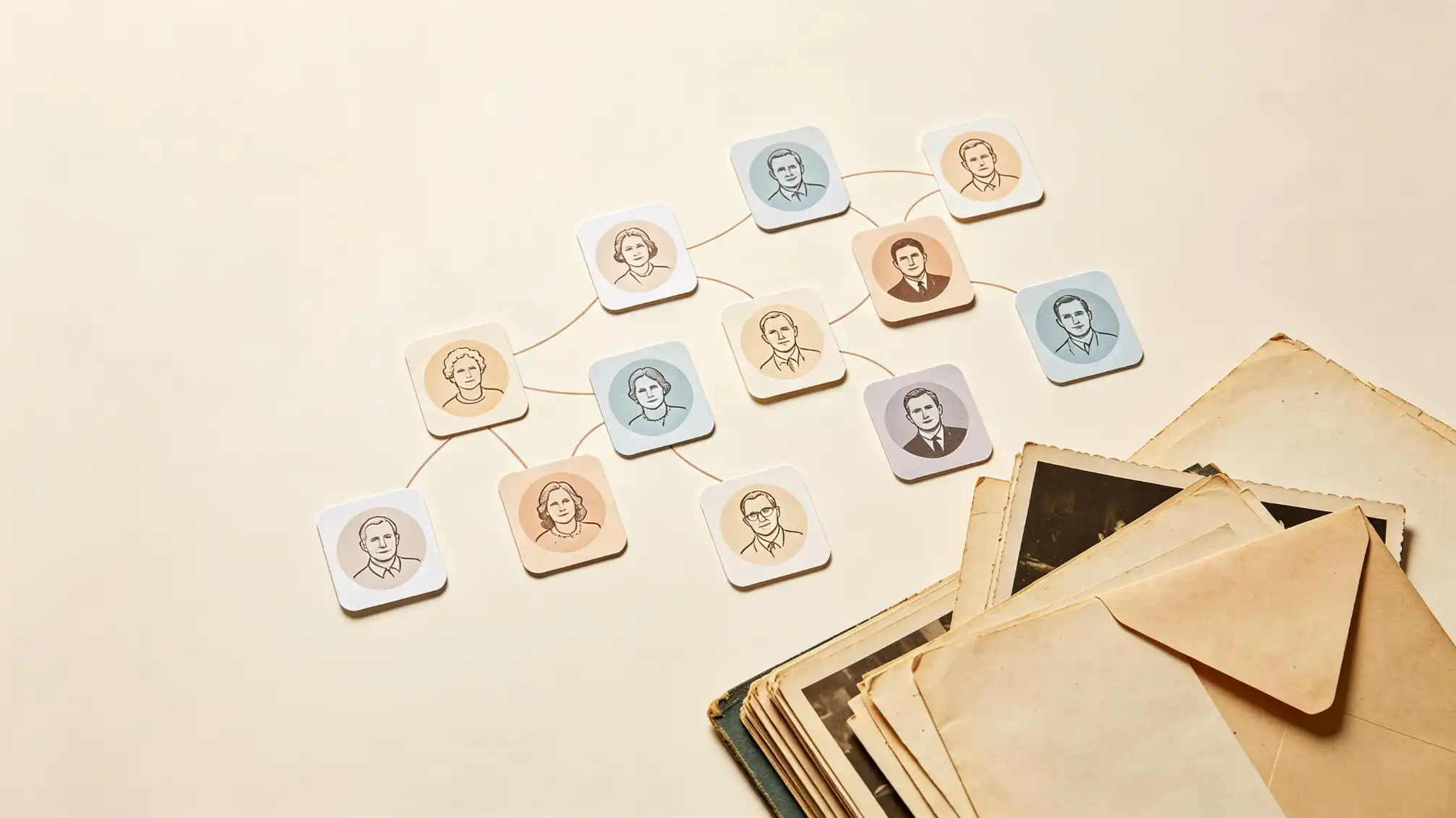
A family tree is a map, not a verdict. Begin with yourself and work outward, one generation at a time, and let it stay incomplete for as long as it needs to.
Start with four branches
Write down what you know about your four grandparents — full names, approximate birth years, places they lived, and one detail about their personality. That is often enough to reveal gaps worth investigating. From there, add great-grandparents only when you have something solid to attach them to.
Leave room for uncertainty
Write "possibly," "according to Aunt Rosa," or "unconfirmed" next to shaky details instead of smoothing them into facts. Honest notes are far more useful to future researchers than confident mistakes, and they preserve the family stories that surround each name.
Keep Everything Findable
Family history projects rarely fail from lack of enthusiasm. They fail because six months of recordings end up on three devices and nobody can find them. A minimal system solves this:
- One home base. Choose a single folder, cloud drive, or binder as the official archive, and resist the urge to keep copies elsewhere.
- Names that explain themselves. Use a consistent pattern like 1954-06-12_Rosa-Miller_childhood-memories.mp3.
- A one-page index. List what you have, who it came from, and when you collected it. Update it the same day you add something new.
- Backups. Store a second copy somewhere physical or in the cloud, and refresh it yearly.
Turn Fragments Into Family Stories Worth Sharing
Recordings and notes become family history the moment someone else can experience them. Transcribe the best five minutes of an interview, pair a photograph with the story behind it, or write two paragraphs about one ancestor's ordinary week. Perfection is not the goal — being readable and reachable is.
If you would like a place to publish what you have gathered and see how other families are doing the same, the community stories at familylove.love/stories are a natural next step. Reading someone else's family story often sparks the memory you were struggling to reach.
Invite the Next Generation In
Children and teenagers engage with family history when it is active rather than archival. Hand them a phone and ask them to interview a grandparent. Let them choose the questions. Show them the family tree and ask them to guess which ancestor they resemble. The point is not accuracy — it is connection, and the sense that these are their ancestors too.
Over time, a few recordings, a rough family tree, and a folder of labeled files become something more: a living record that answers the question, "Where do we come from?" — in voices, not just dates.