Building Your First Family Tree: A Practical Guide for Beginners
A family tree usually starts small: a name on the back of a photograph, a question asked at a holiday dinner, a story about a grandfather who arrived from somewhere nobody can quite name. That is enough to begin. You do not need a subscription, an archive pass, or a free weekend — you need a pencil, a notebook, and the discipline to record what you already know before you chase what you do not.
This guide is written for people starting their first family tree. It skips the romance and focuses on the method: how to capture facts, how to talk to relatives, and how to keep the whole thing accurate as it grows from ten names to a hundred.
Begin With the Facts You Already Have
Before you open a single website, sit down with paper and sketch three generations: yourself, your parents, your grandparents. For each person, write a full name, and where you know them, a birth date, a birth place, a marriage date, and a death date. Leave blanks where you are unsure — blanks are useful, because they tell you exactly what to research next.
Two habits are worth forming immediately. First, always record women under their maiden name, with married names noted separately; maiden names are what link generations together. Second, write dates in one consistent format (day-month-year, for example) so you never have to guess later whether 03/04 means March or April.
When the page is finished, you will have a rough chart and a short list of gaps. That list is your research plan.
Talk to Living Relatives Before You Search Online
Records are patient; people are not. The oldest members of your family are the only source for details that were never written down — nicknames, occupations, why a family moved, which cousin stopped speaking to whom. Start those conversations early.
Come prepared with specific questions rather than a vague request to 'tell me about the family'. Useful prompts include:
- What were your parents' full names, and where were they born?
- Did anyone in the family use a different name than the one on official papers?
- Where did the family live before they moved to where you grew up?
- Do you remember any weddings, funerals, or migrations that changed things for the family?
- Who else should I talk to, and who keeps the old photographs?
Ask permission to record the conversation or take notes, and send a short summary afterward so your relative can correct anything you misheard. Memory is generous but imprecise, so treat everything you hear as a lead rather than a conclusion.
Give Your Family Tree One Home
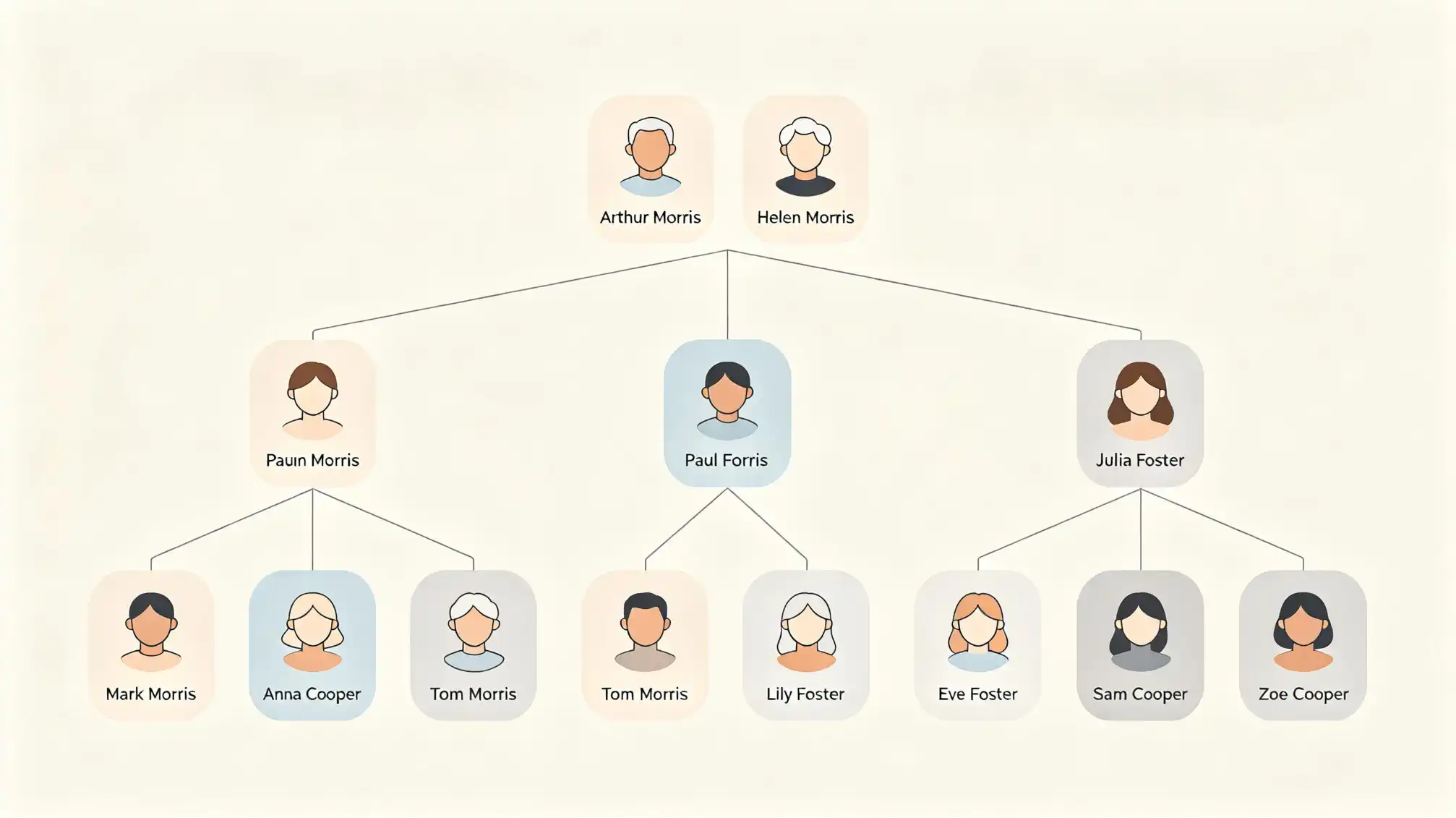
The most common beginner failure is not a lack of records — it is scattering them. Notes in three notebooks, photographs on a phone, dates in a text message, a chart drawn twice with different spellings. Choose one place where your family tree will live, whether that is a dedicated genealogy platform, a structured spreadsheet, or a well-organized folder system, and commit to it.
If you want each relative to have a clear, consistent profile that is easy to revisit and share, the family section here is a practical place to start organizing names, relationships, and notes in one view. Whatever tool you pick, the test is simple: can you find any person's details in under a minute?
Work Backward, One Generation at a Time
Professionals research from the known to the unknown. Beginners are often tempted to leap straight to a famous surname or a rumored ancestor overseas, and that is where trees become fiction. Stay disciplined: finish a generation before moving to the previous one.
In practice, that means confirming a parent's birth record before hunting for the grandparent's marriage record. Each confirmed generation gives you a name, a place, and a date — the three keys you need to unlock the next one. Jumping ahead leaves you with branches that look impressive and cannot be verified.
Write Down Where Every Fact Came From
A name without a source is a rumor with a date attached. Every time you add a fact, note where it came from: an interview with a named relative and the date it took place, a certificate, a census entry, a headstone photograph. This takes seconds and saves years.
Source notes matter most when two relatives disagree. Rather than choosing the version you prefer, record both and note the conflict. Later, a document will usually settle it. Genealogy software has fields for exactly this; if you are working on paper, add a 'source' column to your chart.
Check Before You Connect
Names repeat relentlessly across generations, and the same name can belong to two cousins born three years apart in the same town. Before you attach a person to your tree, cross-check three things: the date fits the timeline, the place is plausible for that family at that time, and at least one other record or relative supports the link.
Watch for spelling variants, boundary changes, and families who used middle names in daily life. A missing record does not mean a person did not exist — it often means the record is indexed under a spelling you have not tried yet.
Mistakes That Slow Beginners Down
- Copying an entire tree from someone else's research without checking a single source.
- Recording only names and skipping dates and places, which makes people impossible to distinguish.
- Ignoring maiden names, which severs the link between generations.
- Collecting hundreds of documents without filing or citing them.
- Waiting for the perfect software before writing anything down at all.
Each of these is easy to avoid at the start and painful to fix at year five.
Keep the Tree Growing
A family tree rewards steady, small effort. Set aside half an hour a month to review your open questions, add one newly found record, and share an update with a relative who can confirm or correct it. Photographs, occupations, and short life notes turn a list of names into family history that other people actually want to read.
And expect corrections. Every experienced researcher has removed a branch that turned out to be someone else's family. Treat that as progress, not failure — accuracy is the whole point.