Your First Family Tree: A Clear Beginner’s Guide to Tracing Family History
A family tree is often imagined as a framed chart with elegant branches and a few dozen names. That image is pleasant, but it is not very useful when you are just starting. For a beginner, a family tree is better understood as a working map: a structured way to record who your ancestors were, how they connected to one another, where they lived, and what evidence supports each conclusion. The chart is only the visible surface. The real work is the research underneath it.
This guide takes a practical approach to family history. It explains the different shapes a tree can take, what to record, how to begin with the relatives you can still talk to, and how to avoid the errors that turn a promising genealogy project into a tangle of unsupported names.
A Family Tree Is a Working Map, Not a Finished Portrait
At its core, a family tree is a model of relationships across generations. It answers questions such as: Who were my parents’ parents? Which families joined through marriage? Where did a branch move between censuses? A good tree does not just list names; it shows connections and keeps track of how you know what you know.
That distinction matters because beginners often confuse a tree with a conclusion. A name typed into a chart is a claim. A name supported by a birth record, a census entry, and a family photograph is a conclusion. Building a tree well means moving claims toward conclusions, one source at a time.
Three common shapes and when to use them
- Pedigree chart: follows your direct ancestors—parents, grandparents, great-grandparents—backward through time. It is the clearest format when your main question is who your direct forebears were.
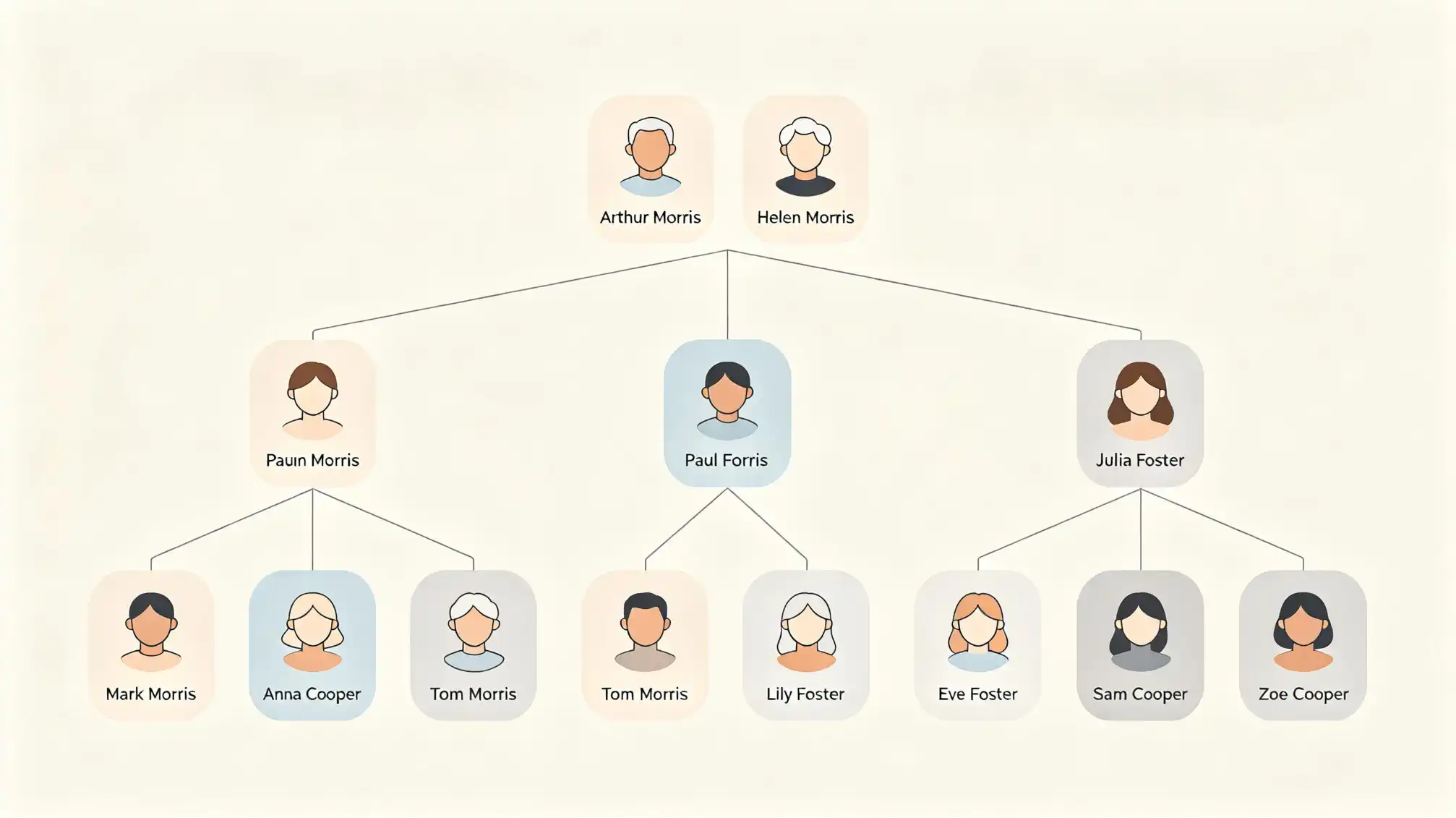
- Descendant chart: starts with one couple and spreads forward through all their children and grandchildren. It is useful for tracing cousins, resolving families with many siblings, and understanding a surname’s spread.
- Hourglass chart: combines ancestors and descendants around a central person. It gives a fuller picture of how a family group connects across generations.
You do not have to choose permanently. Many researchers keep a direct-line pedigree for clarity and a broader database for everyone else.
What belongs on each entry
At minimum, record a person’s full name, including a woman’s maiden name where known; birth, marriage, and death dates and places; and the relationships that connect them to the rest of the tree. Add source notes for each fact, plus a simple confidence level—proven, probable, or tentative. That last habit will save you hours later.
Begin With the Living, Then Move Backward
The most common mistake in genealogy is starting online. Start with people instead. Begin with yourself, then your parents, then grandparents. Interview living relatives while you can. Ask open questions: Where were you born? Who were your parents? What do you remember about your grandparents’ house, work, or holidays? Names and dates matter, but so do stories, photographs, and family Bibles.
Record conversations with permission, and follow up on details. Memory is valuable but imperfect, so treat every recollection as a clue to be checked rather than a final fact. If you want a shared place to gather these details with relatives, the family page is a practical starting point for collecting names, dates, and stories before you move into records.
What to Record—and What to Leave Out
Beginners often try to capture everythingat once: every cousin, every photograph, every rumored connection. A better approach is to record facts that answer a specific research question. If you are trying to identify your great-grandmother’s parents, record her birth, marriage, and death details first. Add occupation, migration, military service, or religious affiliation when those details help distinguish her from someone with the same name.
Leave out, for now, anything you cannot attach to a person or a source. A vague note that the family came from Ireland is a lead, not a fact. Write it down as a lead, then look for a record that gives a county, a townland, or a date.
The Research Cycle: Ask, Find, Record, Review
Genealogy is iterative. The work moves in a cycle rather than a straight line, and each pass makes the tree more reliable.
Ask a focused question
Choose one question small enough to answer with a record: When did John marry? Where was Ellen born? Who were the parents named on a death certificate? Broad questions produce broad, unreliable answers.
Find a record that could answer it
Identify which record type is likely to contain the answer, then check whether that record survives for the place and period. Not every country kept the same records at the same time.
Record the result and the source
Write down what the record says, where you found it, and when you looked. Include the call number, URL, microfilm number, or page reference. A fact without a source is difficult to defend later.
Review and revise
Return to earlier conclusions when new evidence appears. Revising a tree is not failure; it is the normal sign of careful family history work.
First Records Worth Checking
Start with sources close to home, then move outward. Depending on the time and place, useful records include:
- Certificates, family Bibles, letters, diaries, and photograph albums held by relatives.
- Civil registration records of birth, marriage, and death.
- Church baptism, marriage, and burial registers.
- Census returns, which can place a family together at a specific address and date.
- Immigration, naturalization, military, land, and probate records.
- Newspaper notices, cemetery records, and local histories.
Online databases are indexes first and evidence second. Always look for the original record or a clear image of it when possible. A transcription can contain errors, and an index entry rarely tells the whole story.
Organize Names, Places, and Sources Before the Tree Gets Big
A small tree can survive in a notebook. A large one cannot. Decide early on consistent formats for names, dates, and places. Record places from the smallest unit to the largest—town, county, state or province, country—and note boundary changes that may have altered the name of the place your ancestors lived in. Use a consistent file-naming system for scanned photographs and documents,and keep a research log of what you have already checked. This prevents duplicate work and makes it easier to see gaps.
Common Beginner Mistakes That Create False Branches
- Copying unsourced trees. Treat other people’s online trees as clues, not proof.
- Assuming surnames were fixed. Spelling varied, and families sometimes changed names after migration.
- Merging people with the same name. Use age, place, occupation, and family relationships to distinguish them.
- Skipping maiden names. A woman’s maiden name is often the key that opens the next generation.
- Ignoring migration and boundary changes. A family may appear in three places without ever moving far.
Privacy, Ethics, and Living Relatives
A family tree includes living people as well as ancestors. Do not publish details about living relatives without their consent, and be thoughtful with sensitive information such as adoption, health history, or family estrangement. DNA testing can reveal unexpected connections; prepare for that possibility and respect the wishes of others when sharing results. Good genealogy is not only accurate—it is considerate.
When Your Tree Starts to Answer Questions
After a few weeks of careful work, the tree begins to do more than store names. It shows patterns: a family that moved repeatedly for work, a community that married within a small radius, a surname that shifted spelling at a county border. Those patterns are the reward of family history research, and they turn genealogy from a list into a story about ancestors whose choices shaped your family.