Family Tree Template Guide: Build a Family History You Can Actually Share
Most family history projects stall for the same reason: a blank page. You know a handful of names, you've heard a few stories at reunions, but you're not sure where the next name belongs or how much detail to write beside each one. A family tree template removes that hesitation before it starts. It gives every person a fixed slot, every date a consistent shape, and every branch a direction to grow in.
What follows is a practical walkthrough: how to choose a layout that matches your research stage, how to enter information without creating a mess you'll have to untangle later, and how to turn the finished chart into something your relatives will genuinely want to read.
Why Structure Beats Free-Form Note Taking
Research notes scattered across notebooks, phone screenshots, and text threads are hard to audit. Months later you cannot tell whether a birth year came from a census record or from a cousin's memory. A template forces three useful habits from the first entry:
- One person, one entry. No duplicate cousins with three slightly different spellings.
- Consistent data fields. Birth, marriage, death, and place sit in the same position for everyone, which makes gaps obvious.
- Visible relationships. Parent-child and spouse connections are structural, not implied by where you happened to write a name.
That last point matters more than it sounds. When relationships are built into the layout, you can spot a missing generation at a glance instead of discovering it after you've interviewed six relatives.
Choosing the Right Chart Type for Where You Are Now
Not every template suits every stage of research. Pick the one that matches what you already know.
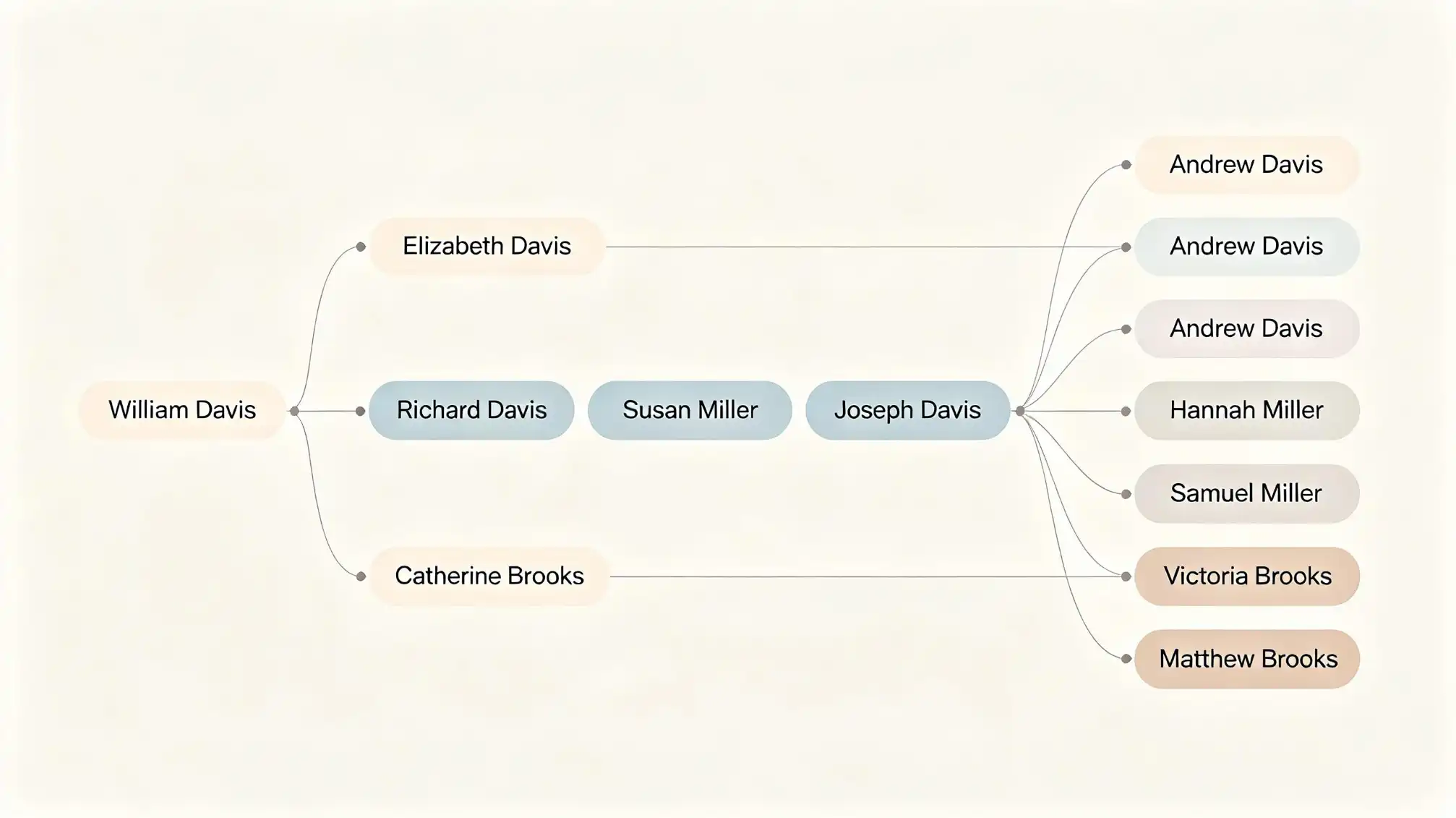
- Pedigree chart (ancestor chart). The classic left-to-right or bottom-to-top layout showing parents, grandparents, and great-grandparents. Best when you're tracing upward and want to see where the line stops.
- Descendant chart. Starts with one ancestor and flows downward through children, grandchildren, and beyond. Ideal for family reunions and surname studies.
- Family group sheet. One couple plus their children, with room for dates, places, and notes. This is the workhorse of serious research because it holds detail a visual chart cannot.
- Fan chart. A circular design that fits five or six generations on a single printable page. Great for wall art, less useful for editing.
Many researchers keep two files: a family group sheet for each couple as the detailed record, and a pedigree chart as the visual summary. The family history template you choose for the visual layer should be the one you can update without redrawing everything.
Filling In the Template Without Creating Future Work
The order in which you add information matters as much as the information itself. These five habits keep a growing tree readable:
- Start with yourself, then move one generation at a time. Jumping between branches invites duplicate entries and contradictory dates.
- Record the source beside the fact. Even "family Bible, page 4" or "told by Aunt Rose, 2019" is enough to know later whether to trust it.
- Use one date format everywhere. Day-month-year or month-day-year, but never both in the same tree.
- Mark uncertainty visibly. A question mark or the word "approx." is honest and prevents guesswork from hardening into fact.
- Leave place fields for last. Names and dates first, locations second — chasing a village spelling too early slows down the whole project.
If you delete a person, don't simply clear the cell. Note why in your research log. Six months from now, that note is the difference between a clean decision and starting the same search over.
Simple Naming and Filing Conventions That Scale
When your tree has forty names it fits in your head. At four hundred it does not. Two conventions carry almost all the weight:
- Names: use a person's birth name in full, and add married names in parentheses. Keep maiden names intact so maternal lines stay searchable.
- Files: name digital records and scanned photos with a consistent pattern, such as Surname_Firstname_Year_RecordType. This makes the file folder behave like a second index.
Write these rules down once and apply them to every new entry. Inconsistency is the single biggest reason people abandon a template halfway through and start over.
Free Family Tree Template vs. Paid Options
A free family tree template is usually enough if you're working with one or two family lines and want a printable chart. Paid tools earn their cost when you need automatic relationship calculations, source citations that link to records, or multi-user editing. The practical test is simple: choose the option you can still maintain in a year, not the one with the most features today.
Whatever you pick, export a copy you own. A plain spreadsheet or PDF version means your research survives a subscription change, an account lockout, or a company quietly discontinuing a product.
Turning the Finished Chart Into Something Relatives Will Read
A tree that lives only on your laptop has a short life. Printing a clean copy for a reunion, adding short captions under two or three photographs, or sharing a digital version with cousins turns a research file into a family resource — and relatives often respond with details you never had.
If you want a shared space where those contributions can collect, it helps to see how an organized family profile page is structured before you invite anyone in. Browse the family page for a working example of how names, dates, and relationships are presented when they're meant to be read by the whole family, not just the researcher.
One more habit worth keeping: revisit the tree twice a year. New family news, a found photograph, or a corrected date takes five minutes to add and keeps the whole project alive rather than archived.