{
"title": "Why an Online Family Tree Makes Family History Easier to Build and Share",
"metaTitle": "Online Family Tree: Build & Share Family History Easily",
"metaDescription": "See how an online family tree keeps sources, photos, and relatives in sync — plus a practical checklist for comparing digital genealogy tools before you commit.",
"summary": "An online family tree changes genealogy from a private pile of notes into a searchable, source-backed record that relatives can help maintain. This guide explains the four practical gains that matter most, a checklist for comparing digital family tree tools, common mistakes that undo the advantages, and how to turn research into something the whole family can use.",
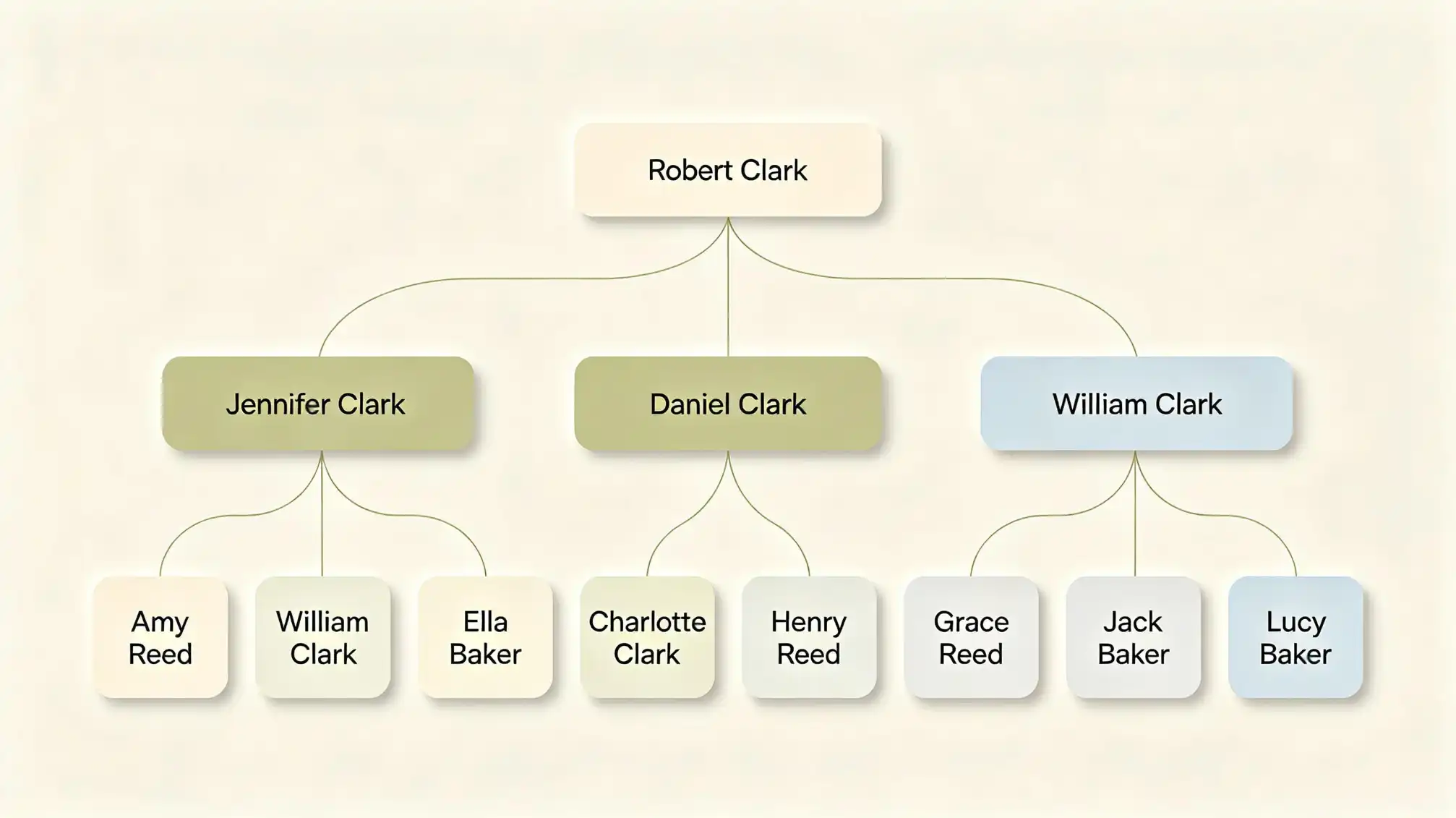
"contentHtml": "<h1>Why an Online Family Tree Makes Family History Easier to Build and Share</h1>\n<p>Most genealogy projects begin the same way: a shoebox of photographs, a few names penciled into a notebook, and one relative who seems to remember every birthday since 1930. That approach works beautifully — until the notebook is misplaced, the family historian slows down, or two cousins quietly research the same branch and reach different conclusions.</p>\n<p>An online family tree does not make research glamorous. What it does is keep every name, date, place, and source in one durable place, so the family history you build today is still usable in ten or twenty years. For anyone comparing digital family tree tools, the real question is not which app looks nicest, but which one protects the work you are about to do.</p>\n\n<h2>Paper Notes Versus a Living Record</h2>\n<p>A paper chart is a snapshot. It records what someone knew on the day they drew it, and correcting a mistake means erasing ink or starting again. A digital tree is a working document: add a burial record on Tuesday, attach a photograph on Thursday, and every connected view updates itself.</p>\n<p>The difference shows up fastest in the messy middle of research. You find a marriage certificate that gives a maiden name. On paper, that means rewriting a line and possibly re-drawing a branch. In an online family tree, you attach the record to the person, adjust one field, and the relationship structure recalculates. Multiply that by a hundred corrections — which is a realistic number for any serious family history project — and the time saved becomes substantial.</p>\n\n<h2>The Four Gains That Matter Most</h2>\n<p>When people compare genealogy platforms, they often fixate on features. It helps to step back and ask what each feature actually protects.</p>\n\n<h3>1. Every Fact Can Carry Its Source</h3>\n<p>An unsourced date is a rumour. The strongest argument for moving your research into an online family tree is that citations travel with the person. Instead of a separate folder of scanned certificates that nobody can match to the right individual, each record sits beside the fact it supports. Years later, you or another researcher can ask \"how do we know this?\" and get an answer in seconds.</p>\n\n<h3>2. Relationships Update Automatically</h3>\n<p>Add one grandparent and the tree rebuilds itself across every branch, including relationship labels such as second cousin once removed that most of us cannot calculate by hand. This is where digital tools justify their cost: consistency. A deleted duplicate disappears everywhere, not just from the page you were editing.</p>\n\n<h3>3. Collaboration Without Chaos</h3>\n<p>Relatives who would never sit down with a binder will happily add a photo from their phone. Inviting a cousin to contribute one memory or one scanned document can add a detail no archive holds. Good platforms handle this carefully — changes are visible, reversible, and attributable — which keeps cooperation from turning into a tug-of-war over the same record.</p>\n\n<h3>4. Continuity Across People and Devices</h3>\n<p>Family history is fragile. Files on a single laptop, notes on one phone, and a chart in one house all share the same risk. When your genealogy lives online, the work survives moves, device changes, and the loss of any single contributor.</p>\n\n<figure>\n<img src=\"https://r2.familylove.love/static/seo/modernFamilyTreeDiagram2.webp\" alt=\"Diagram of an online family tree showing connected generations, sources, and shared branches\" />\n<figcaption>A well-structured online family tree links each person to relationships, records, and contributors — so the same chart serves as research tool, archive index, and family reference.</figcaption>\n</figure>\n\n<h2>A Practical Checklist for Comparing Digital Family Tree Tools</h2>\n<p>Before committing years of research to any platform, test it against the things that are expensive to fix later:</p>\n<ul>\n<li><strong>Export options.</strong> Can you download your data as a standard GEDCOM file or similar format? If not, you are renting your family history rather than owning it.</li>\n<li><strong>Source handling.</strong> Does the tool treat citations as first-class information, or as a free-text note you will eventually lose track of?</li>\n<li><strong>Privacy.</strong> Can you keep living relatives hidden while publishing older generations? Sensitive data about the living should never be public by default.</li>\n<li><strong>Duplicate detection.</strong> Look for merge tools that let you combine two records without re-entering every fact.</li>\n<li><strong>Media storage.</strong> Check limits on photographs and documents, and whether stay attached to the right person forever.</li>\n<li><strong>Searchability.</strong> A tree that cannot be searched by place, date, or surname is just a picture of a tree.</li>\n</ul>\n<p>Run one real branch — about twenty people — through two or three tools before deciding. The comparison takes an afternoon and prevents years of rework.</p>\n\n<h2>Where New Builders Usually Go Wrong</h2>\n<p>The most common mistake is copying an existing online tree wholesale without checking its sources. Shared trees are useful for leads, not conclusions. Treat every borrowed name as a hypothesis until a record confirms it.</p>\n<p>The second mistake is chasing ancestors while ignoring the living. Names, stories, and photographs of parents and grandparents disappear faster than parish records Interview them first, then dig backward. A useful starting point is building the immediate family layer first, which you can structure through the <a href=\"://www.familylove.love/family">family</a> section before expanding outward into deeper genealogy.</p>\n<p>The third inconsistency. Decide early how you will record names, dates, and places — full maiden names, day-month-year, town plus county — and apply the same rules everywhere. Consistent data is what makes an online family tree searchable and mergeable later.</p>\n\n<h2>From Private Research to Shared Heritage</h2>\n<p>The quiet reward of a digital tree is that it stops being a solo project. A birthday reminder, a photo caption, a corrected spelling — small contributions compound. Within a year, most families find that the tree answers questions no single person could have answered alone: which branch emigrated first, where two surnames intersect, and why a certain photograph was kept for a century.</p>\n<p> is the practical case for moving your genealogy online. Not novelty, but durability, accuracy, and the ability to hand something complete to the next person who asks where the family came from.</p>\n\n<h1>Practical Steps</h1>\n<ul>\n<li>Start your tree structure with the people closest to you by using <a href=\"://www.familylove.loveamily\">https://www.familylove.love/family</>, then expand branch by branch as records are confirmed.</>\n<li>For setup guidance, export instructions, and troubleshooting as you build, refer to the help and documentation at <a href=\"https://www.familylove.love/docs\">https://www.familylove.love/docs</a>.</lin</ul>",
"images": [
"https://r2.familylove.love/static/seo/modernFamilyTreeDiagram2.webp"
]
}