Tracing Your Ancestors Backward: A Practical Workflow for Reliable Family History
Most family history projects stall for the same reason. People jump straight to the famous ancestor, the immigrant ship, or a county record they half-remember from a cousin's story, and the family tree ends up with holes, duplicated people, and branches that collapse the moment someone checks. The durable method is quieter: trace your ancestors backward, one generation at a time, and attach evidence to every link before you move on. What follows is a working process you can apply this week, whether you are starting with two names or two hundred.
Start with what you can prove, not what you hope to find
Begin with yourself and work back through parents and grandparents, writing down full names, dates, and places exactly as you believe them today. Mark each fact as confirmed, probable, or family lore. That single habit prevents the most common error in genealogy: building a branch on an assumption and then spending months defending it.
Interview the oldest living relatives while you can. Ask about nicknames, maiden names, occupations, moves, and the towns people left and why. Record the conversations if they agree. Memory is imperfect, but it generates the specific search terms that databases need, and it often supplies the detail that makes a common name searchable.
Keep one research question open at a time
Replace a vague goal such as finding my ancestors with a question narrow enough to answer: When and where was my great-grandmother Rosa born, and who were her parents? Give that question a deadline of a week or two. When you have an answer, record the source, then open the next question. A family tree grows fastest when it grows in a straight line rather than in five directions at once.
Gather home sources before you pay for records
Before subscriptions and courthouse fees, exhaust the house. Photographs, letters, bibles, funeral cards, military discharge papers, school certificates, address books, and the backs of pictures often carry names, dates, and places that no database holds. Scan both sides of every photograph, even the blank ones.
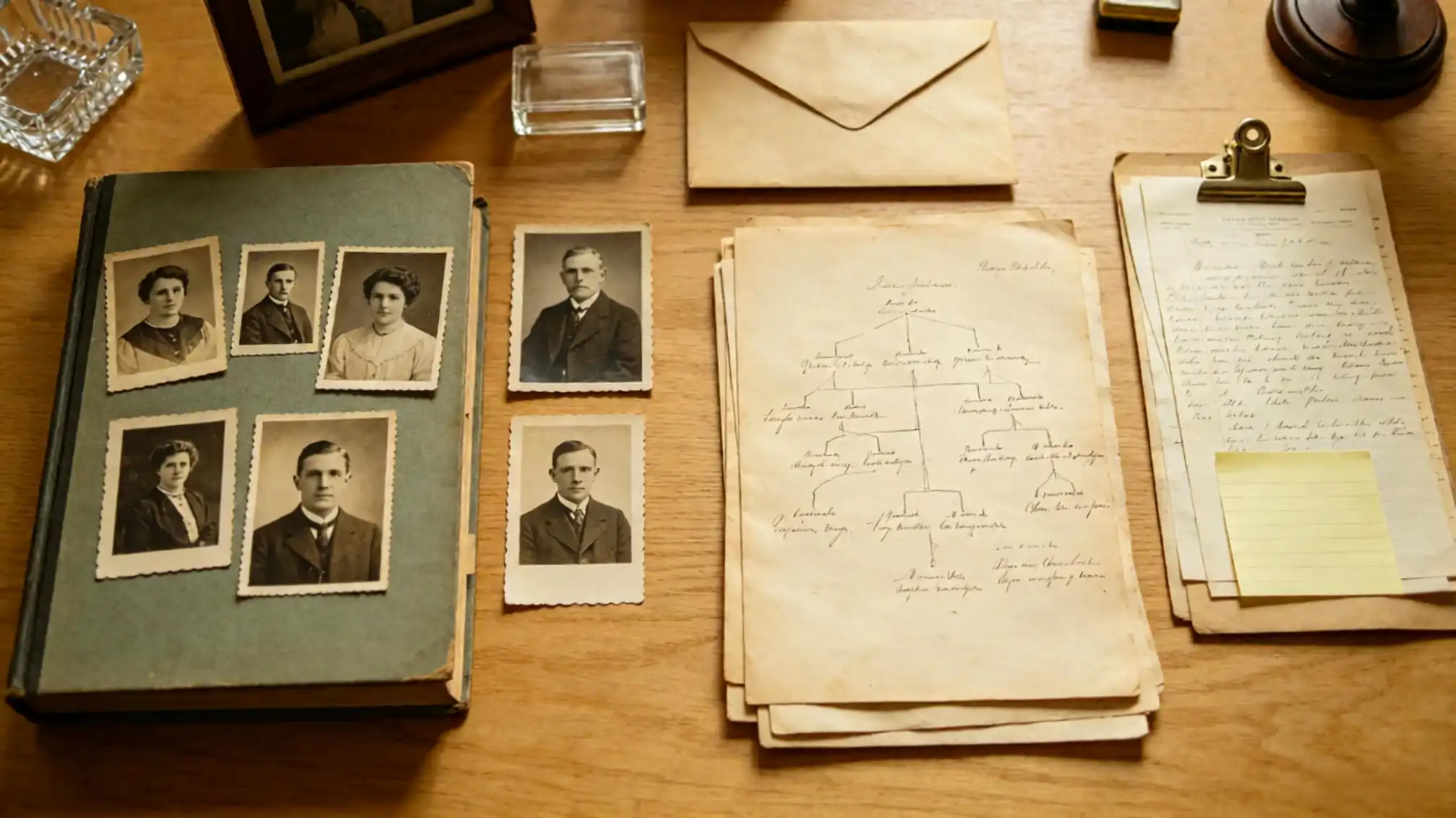
Store the scans in one place with a predictable naming convention, for example surname-firstname-event-year, so a wedding photo from 1911 is findable by name and date rather than by memory.
Work through record types in a predictable order
Once home sources are catalogued, move to official records, always from the most recent event back to the oldest. A practical sequence for most families is civil birth, marriage, and death registrations, then census returns, then church baptisms, marriages, and burials, then cemetery and probate files, then military, immigration, naturalization, land, and tax records. Each type answers different questions and covers different decades, so a gap in one is rarely a dead end.
In many countries civil registration began only in the mid-nineteenth century, which means church and land records carry the earlier generations. Knowing the start date of each record set stops you searching a database that cannot possibly contain your ancestor. Search indexes first, then view the original image. Indexes contain transcription errors, while the original often includes parents' names, addresses, or witnesses that the index drops.
Treat every document as a claim, not a verdict
Weigh the informant, not just the form
A death certificate is only as accurate as the grieving relative who supplied the details. A census taker wrote what a neighbour said. A baptism record reflects what parents believed. Ask who provided the information, how close they were to the event, and how soon afterwards they spoke.
Confirm each link with two independent sources
Before you add a parent-child connection to your family tree, look for a second source that agrees: a census placing the child in the household, a marriage record naming the father, a probate file listing heirs. When sources conflict, record the conflict instead of choosing a favourite. Differences indate, place, and spelling are normal, especially across languages and among people who could not read or write.
Log your searches, including the ones that failed
A research log with the date, database, search terms, and result will save you more time than any subscription. It stops you repeating the same fruitless query, shows exactly which records you have not touched, and lets another researcher pick up the work later. Negative results are data: a missing census entry tells you the family may have been missed, moved, or enumerated under a spelling you have not yet tried.
Use collateral relatives to break brick walls
When a direct line disappears, researchsiblings, in-laws, cousins, and neighbours. Genealogists call this the FAN club: friends, associates, and neighbours. People migrated in groups, witnessed each other's documents, and were buried near each other. A brother's land record or a neighbour's will may name the parents that your ancestor's own documents never did.
Treat DNA as a confirmation tool, not a shortcut
Autosomal DNA is excellent for verifying a suspected relationship or separating two families with the same name. It is poor at replacing paper research, because a shared segment tells you that you are related, not how. Use it after you have a hypothesis: test the oldest available generation, sortmatches into known branches, and look for clusters of shared matches that point to one ancestor couple.
Write the story, not only the dates
A tree of names and dates rarely survives a generation. Occupations, migrations, illnesses, the reason a family left a village, the trade a grandfather practised, the church they attended: these are what descendants actually read. When a line is confirmed, write it down in plain language and keep the sources attached. You can collect and publish those narratives at https://www.familylove.love/stories, a straightforward way to turn a private research folder into something relatives can read, correct, and add to.
Expect a long project, and pace it accordingly
Experienced researchers rarely solve a line in a weekend. Set a reasonable target, such as one confirmed generation every few weeks with sources recorded as you go. Revisit your earliest conclusions once a year: new record sets are released constantly, and questions that were unanswerable in March are often answerable by October.