Family History Questions That Actually Get Relatives Talking
Most people sit down with a parent or grandparent intending to capture the family story, ask three questions, get three short answers, and quietly give up. The problem is almost never the relative. It is the question. "Tell me about your childhood" invites a shrug. "What did your street sound like on a summer evening?" invites a memory.
The prompts below are built for real conversations with parents, grandparents, aunts, uncles, and anyone old enough to remember a world you never saw. They run loosely from warm and easy to deeper and more delicate, so you can follow the natural flow of a conversation instead of reading from a clipboard.
Warm-Up Family History Questions That Break the Ice
Start with something concrete and sensory. Facts are easy to retrieve; feelings take longer to surface. A good opening question has a visible answer — a place, a sound, a smell, a routine.
- Where were you born, and what have you been told about that day?
- What is the first home you actually remember? Walk me through the rooms.
- What did your family eat on an ordinary weeknight?
- Which songs or radio shows were always playing in the background?
- Who was your closest friend as a child, and what did the two of you do together?
- Where did you go when you wanted to be alone?
Notice that none of these ask for an opinion or a summary. They ask for a picture. Pictures are easier to hand over.
Childhood, School, and Everyday Life
Once your relative is talking, stay in that era a little longer than feels necessary. The small details are what make a family history feel real decades later — the price of bread, the name of a teacher, the walk to school.
- What was school like? Who was your favorite teacher, and why?
- Did you have chores? What happened if you skipped them?
- What did you do for fun that cost nothing?
- What was the biggest trouble you ever got into?
- What did your family do on Sundays or holidays?
- What did you want to be when you grew up, and when did that change?
Questions About Grandparents and Earlier Generations
This is where most family trees go thin. People remember their parents far less precisely than they remember themselves, so ask for images and habits rather than dates.
- What was your mother like when you were a teenager? What did she worry about?
- What did your father do for work, and did he enjoy it?
- Which grandparent did you know best, and what do you remember most clearly about them?
- Did anyone in the family speak a different language or cook a dish nobody else made?
- What family stories were repeated so often that everyone knew them by heart?
- Was there anyone in the family nobody talked about? What happened there?
That last question often unlocks more than the ten before it. Ask it gently, and let silence do some of the work.
Work, Money, and Hard Times
Money and struggle shape families quietly. Ask about them plainly, without judgment, and be ready for answers that are shorter than you hoped.
- What was your first job? What did it pay, and what did you spend it on?
- Was there a time when money was genuinely tight? How did the family cope?
- What did your parents teach you about saving, debt, or lending to relatives?
- Did you ever have to move, leave a job, or start over?
- What did you worry about at night when you were in your thirties?
Love, Marriage, and Family Life
These questions usually get the best stories, because they carry the most feeling. Ask about the beginning, not the summary.
- How did you meet your partner? What was your first impression?
- What did your families think of the match?
- What surprised you most about becoming a parent?
- What did you and your partner disagree about most, and how did you handle it?
- What do you think held the family together during the hardest years?
Deeper Family History Questions for Later in the Conversation
Save these for when trust is established — often a second or third sitting, not the first.
- What is the hardest thing you have ever lived through?
- Is there something you wish you had done differently, or said sooner?
- What do you hope your grandchildren know about you?
- What do you want our family to never forget?
- What advice would you give your twenty-year-old self?
How to Ask So People Keep Talking
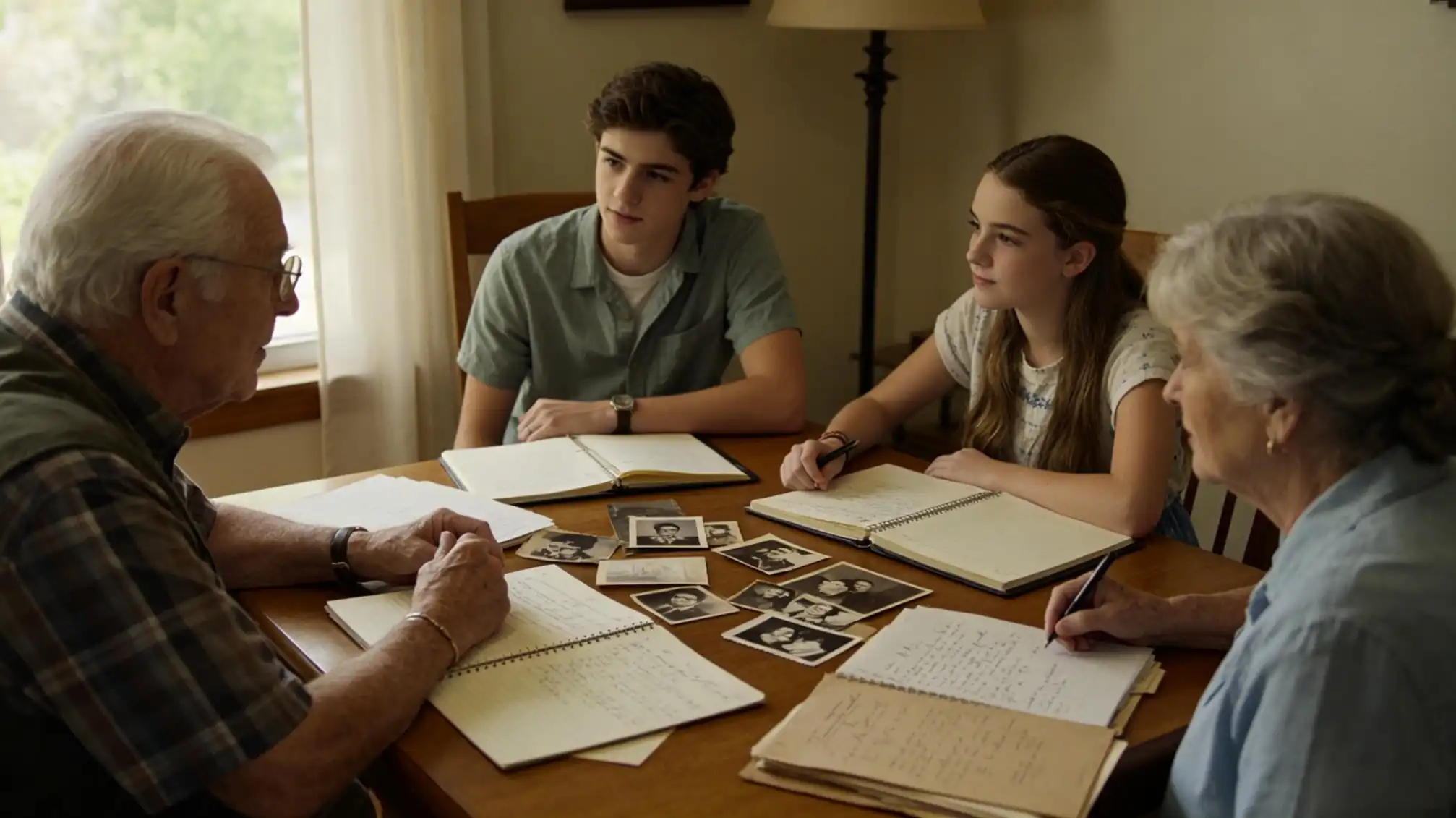
Technique matters as much as the wording. A few habits make the difference between a polite five-minute exchange and a two-hour conversation.
- Ask one question at a time. Stacked questions get the easiest answer only.
- Follow the emotion, not your list. If their voice changes, stay there and ask, "What was that like for you?"
- Use silence. Count to five before rescuing a pause. The next sentence is usually the honest one.
- Ask for scenes, not verdicts. "What happened next?" beats "Was that a good time in your life?"
- Bring props. Old photographs, a recipe card, or a letter pulls up memories that direct questions cannot reach.
- Record with permission. Say who is speaking, the date, and the location at the start of the recording.
- Share something first. Answer your own question briefly so the exchange feels equal, not like an interview.
From Conversation to Family Archive
An hour of talk is easy to lose. Transcribe the recording, add the names and dates you can verify, and note which parts are family legend rather than confirmed fact. Then put it somewhere the rest of the family can find it — a shared folder, a printed booklet, or an online collection of family stories such as https://www.familylove.love/stories, where you can read how other families preserved theirs and add your own.
One practical habit: after each session, write three sentences — who you spoke to, what surprised you, and what you want to ask next time. Those three lines become your roadmap for the following visit, and over a year they add up to a genuine family record.
Don't wait for the perfect moment or a professional microphone. The best time to ask these family history questions is while the people who can answer them are still sitting across the table from you.