Genealogy Without the Guesswork: A Calm, Practical Start to Tracing Your Family History
Most people who fall in love with genealogy do not begin with a burning question about the 1700s. They begin with something small: a grandparent's accent, a photograph with no names written on the back, a surname nobody in the family can explain. That curiosity is enough to start. What usually stops beginners is not a lack of interest but a lack of order — too many websites, too many conflicting dates, too many half-finished family trees.
This guide takes a different approach. Instead of handing you a long list of archives to visit, it teaches you to think like a researcher: begin with what you can prove, move one generation at a time, and treat every new name as a hypothesis rather than a fact. Do that, and your family tree grows steadily instead of collapsing under its own speculation.
Start With the Facts You Already Have
The most valuable information in your first month is probably sitting in your own home or in a relative's cupboard. Before you open a single database, write down everything you know with confidence — and be strict about the word "know." If you are repeating something because it has been said at family dinners for thirty years, mark it as unverified.
Create one simple document or notebook page and capture:
- Full names, including middle names and maiden names
- Approximate birth, marriage, and death dates
- The town or city where each event took place
- Relationships, nicknames, and any family stories attached to them
This step feels almost too basic, but it prevents the most common beginner problem: researching the wrong John Miller because nobody wrote down which John Miller was already accounted for.
Build Your Tree One Generation at a Time
New researchers often jump straight to a famous ancestor, a distant country, or a dramatic family legend. Resist that pull. Work backwards in clean, verifiable steps: you, then your parents, then your grandparents, then their parents. Each generation should be reasonably documented before you climb further.
Why does this matter? Because records are indexed by name, place, and date — and the further back you go, the more those details blur. When you know your great-grandmother's exact town and her parents' names, her parents become findable. When you only have a surname and a guess, every search returns noise.
Learn the Four Record Types That Answer Most Questions
You do not need to master every archive in the world. Most beginner questions are answered by four categories of records, and each one fills a different gap.
1. Vital Records
Birth, marriage, and death certificates are the backbone of family history. They usually supply dates, places, occupations, and — most valuably — parents' names. Availability varies widely by country and date, so check what your local registry holds before assuming nothing exists.
2. Census and Residence Records
A census places an entire household in one moment of time. Ten-year intervals let you watch children appear, occupations change, and families move. They are excellent for confirming that two people with the same name are actually the same person.
3. Religious and Community Records
Baptisms, marriages, burials, and membership rolls often survive earlier than civil registration. They can also capture communities — immigrant congregations, small rural parishes — whose members rarely appear in official paperwork.
4. Newspapers and Obituaries
Obituaries are quietly one of the richest beginner sources. They name siblings, married names, former addresses, and sometimes the town a family emigrated from. Local newspaper archives reward patient searching with details no certificate ever records.
Interview Living Relatives Before You Search Anywhere Else
No archive can tell you what your grandmother sounded like when she described her mother, or why the family stopped speaking to an uncle in 1962. Those details shape how you interpret every record you find later.
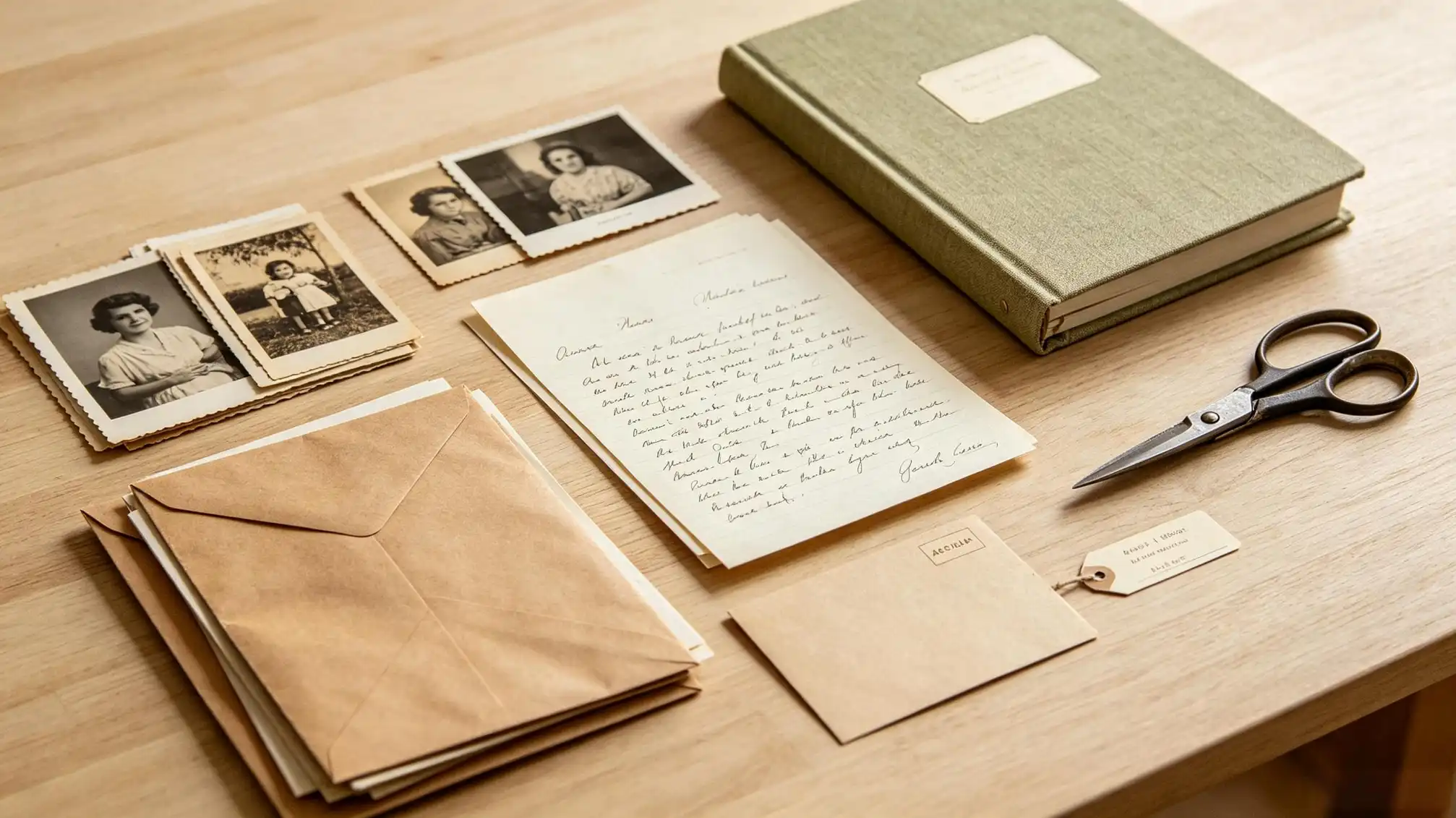
Ask open questions rather than yes-or-no ones: "What was your childhood home like?" "Who in the family was considered difficult, and why?" "What did your parents call their grandparents?" Record the conversation if you are given permission, and label the file with the date and the speaker's name. You can also preserve and share written memories through FamilyLove Stories, which keeps those narratives attached to the people they belong to rather than scattered across old phones.
Keep a Simple Research Log
A research log is nothing more than a running list of where you looked and what you found. It takes two minutes to update and saves entire afternoons of duplicated effort.
- Date of the search
- Source or website you checked
- Names and spellings you searched for
- Result, including "nothing found"
- Your next step or open question
Negative results are genuinely useful. Knowing that a record set does not cover your ancestor's town in 1870 stops you from searching it again next month.
Mistakes That Slow New Researchers Down
- Accepting other people's trees. An online tree is a lead, not a source. Verify every name against an original record.
- Trusting name spellings. Spelling was rarely fixed, and clerks wrote what they heard. Search phonetic variants and abbreviations.
- Skipping documentation. Record where each fact came from while the memory of finding it is fresh.
- Chasing the famous branch. The ordinary ancestors usually have the best surviving records.
- Storing everything in one place. Back up scans, photographs, and notes somewhere that survives a lost laptop.
Patience Is the Real Skill
Family history is a long game. Some lines will move forward quickly; others will sit unmoved for months until one new record set is released. That is normal and not a sign that you are doing it wrong.
What separates a researcher who eventually breaks through a brick wall from one who gives up is consistency. A few focused hours each month, with good notes and one generation at a time, will take you further than a weekend of frantic clicking through every name that looks close enough.