Turning Memories Into a Legacy: How to Begin Your Family History Journey
Almost everyone reaches a moment when a question about the past becomes urgent. Maybe a grandparent pauses mid-sentence and you realize you never asked about their childhood. Maybe you find a photograph with names pencilled on the back that no longer match anyone you know. That moment is not a reason to feel guilty — it is the perfect starting point for your family history project.
You do not need to be a trained researcher, own expensive software, or trace a line back to the 1600s. What you need is a simple method, a small amount of time each week, and the willingness to treat memory as something worth protecting. Here is how to begin well.
Why Family History Is Worth Starting Now
Research on family storytelling consistently points in the same direction: people who know where they come from tend to feel more resilient and more connected, especially during difficult seasons. Knowing that a grandmother crossed an ocean alone at nineteen, or that a great-uncle rebuilt a business after a fire, gives shape to your own story. Ancestors stop being names on a chart and become people who survived things you can learn from.
There is also a practical reason to start today. Memories are perishable. A story told once and never written down rarely survives two generations. The work you do in the next few months is the difference between a family that remembers and a family that guesses.
Begin With What You Already Have
Before you open a genealogy website or message a distant cousin, take stock of the material sitting in your own home. Most family history projects stall because people start by searching outward instead of looking inward first.
- Photographs — in albums, drawers, phone galleries, and old wallets.
- Documents — birth and marriage certificates, military papers, passports, letters, and recipe cards.
- Objects — a watch, a sewing kit, a tool, a piece of jewellery, each carrying a story someone once told.
- What you already know — names, places, birthdays, and family sayings you take for granted but nobody has written down.
Write these details down as plain notes before you try to organize them. Accuracy is easier to improve later than a blank page.
Record Family Stories While Voices Are Still Here
Documents tell you where people were. Family stories tell you what it felt like to be there. If you only have time for one activity, choose this one: sit with a relative and listen, with something recording.
You do not need professional equipment. A smartphone propped on a glass, placed between you, works beautifully. Ask permission first, explain what the recording is for, and offer to share a copy. People relax when they know the story stays in the family.
Questions That Open a Memory
- What did your home look like when you were a child, and who lived there?
- What did your parents do for work, and what did that mean for your family?
- Who was the kindest person in your family, and why?
- What is the hardest thing your family ever went through together?
- What family recipe, song, or saying should never be lost?
- What do you hope your grandchildren know about you?
Follow the emotion, not the script. If a question produces a long silence, let it sit — the best answers often arrive a few seconds later. Afterwards, write a short summary of each recording the same day, while the details are fresh.
Build a Family Tree Gradually, Not All at Once
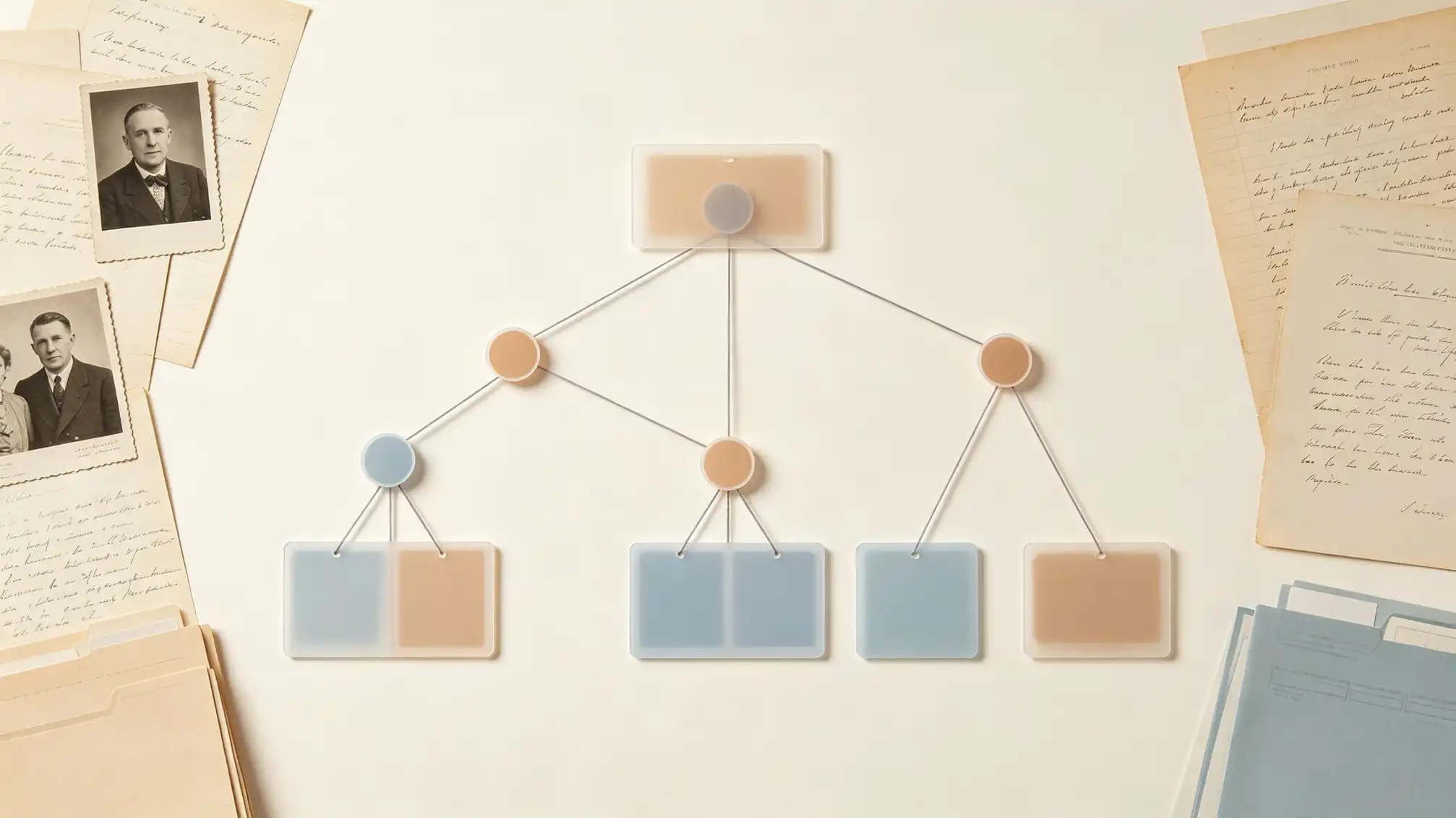
A family tree is not a finish line; it is a working map. Start with yourself, then add parents, grandparents, and known great-grandparents. Aim for correct dates and places rather than distant names. One well-documented generation is worth more than five speculative ones.
As you go, mark anything unverified with a simple note such as “family memory — needs confirmation.” This one habit keeps your tree honest and saves you from chasing mistakes made by other researchers years ago.
When you are ready to go further, look for records that match the details you already have: census entries, marriage registers, immigration lists, and local newspaper archives. Each confirmed fact usually unlocks the next question. If you would like a place to keep written tributes and oral histories alongside your research, the story collection at familylove.love/stories is a gentle way to give each person a page of their own.
Keep Everything Safe and Findable
A family history that cannot be found is a family history that will be lost. Spend one afternoon building a simple system, and the rest of the project becomes far easier.
- Name files consistently — for example, 1952-06-14_Margaret-ONeill_wedding.jpg.
- Store in three places — your computer, an external drive, and cloud storage.
- Back up recordings as soon as you finish an interview, before you edit anything.
- Label physical photos in pencil on the back, never pen.
- Keep a simple log of what you have, where it came from, and who gave it to you.
Use folders that match how you think — by family line, by decade, or by person. The system only needs to make sense to you and to whoever inherits it.
Share It Before It Becomes a Dusty Box
Family history quietly loses its power when it stays private. Print a short booklet for a birthday. Send a cousin the recording of their mother laughing. Start a group message where one story is shared each week. When relatives see the project, they often remember things they had forgotten and hand over photographs you never knew existed.
Start small, stay consistent, and let the project grow at the pace of your life. Ten minutes a week for a year will produce something remarkable — a record of real people, in their own words, kept safe for the generations who will one day be curious about you.