Family History Questions That Turn a Short Chat Into a Real Story
Almost everyone means to sit down with Mom or Grandpa and ask about the old days. Then a decade slips past, and the details only they could have given you are gone. The good news is that you do not need a formal interview, a recorder, or a hundred-question script. You need a handful of family history questions that open a door — and the patience to walk through it slowly.
What follows is a sequence that works whether you have one long afternoon with your grandmother or a series of short phone calls with an aunt three states away. Start soft. Go deeper as trust builds. Let the conversation wander a little.
Begin With Easy Questions So the Stories Can Warm Up
Memory works best when it starts somewhere familiar. Opening with "What was the hardest thing about your childhood?" usually gets you a shrug. Opening with something concrete gets you a scene.
- Where did you live when you were little, and what did the house look like?
- What did you eat for breakfast on a normal school day?
- Who was your best friend, and what did the two of you do for fun?
- What was your favorite sound or smell in that house?
- What was the weather like the day you remember most clearly?
Notice that none of these ask for an opinion or a summary. They ask for a picture. Sensory questions are the fastest route into long-term memory, and once your relative is picturing a kitchen table or a back porch, the rest of the conversation flows more easily.
Ask About Childhood and the People Who Raised Them
This is where your family history starts to take shape — not in dates, but in personalities.
- What was your mother like when you were growing up? What did she do when she was worried?
- What did your father do for work, and did he like it?
- Who in the family made you feel safest?
- What rules did you have to follow that would surprise kids today?
- Was there a family story that got told over and over at holidays?
- What did your grandparents call each other?
The last one sounds small, but nicknames, pet phrases, and the way people addressed each other are exactly the details that disappear first. They are also the details that make a family tree feel like a family.
Move Into Work, Money, and Hard Seasons
Once the easy ground is covered, you can ask about struggle — carefully, and without pressing if your relative changes the subject.
- What was your first job, and how old were you?
- Was money tight when you were growing up? How did the family manage?
- Did anyone in the family lose work or have to move because of it?
- What was the hardest year you remember, and how did you get through it?
- Was there ever a time you went without something you really wanted?
- Who helped your family when things were bad?
That last question often produces the most useful answer of the whole interview. It names the people your family leaned on — neighbours, aunts, a church, a boss — and those names rarely appear in any document you could find on your own.
Ask About Love, Marriage, and Family Ties
- How did you meet the person you married? What was your first impression?
- What did your families think of the match?
- What was the wedding like — and who was there?
- What did you argue about in the early years?
- What did you learn about being married that you wish you had known sooner?
- Who in the family did you drift away from, and why?
The friction questions matter as much as the sweet ones. Families are not tidy, and your relative's honest version of a falling-out is part of the record. If they say "we don't talk about that," accept it and move on. You can always return later.
Reach for the Relatives You Never Met
This is where grandparents and great-grandparents come into focus, and where the questions get genuinely valuable.
- What do you remember about your own grandparents?
- What did you hear about them from your parents?
- Was there anyone in the family who was talked about in whispers?
- Did anyone in the family leave home and never come back?
- What language did the older generation speak at home?
- What traditions did they bring with them, and which ones did your family keep?
The Follow-Up Questions Do the Real Work
A single question rarely produces a story. The story arrives in what you ask next. Keep these four in your back pocket and use them constantly:
- What happened next?
- What did that feel like at the time?
- Who else was there?
- What do you wish you had known then?
Also, repeat back what you hear: "So you were fifteen and you took the train alone?" That one habit slows people down and shows you are actually listening, which is when the good material starts coming.
How to Ask So It Feels Like a Conversation, Not a Questionnaire
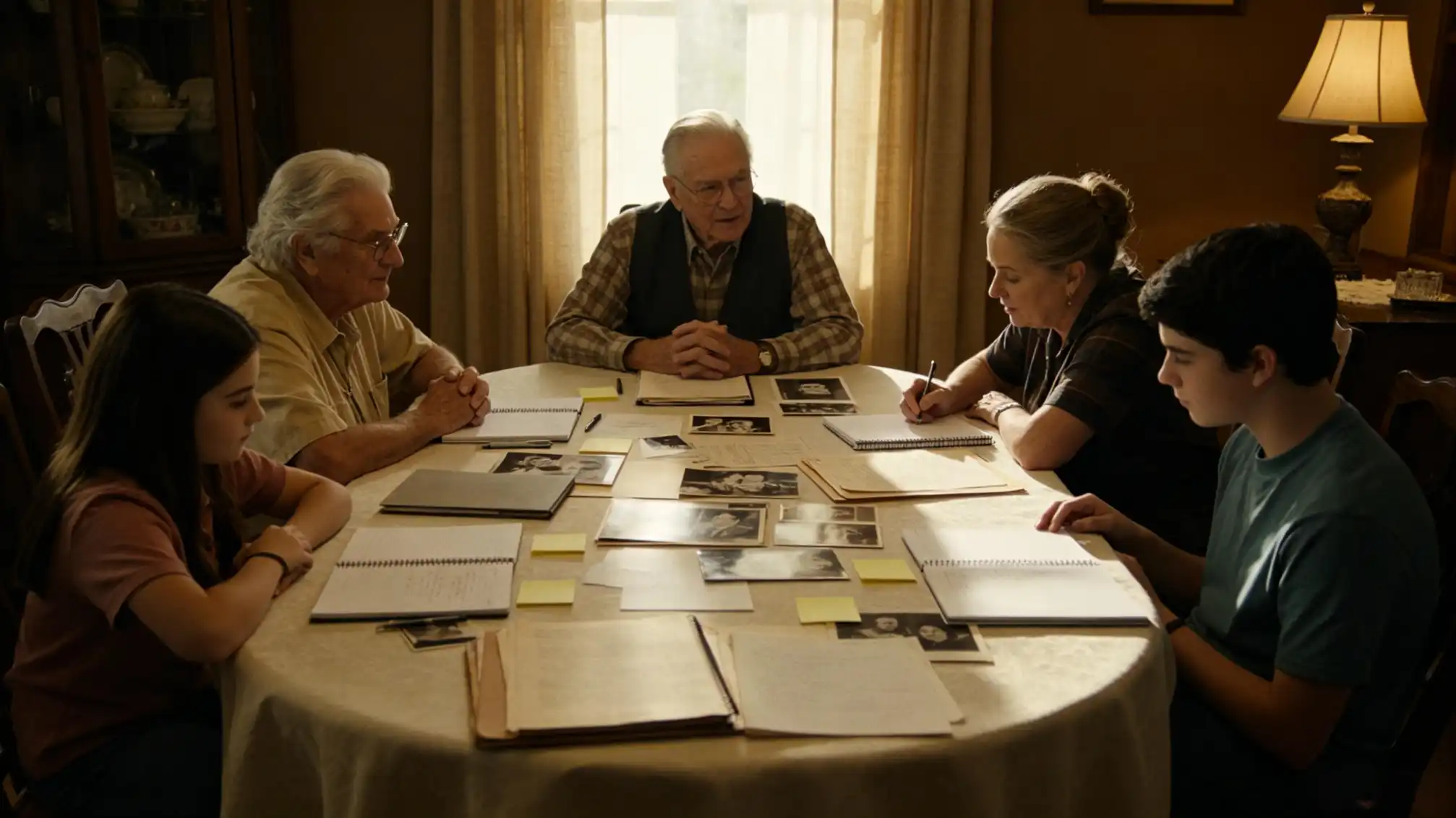
Ask one question at a time and then stop talking. Silence feels awkward, but it is usually the moment your relative is deciding whether to tell you the real version. Let it sit.
Do not correct them, even if the dates are off. Memory is emotional, not chronological, and a gentle "that's interesting, tell me more" gets you further than a fact-check. If you want a record, say so out loud and ask permission before recording — then put the phone face down and forget about it.
And if a subject gets heavy, follow their lead. Some people will tell you everything about a difficult year; others will tell you the weather that day and nothing else. Both are answers.
Put What You Gather Somewhere It Will Survive
The hard part is not collecting stories — it is keeping them. Write up your notes the same evening, while you still remember the tone of voice and the details you did not write down. You can publish what you collect to the family stories archive, where it becomes something cousins and grandchildren can read years from now instead of a file on a laptop that nobody opens.
You do not need to finish the whole family history in one sitting. One relative, one afternoon, four good questions is a real start.