Family Tree Template: Build Your Family History Without the Guesswork
Starting a family history project is exciting for about ten minutes. Then you open a blank page, realize you are not sure where your great-grandmother's second marriage belongs, and quietly close the laptop. A family tree template removes that friction. It gives you a ready-made structure where names, dates, places, and relationships already have a home, so your energy goes into research instead of formatting.
The sections below cover how to choose the right template, how to fill it in without getting stuck halfway, and how to grow a simple chart into a genuine family history record.
Why a Template Beats a Blank Page
A blank document asks you to decide everything at once: how far back to go, whether to include siblings, where to record a maiden name, how to handle a second marriage. Those decisions are small, but there are dozens of them, and they pile up fast. A template makes most of those choices for you.
There is a second benefit that matters more over time: consistency. When every person in your tree sits in the same predictable spot with the same field order, you can scan the chart and spot the gaps instantly — the missing birth year, the branch with no place names. Templates make your gaps visible, and visible gaps are the ones you actually fill.
Match the Template to the Job You Are Doing
"Family tree template" covers several different layouts, and picking the wrong one is the most common reason people abandon a project in week two. Ask what question you are trying to answer first.
- Pedigree or ancestor charts — best when you want to trace a direct line backwards: you, your parents, grandparents, and so on. Clean, compact, and easy to extend.
- Descendant charts — best when you are documenting everyone who came from a single couple. Ideal for reunions and cousin-hunting.
- Fan charts — a circular pedigree that fits many generations on one page. Great for framing, less useful for notes.
- Family group sheets — one couple per sheet, with their children, dates, and places listed. The workhorse for detailed research.
What to Check in a Free Family Tree Template
Free templates are genuinely good now, but they are not interchangeable. Before you commit, check four things:
- Editable format. A PDF you can only print is a dead end. Look for a spreadsheet, document, or fillable version you can update.
- Room for sources. If there is no place to note where a date came from, you will be re-researching the same record in two years.
- Space for notes. Nicknames, spelling variations, and "probably born in Kent" all belong somewhere.
- Room to grow. A five-generation chart looks generous until you hit generation seven.
The Four-Pass Method for Filling In Your Template
The fastest way to stall is trying to complete one person fully before moving on. Instead, run four passes over the whole tree. Each pass is easier than the last, and the chart looks impressive early on.
Pass 1: Names and relationships
Write down everyone you can name, even if you only have a first name. Connect them. Do not research, do not verify, and do not judge the quality of what you know. This pass is about drawing the shape of the family.
Pass 2: Dates
Add birth, marriage, and death years where you are confident. Approximate years are fine — mark them clearly with a "c." for circa. Half-remembered dates give you search targets, and search targets are what actually move a project forward.
Pass 3: Places
Places are the most underrated field in any family history template. "Born 1898" is a fact; "born 1898 in a village outside Kilkenny" is a research plan. Record places as specifically as you know them, and note when boundaries changed — an 1890 record and a 1930 record may name the same spot differently.
Pass 4: Sources
Go back through and note where each fact came from: a census record, a family Bible, an aunt's memory. Facts without sources get quietly overwritten by guesswork later. This is the pass that turns a chart into research.
Working With Relatives to Fill the Gaps
Your template's blank spots are a to-do list, and the fastest way to clear it is often a conversation rather than an archive visit. Older relatives can confirm names, point you to the right county, and correct dates that have drifted over the years.
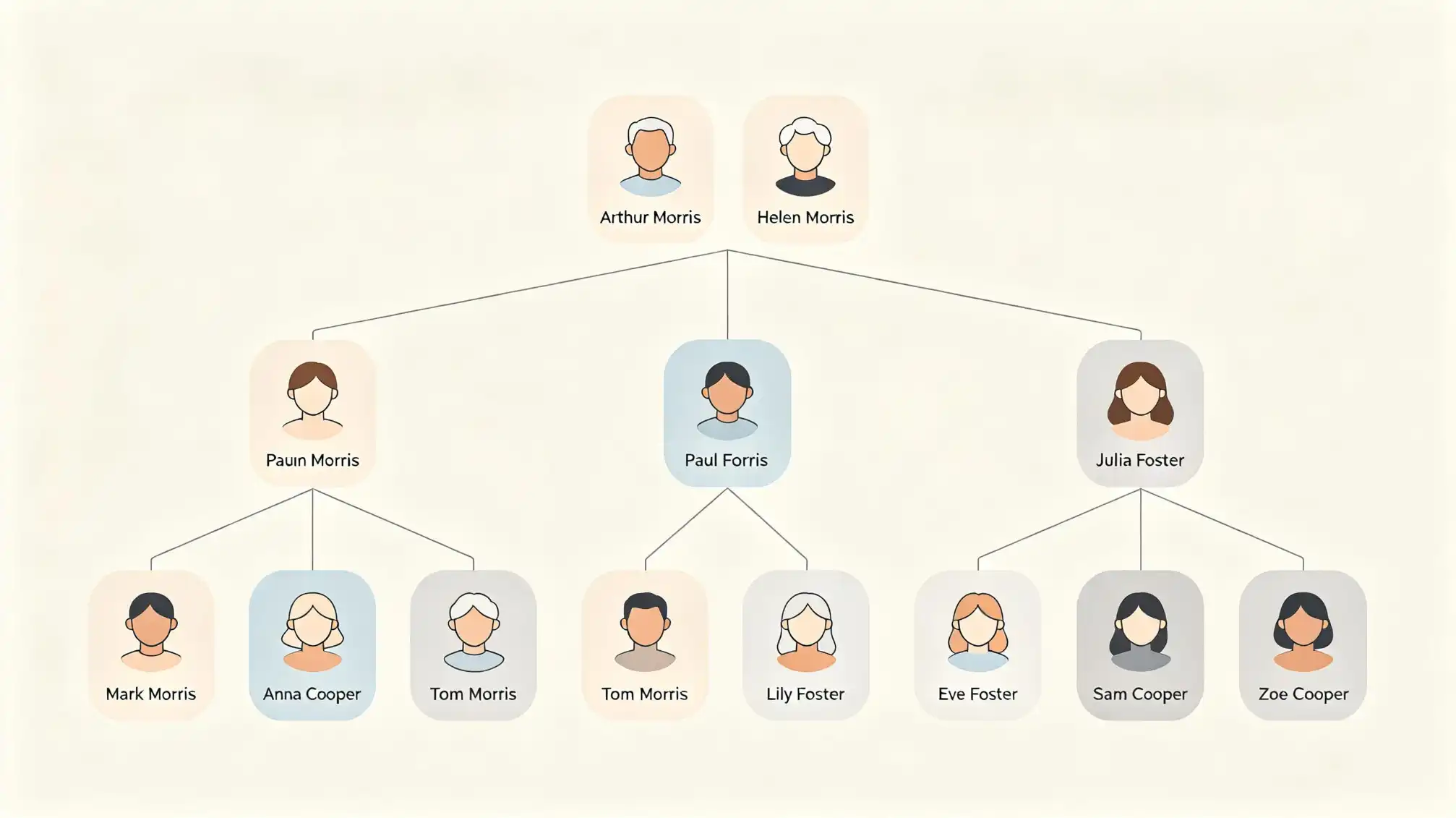
Bring the printed template to that conversation. People correct a document in front of them far more readily than they answer open questions, and watching the tree take shape often prompts memories that would not surface otherwise.
Turn the Chart Into a Real Family History Template
A filled-in tree is a skeleton. The interesting part — the migration, the trades, the marriages, the moves — lives in the stories around it. Once your structure is stable, you can layer narrative onto each person: a short paragraph, a photograph, a transcript of a record.
If you would rather build the structured, shareable side of this first, you can set up your family profile and keep the tree and its stories in one place instead of scattered across three spreadsheets and a shoebox.
Five Mistakes That Stall a Family Tree Project
- Chasing one dramatic ancestor. The famous-relative quest burns weeks. Build the ordinary lines first; they are what connect to the interesting ones.
- Ignoring siblings. A sibling's record often names parents when your direct ancestor's does not.
- Copying other people's trees without checking. Errors replicate quickly across shared trees.
- Recording facts without dates. An undated fact cannot be verified or placed in context.
- Keeping it private forever. Family history grows when several people are able to add to it.