Tracing Your Ancest: A Practical Research Framework for Older Generations
Most people begin genealogy with a surname, a rough date, and a great deal of optimism. They open a search box, type the name, get forty results, and immediately lose confidence in the whole enterprise. The obstacle is rarely a shortage of records. It is the absence of a method — a defined order of work that tells you what to do next and, more importantly, what not to do yet.
This framework is built for researchers working backwards into older generations, where living memory runs out and every conclusion has to be earned from documents. Follow it in sequence and your family history will grow more slowly at first, then far faster, because you will stop re-searching the same ground.
Step One: Exhaust Living Memory Before You Touch a Database
The cheapest, richest and most perishable source of information about your ancestors is the people who knew them. Before you subscribe to anything, work through the current generation and the one above it. Interview relatives in person or by phone, record the conversation with permission, and ask open questions — where did the family live when you were a child, who came to the weddings, who was not spoken to and why. Silence and estrangement are often more informative than the stories.
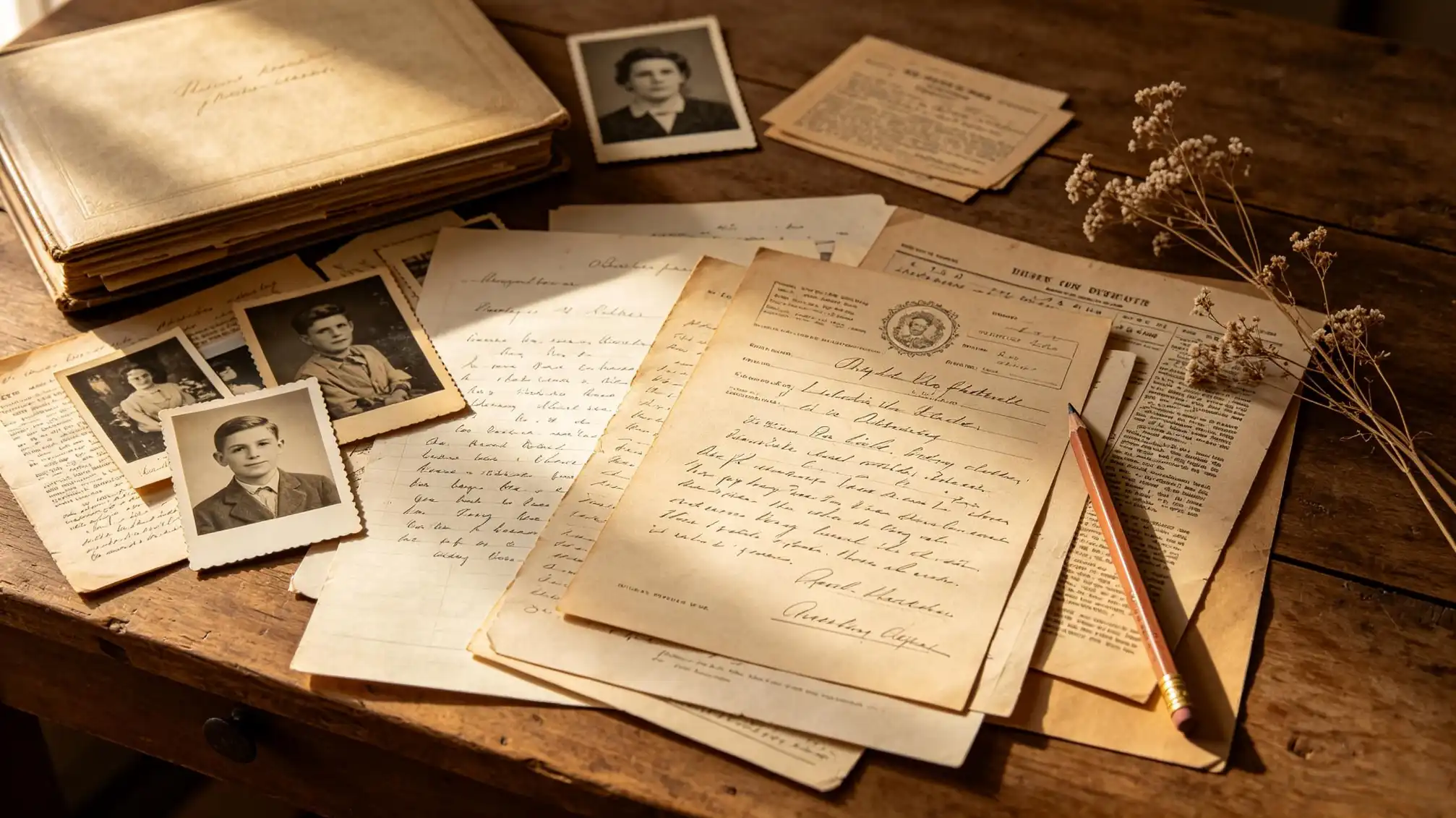
At the same time, collect the paper that already exists in the family: birth and marriage certificates, military papers, apprenticeship indentures, funeral cards, obituaries, letters, and family bibles with entries in the middle pages. Photographs matter as much as documents. A studio portrait can date a family to a decade and to a town, and clothing, backdrops and photographer's imprints are all datable evidence.
<>
Record who told you what, and when. A memory reported in 2024 about a birth in 1938 is a lead, not a fact. Mark it such in your notes.
Step Two: Build a Working Family Tree, One Person at a Time
A working family tree is a research tool, not a monument. Its purpose is to show you where the gaps are. For every individual, capture four facts before moving on: birth, marriage, death, location. A person with a name but no place is effectively unsearchable, because every archive in the world is organised geographically.
Resist the temptation to jump back three generations because a compiled tree on a website appears to hand you the answer. Unverified pedigree is the single most common reason family history researchers spend years pursuing the wrong family. Work generation by generation: confirm the parents of your great-grandfather before you look for his grandparents.
Step Three: Rank Your Sources by Reliability
Not all evidence is equal, and treating it as if it were is how errors become permanent. A rough order of trust, from strongest to weakest:
- Civil registration and government-issued certificates created at the time of the event.
- Church registers of baptism, marriage and burial, recorded contemporaneously.
- Census returns and tax or property records, which place a household in a specific year.
- Newspapers, directories and probate notices, which may be accurate but are often second-hand.
- Compiled family trees, surname histories and online databases, which are indexes or other people's conclusions.
Use the weaker sources to find the stronger ones Never use them to settle a question.
Step Four: Read the Original, Not the Index
Indexes are finding aids written by fallible people under time pressure, often from handwriting they could barely read. They misspell names, transpose digits, omit middle names, and occasionally attach the wrong image to the wrong entry. Once an index gives you a reference, obtain the original or a high-quality image of it and read every field yourself.
Original records also carry information you did not ask for. A marriage certificate names witnesses, who are frequently relatives. A death certificate names the informant, whose address may tell you where the family scattered to. A baptism entry may record the father's occupation and the family's street. That incidental detail is what breaks through walls.
Step Five: Plan for Names, Dates and Boundaries That Move
Your ancestors did not spell consistently, and the clerks who wrote them down spelled phonetically. Search every plausible variant: interchange of letters, dropped prefixes, anglicised forms, and the classic trap of a family recorded under a stepfather's surname. Set a date range wide enough to absorb misremembered years, and remember that in some jurisdictions the calendar itself changed.
Boundaries shift too. Parishes were reorganised, counties redrawn, and entire towns renamed or absorbed. A village that was in one county at your ancestor's birth may sit in another today, with its records split between two archives. Check historical jurisdictions rather than assuming modern ones.
Step Six: Keep a Research Log From Day One
Write down every search you conduct: the source, the reference, the date, and the result. Negative results are as valuable as positive ones, because they stop you repeating the same fruitless query in eighteen months. A log also forces you to articulate what you were looking for, which is often when you notice you were asking the wrong question.
Cite every conclusion back to a source. If a future researcher — including your own future self — cannot retrace your reasoning, the work has to be redone from scratch.
Step Seven: Treat DNA and Online Trees as Corroboration
DNA testing is a powerful tool for genealogy, but it identifies shared segments, not relationships. It tells you that two people are related and roughly how closely; it does not tell you through which ancestor. Use it to confirm a documentary conclusion or to point you towards a branch worth investigating, then prove the connection on paper.
Online family trees are other people's working notes. They are useful for leads and for locating living researchers, and unreliable as evidence. Contact the tree owner and ask what their source was. The answer is frequently illuminating.
Step Eight: Break Brick Walls by Researching the Neighbourhood
When a direct search fails, stop looking at your ancestor and look at the people around him. Witnesses at a marriage, godparents at a baptism, neighbours listed on consecutive census lines, and men who enlisted together are frequently kin. This cluster approach — sometimes called the FAN principle, for friends, associates and neighbours — resolves more stalled family history problems than any single database.
Also widen the record type rather than the name. If parish registers fail, try tax lists, manorial records, poor law applications, apprenticeship registers, coroner's inquests and newspaper court reports. People appear in records for reasons other than demography.