Keeping Family Photos Alive: A Calm, Practical Plan for Passing Down Family History
Every family has a shoebox like this: a few dozen pictures curling at the edges, a sticky album from the 1970s, a folder of negatives nobody can identify, and a handful of faces that everyone vaguely recognises but nobody can name. These family photos are often the only surviving record of people who never wrote anything down. The good news is that saving them does not require a conservator's budget or a perfect system. It requires a weekend of attention, a few inexpensive supplies, and one decision about who keeps the master copy going forward.
Begin With a Rescue Weekend, Not a Perfect System
Most people stall because they imagine sorting thousands of images at once. Instead, block out two or three hours and work in passes.
First pass: gather everything into one room — albums, envelopes, frames, drawers, that tin at the back of a wardrobe. Second pass: separate by broad era or household, not by individual photo. Third pass: pull out the truly fragile items — anything torn, water-damaged, mouldy, or from before roughly 1900 — and set them aside for gentle handling later.
Do not try to organise and identify at the same time. Sorting and remembering use different kinds of attention, and mixing them is how people burn out by lunchtime. Keep a notebook nearby for questions that come up: Who is the man in the uniform? Whose house is that? Those questions are the beginning of your family history research, and they are worth more than a tidy pile.
Handle the Originals Like the Fragile Evidence They Are
Old prints are more delicate than they look. The image layer sits on the surface, so every fingerprint, adhesive label and paperclip leaves a permanent mark.
- Wash and dry your hands before touching anything; skip lotions and hand sanitiser.
- Hold prints by the edges, and support large or stiff photographs with a piece of clean card underneath.
- Never repair with sellotape, glue sticks, rubber bands or ordinary photo albums with sticky pages — all of them stain and eventually bond to the image.
- If you must label an original, write lightly in soft pencil on the back corner, never across the image, and never in ballpoint pen.
- Keep food, drink and, most importantly, sunlight away from the working table.
For anything cracked, flaking or unusually old, photograph it as it is, store it flat in a rigid box, and consult a conservator before attempting repairs yourself.
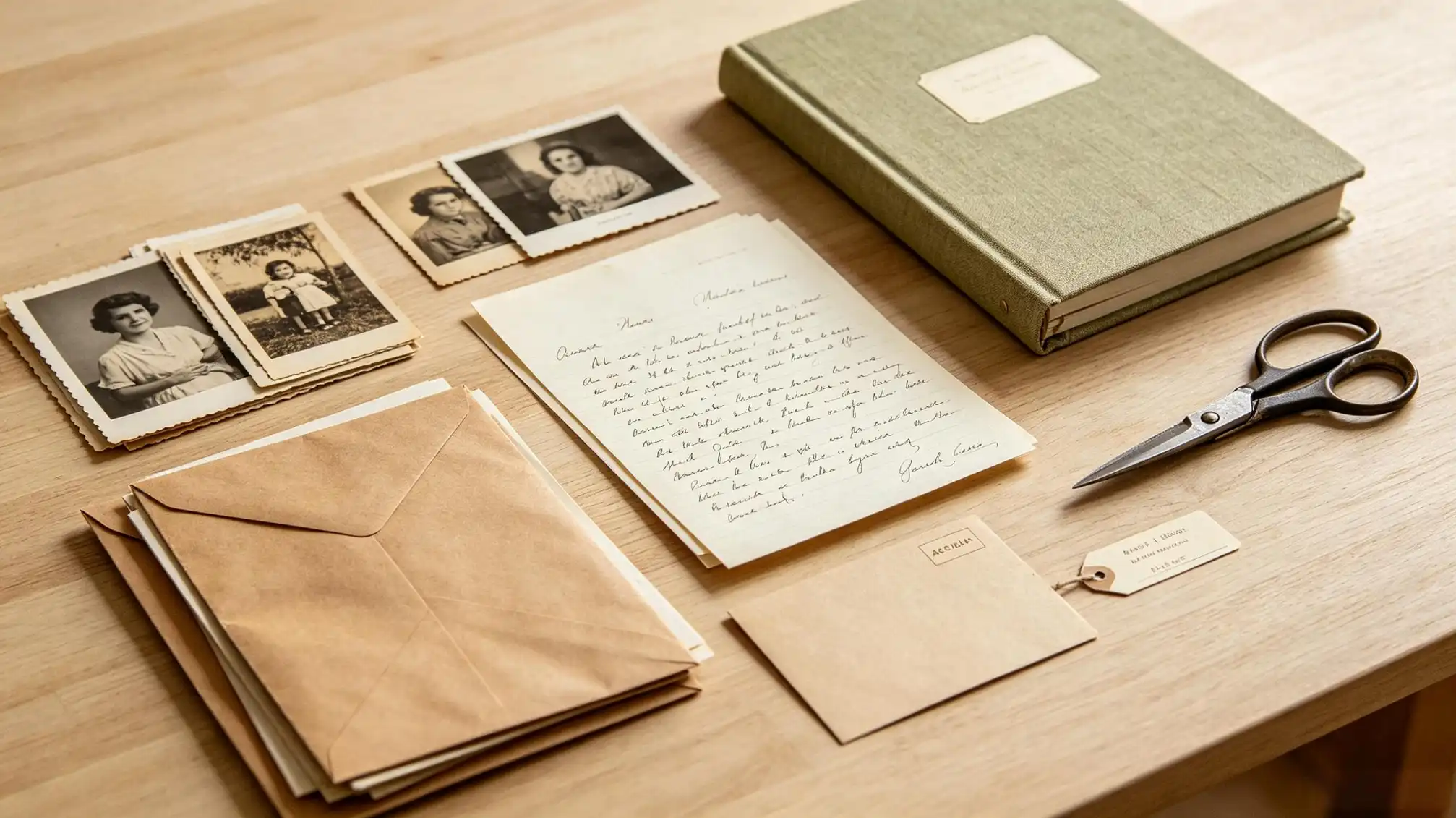
Give Every Photo a Home It Can Age In
Where photographs live matters more than how neatly they are arranged. Heat, humidity, light and unstable plastic do the real damage, quietly, over decades.
Move the collection out of attics, garages, basements and sun-facing shelves. Aim for a cool, dry interior cupboard with steady conditions — fluctuations are harsher than a consistent slightly warm room. Use archival-quality boxes and acid-free paper or polyester sleeves, and replace the old magnetic albums that have been clinging to your pictures since childhood. Store prints either flat in boxes with gentle support, or upright in rigid folders that prevent slumping and bending. Glass frames hung in direct sun are one of the most common ways a treasured portrait fades to yellow.
Scan Once, Then Back It Up Three Times
Digitising is not optional anymore — it is insurance. Even a careful archive can be lost to a burst pipe or a house move, whereas a good digital copy can live in several places at once.
Scan prints at 600 dpi and save a high-quality master file; 300 dpi is acceptable for quick reference copies of modern snapshots. Keep the masters in a lossless format and create smaller JPEG versions for sharing and printing. Shoot negatives and slides with a dedicated scanner if you can, or send a batch to a reputable service rather than trusting a phone photo of a photo.
Then follow the simple three-copy rule: one copy on your computer, one on an external drive kept in a different room, and one in cloud storage or with a relative in another town. Name files so a stranger could understand them — a pattern like 1958-Smith-Wedding-Aunt-Mary will still make sense in thirty years; IMG_4471 will not.
Write Down What the Picture Cannot Say
A photograph shows a face; it does not explain that the family walked six miles to the church, that the dress was borrowed, or that the serious-looking boy grew up to be the grandfather everyone remembers for terrible jokes. Those details are what turn a picture into family memories.
Sit with your oldest relative while the images are on the table and record the conversation on your phone. Ask simple, specific questions: what was the occasion, what was the weather, who took the picture, what happened next. Capture names in full, including maiden names, and note places and approximate years. Transcribe the answers into the file names or a short document kept beside the digital folder. In a single afternoon you can rescue information that no future search will ever recover once the person who remembers has gone.
Turn Private Boxes Into Shared Family Memories
An archive kept by one person is one accident away from disappearing. Sharing is both a preservation strategy and the point of the whole exercise. When cousins, siblings and grandchildren can see the pictures, they start identifying people, adding context, and caring about the outcome.
A simple way to start is to publish a small selection with the stories attached, so relatives can comment, correct spellings and add what they know. You can build that collection of photographs and recollections on the stories page, then invite family members to contribute their own branch of the tree. Choose one person in each generation to hold the master copies, and tell everyone who that keeper is.
Small Mistakes That Quietly Undo Years of Work
- Storing originals in a garage or loft where summer heat and winter damp do the damage.
- Relying on a single phone gallery or one laptop as your only copy.
- Digitising without labelling, creating thousands of anonymous files.
- Discarding originals after scanning — the print often holds detail the scan missed.
- Leaving the only copy of a family archive in the hands of someone who has not been asked and does not know it matters.