Grandparents Family History: How to Gather the Stories Before They Slip Away
There is a particular kind of silence that follows the question “So, what was your childhood like?” Your grandfather says “Fine,” and reaches for his coffee. It isn't that he doesn't want to talk. It's that the question is too wide, too sudden, and too big to walk into cold.
That's the real challenge behind grandparents family history: not a shortage of stories, but a shortage of doorways. Most of us own a phone that records audio, a handful of free afternoons a year, and no idea how to help someone who has lived eight decades start telling it out loud. This guide is about the doorways — the small, specific, gently asked questions that let memory do the heavy lifting.
Start Before You Feel Ready
Nobody feels prepared for this. You will not have the perfect questions, the perfect recorder, or a tidy two-hour block. That's fine. Begin with twenty minutes and a cup of tea, because the alternative — waiting until you are organized — is how family stories quietly disappear. One recording made on a phone propped against a sugar bowl is worth more than the interview you keep postponing.
A little logistics goes a long way. Ask when your grandparent is fresh rather than at the end of a long day. Keep the group small — two or three people is plenty, because a crowd turns a conversation into a performance. And tell them in advance that you'd like to record something, not so they can rehearse, but so they can decide what they're comfortable sharing.
Set the Scene So the Stories Come Easier
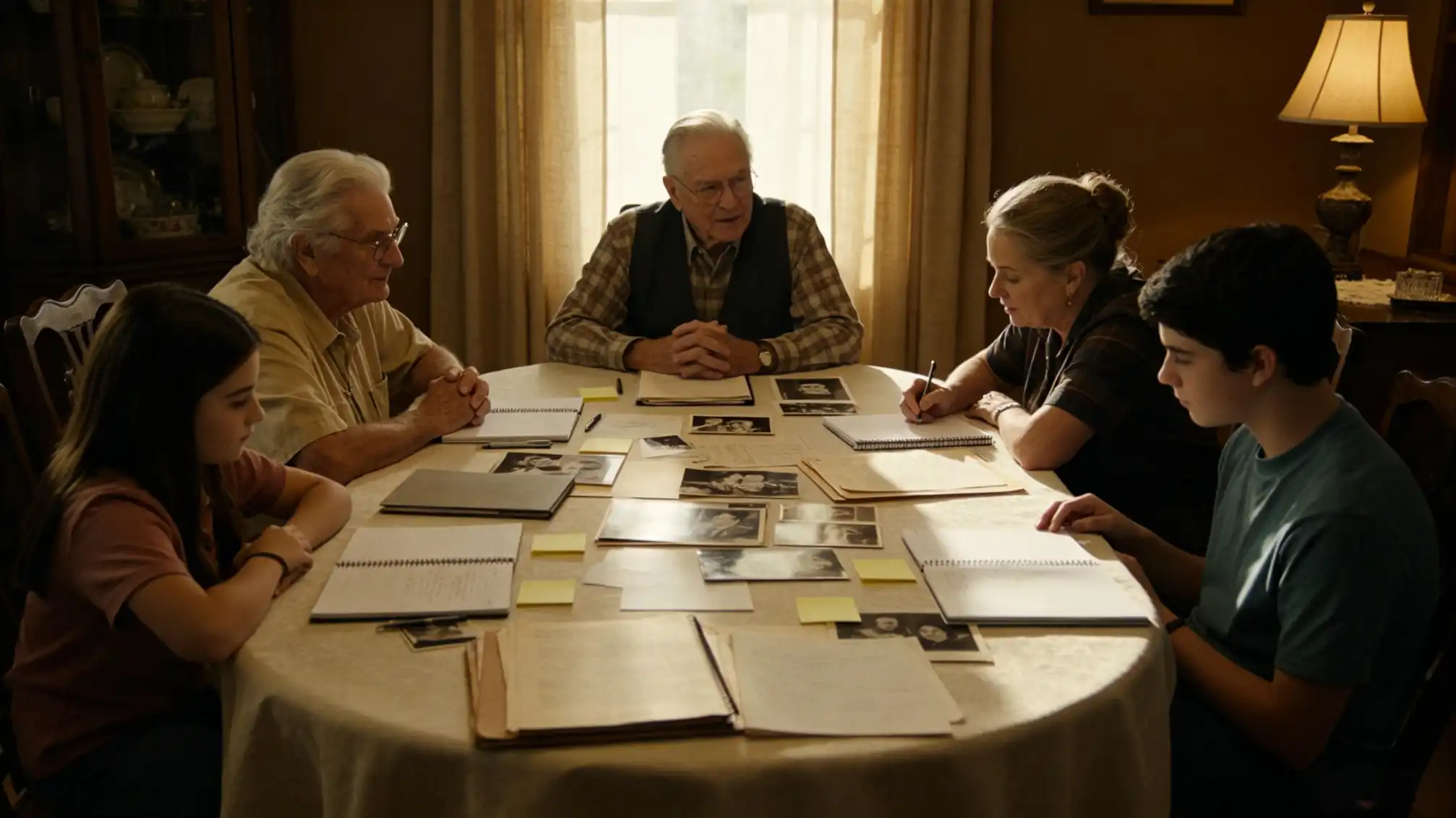
Memory is greedy for props. If you ask about the house where your grandmother grew up while a photo of it sits on the table, you'll get rooms, smells, a neighbor's name, the color of the front door. If you ask with nothing to look at, you'll get “It was small.”
So before you press record, put three or four things on the table: an old photograph, a recipe card, a document, a piece of jewelry, a kitchen tool they still use. Objects do something abstract questions cannot — they give memory a place to land. Keep the room reasonably quiet, lay your phone face-down so it doesn't feel like a formal interrogation, and put a glass of water within reach. Talking for an hour is tiring in a way nobody expects.
Open With Questions That Invite Rather Than Test
Skip “tell me about your life.” Try one of these instead, then stop talking and let the pause do its work:
- What did your street sound like on a summer evening?
- Who was the first person outside the family who really believed in you?
- What did your parents do when they were worried about money?
- What's a meal you can still taste?
- What were you not allowed to do that everyone else seemed to get away with?
- Who in the family made everybody laugh, and what exactly did they do?
Notice what these have in common: sounds, smells, food, rules, feelings. They are sensory and specific. None of them can be answered with a date, so none of them can be answered with a yes or no.
Move From Facts to Ordinary Days
Once the first stories are flowing, widen out. The everyday details are what make relatives feel real to the next generation — not the birth years, but the Tuesday afternoons. Try asking about:
- Work and school. What was your first job, and what did it actually feel like to do it? Who was your favorite teacher, and why?
- Chores and routines. What were you responsible for at home? What did a normal Saturday look like?
- Cousins and neighbors. Who did you run with? Who lived next door, and were you allowed in their kitchen?
- Celebrations. What did the family do for birthdays, holidays, or funerals? Who cooked, who argued, who sang?
- Money and travel. How far from home had you been by the age of eighteen? How did people get around?
These family history questions work because they are concrete. A person who can't recall a decade can almost always recall a kitchen.
Ask About the Harder Chapters With Care
Every long life holds loss — war, migration, illness, money trouble, someone who stopped speaking to someone else. These are often the stories worth keeping most, and also the ones most likely to close a conversation if handled badly.
Offer an exit before you go in: “We don't have to talk about this if you'd rather not.” Then mean it. If they do open up, resist the urge to fill the silence or to correct details you think you know. Ask “What was that like for you?” rather than “What exactly happened?” You are collecting their experience, not auditing the record. If they become tired or tearful, say thank you, close the notebook, and make tea. You can always come back another day.
Follow-Up Phrases That Turn One Sentence Into Twenty
Most beginners collect too many questions and too few follow-ups. Five short phrases will carry an entire afternoon:
- “What was that like?”
- “Who else was there?”
- “What happened next?”
- “How did that change things for you?”
- “What do you wish people knew about that?”
Then add silence. Count to five before you rescue anyone. The best sentence of the whole recording usually arrives about three seconds after the point where you were tempted to jump in.
Write Down What You Gather — the Stories Need a Home
A voice memo on your phone is a start, not an archive. Phones get replaced, files get lost, and nobody in your family can search a recording they don't know exists.
So within a day or two, while it's fresh, write a few lines: who you spoke to, the date, three things you learned, one quote in their own words, and one thing you want to ask next time. Add the names of the people they mentioned, even the half-remembered ones, because those names are how future relatives find each other. If you'd like a shared space for this, you can collect and keep these pieces together at FamilyLove Stories so the whole family can read and add to them.
And plan the next conversation before you leave. Grandparents family history isn't a single interview — it's a habit of showing up, asking one good question, and writing down the answer.