Tracing Ancestors Without Guesswork: A Records-First Research Plan
Most family history projects stall for the same reason: a name has been added to a family tree without enough evidence to prove it belongs to the right person. Tracing ancestors is identity work. The aim is not to collect the largest tree; it is to connect older generations with records that confirm relationships, places, and dates. A records-first plan keeps your genealogy credible and makes the research easier to continue.
Start with the family archive, not a search engine
Before you open a subscription database, inventory what your family already keeps. Photographs, birth and marriage certificates, funeral cards, obituaries, military papers, letters, diaries, bibles, school records, and immigration documents often contain the place and date clues that make online searches productive. Interview the oldest living relatives. Ask for full names, maiden names, occupations, churches, migration routes, and the towns your ancestors left. Record the conversations, scan original documents at highresolution, and note who supplied each detail. Family memory is a lead, not proof, but it is often the best lead available.
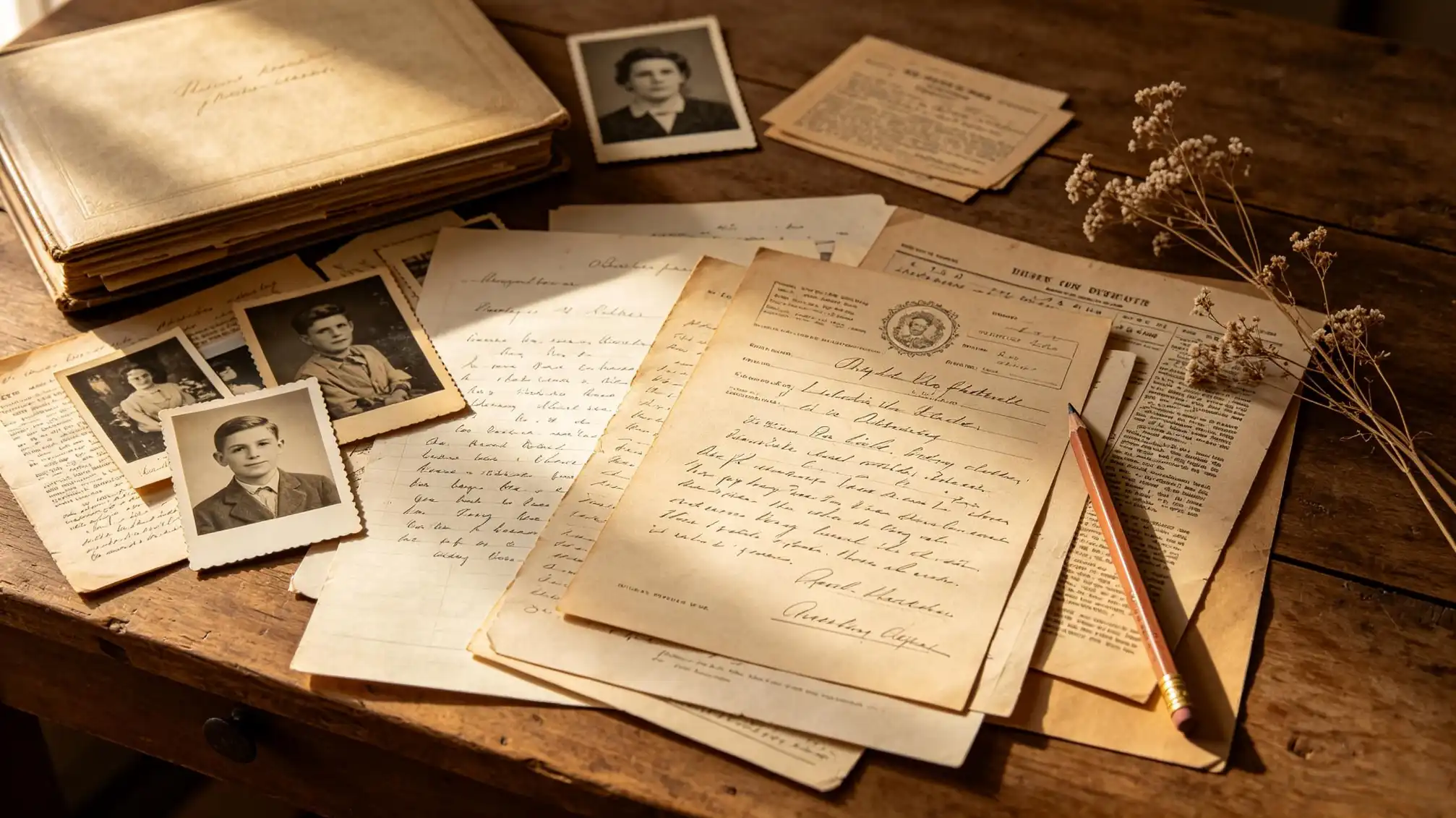
Look for clues in the backs of photographs, the inside covers of bibles, and the addresses on old envelopes. A single funeral card may give a birth date, a death date, a church, and the name of an informant. Scan both sides of every item and label the file with the family line, not just the surname. Use a simple capture system from day one. Store scans in dated folders, transcribe names and places exactly as written, and record provenance. If you want a structured place to preserve interviews and document images as family stories, use FamilyLove Stories as your action reference. Keeping the source close to the conclusion is what turns a collection of files into usable family history.
Build a skeleton family tree and mark every gap
Your family tree should begin as a skeleton: names, relationships, and the core events of birth, marriage, and death, each tied to a place. Do not treat the tree as finished. Mark every fact as sourced, unsourced, or uncertain. Keep a research log that records what you searched, the spelling you used, the date of the search, and the result. This log saves time and reduces the risk of merging two people who share a common name.
Choose one research question at a time. For example: who were the parents of Mary Ann Carter, born about 1842 in Ohio? Write that question at the top of your log, then list the record sets most likely to answer it. A focused question prevents browsing from replacing research.
Apply an identity test before adding a generation
For each new person, compare at least three points: name, age or date, place, occupation, spouse, parent, or sibling. A single name match is a coincidence until the surrounding details agree. Work backward one generation at a time. Confirm the parent-child relationship from a record created near the event, then move to the next generation. Skipping generations is the fastest way to attach the wrong family history to your family tree.
Research older generations in layers
Genealogy records were created for administrative, religious, legal, or military purposes, not to make research easy. Search in layers. Start with civil registration for birth, marriage, and death, then add census or household records, church registers, cemetery and funeral records, land and probate files, military service files, newspapers, and migration records. For older generations, church and land records may survive where civil records do not. Treat indexes as finding aids, not as the record itself. View the original image whenever possible and cite the collection, volume, page, and date accessed.
Census records are especially useful for placing a family in a specific community every ten years, but they are not proof of a birth date. Use them to build a household timeline, then confirm relationships with birth, marriage, death, or probate records. Probate and land records can be slow to search, but they often name spouses, children, and neighbors when other records are silent. Newspapers add context: an accident report, a migration notice, or an obituary may give the clue that links two generations.
Search names and places with deliberate variants
Try spellings with and without accents, phonetic variants, abbreviations, patronymics, and boundary changes. Plot the places on a map. Ancestors often married within a short distance, and a record may sit in a neighboring jurisdiction. When a record seems missing, ask which authority kept that type of record at that time. The answer often points to a different archive, not a dead end.
Use collateral relatives to break brick walls
When a direct ancestor disappears from the records, widen the circle. Siblings, witnesses, neighbors, in-laws, and business associates can leave clues in probate files, land deeds, newspapers, and church registers. Build a small cluster map for each brick wall: the ancestor, siblings, spouse's family, witnesses, and the places they shared. Then search the cluster rather than the individual. Cluster research is often more effective than repeating the same name search. DNA can also help, but use it carefully. A DNA match can point to a branch or a missing surname, yet it cannot replace a documented paper trail. Treat genetic evidence as a lead that must be combined with genealogical records.
Keep the family tree audit-ready
Every conclusion should have a source, and every source should be easy to find again. Attach scans or clear citations to each fact. Separate what you know from what you suspect. State hypotheses plainly and revise them when new evidence appears. Share the tree with relatives who can correct names, places, and family stories. Record negative searches too. Knowing that a record set was checked and did not contain the person prevents another researcher from repeating the same work. A family tree without sources is a draft; a tree with citations is a research tool that another family historian can trust.
Write the family history while the evidence is fresh
Turn raw findings into timelines, short narratives, and captioned images. Explain why you accepted one record and rejected another. Note the questions that remain. This practice improves your analysis and makes the family history more useful to relatives who are not researchers. It also protects older generations from becoming a list of dates with no context.