Tracing Ancestors Who Left Few Records: A Practical Research Method
Most people researching older generations hit the same wall around the third or fourth generation. Names become inconsistent, birthplaces shrink to a county or a village, and the tidy trail of civil registration gives way to handwritten registers, unindexed ledgers, and family stories that contradict one another. The work does not become impossible at that point — it becomes slower, and it demands a different method.
What follows is a research framework rather than a list of websites. It is written for people who already hold the basics and now need to push their ancestors further back without building a family tree on guesswork.
Define One Answerable Question Before You Search
The most common cause of stalled genealogy work is not a missing record. It is an unfocused question. "Find my great-grandfather's parents" is not a research question; it is a wish. A workable question has a name, a place, a date range, and a record type attached to it.
Compare these two approaches:
- Unfocused: Where did the O'Connors come from?
- Focused: Which parish recorded the baptism of Michael O'Connor, born between 1858 and 1864, whose marriage certificate in 1887 names his father as Patrick O'Connor?
The second version tells you what to search for, what would count as an answer, and when to stop. Write your current question at the top of a document and keep it there until it is resolved. One question, one research session, one conclusion.
Build a Tree That Records Evidence, Not Assumptions
A family tree is only as reliable as the notes attached to it. Every name you enter should carry three things: the source it came from, a transcription of what the source actually says, and a confidence level.
That matters most when names repeat. If three consecutive generations are called John, a tree built on assumption rather than evidence will silently merge two men into one and send you searching in the wrong decade. When a document says "John Smith, labourer," write it down exactly — occupation and address are often the only details that separate father from son.
Adopt a simple rule: no person enters the tree without at least one record that names them and connects them to a parent, spouse, or child. If a connection is inferred rather than documented, label it as inferred. Future you, and anyone you share the research with, will need that distinction.
Work Backwards One Generation at a Time
Sound family history research moves from the known to the unknown. Each generation you add should rest on a record that names both the person and the previous generation.
The sequence that works most reliably:
- Death and burial records — often name parents, a birthplace, and an informant who may be a relative.
- Marriage records — frequently the single most useful document, because they name fathers, occupations, ages, and residences at a fixed date.
- Birth and baptism records — confirm parentage and give you a place to anchor the next search.
- Census and household returns — place the family in a location across a decade and reveal siblings, lodgers, and in-laws.
- Probate, land, and tax records — the practical substitute when baptism registers do not survive.
Do not skip ahead to a romantic-sounding distant ancestor while a gap remains two generations back. Every shortcut forward is a place where the chain can break silently.
When an Ancestor Disappears, Research the Neighbours
The moment a direct ancestor seems to vanish — no baptism, no death entry, an impossible gap between censuses — stop researching that person and start researching everyone around them. This is cluster research, and it resolves more brick walls than any name-search technique.
Record every witness on a marriage certificate, every informant on a death entry, every godparent at a baptism, and every neighbour listed two households away. Families migrated in groups, stood witness for one another, and followed each other into the same trades and streets. When your ancestor's own record is missing, a sibling's or a witness's record will often state the parents' names for you.
Pay attention to spelling variants, too. Illiterate ancestors did not fix the spelling of their own names; clerks wrote what they heard. Search phonetically, and search initials and abbreviations.
Organise, Verify, and Share as You Go
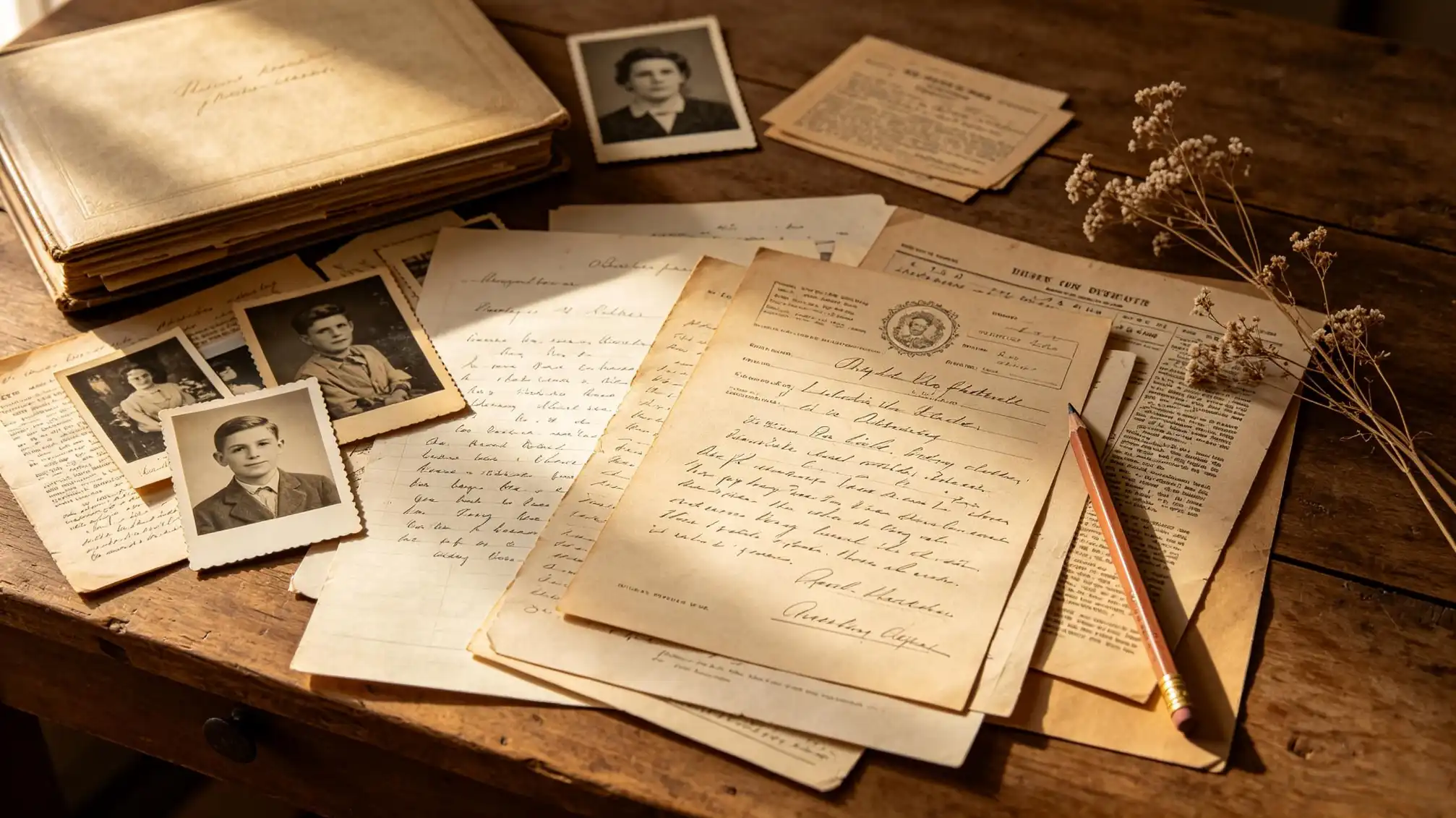
Unorganised research quietly duplicates itself. Keep one folder per surname, name every file with a date and a record type, and transcribe documents rather than relying on memory. When you photograph a register entry, note the archive, the reference number, and the date you accessed it, because indexes change and pages move.
Verification is the step most often skipped. Any fact that appears in only one source stays provisional until a second independent record agrees with it. Dates, places, and maiden names are the three details most likely to be wrong in compiled trees and unsourced online databases.
Sharing is not a vanity step — it is a research tool. Relatives hold photographs, letters, and memories that no archive will ever index. Publishing a short, specific note about the ancestor you are currently working on is one of the fastest ways to surface those details; you can do that at Family Love Stories, where living family members can add information directly to the person you are stuck on.
Mistakes That Cost Weeks of Work
- Merging people with the same name. Check occupation, address, and spouse before combining any two individuals.
- Trusting an online tree as evidence. Treat compiled trees as leads to be verified, never as proof.
- Ignoring the back of the photograph. Handwritten captions are primary evidence for relationships nothing else records.
- Researching without recording. If you cannot say where a fact came from, you cannot defend it later.
- Working four branches at once. Depth beats breadth; finish a generation before opening a new line.