Family History Questions That Get Relatives Talking Instead of Nodding
Most of us wait too long. We mean to sit down with a parent or grandparent and ask about the old days, and then a decade slips by. When we finally do ask, the conversation often stalls after three polite sentences — not because the relative is hiding anything, but because the questions were too broad to answer. "Tell me about your childhood" is a request for a book, not a conversation.
The fix is not better intentions. It is better questions: specific, easy to answer, and arranged in an order that builds trust. Below is a working set of family history questions you can take to your next visit, along with the techniques that keep the good material coming once the recorder is on.
Start With Warm-Ups That Cost Nothing to Answer
Nobody opens up about grief or money in the first five minutes. Begin with low-stakes territory — sensory details, small routines, harmless preferences. These questions loosen the memory muscles and signal that you are genuinely curious, not conducting an interrogation.
- What did your bedroom look like when you were ten? What was on the walls?
- What did your family eat on an ordinary Tuesday? Who cooked it?
- What sounds do you remember from the street or yard you grew up on?
- What was the first song you loved, and where did you hear it?
- Who was your best friend, and what did the two of you get up to?
Specific sensory questions work because they bypass the pressure to summarize a whole life. A person who cannot tell you "about their childhood" can almost always tell you what their mother's kitchen smelled like on a Sunday.
Move Into Childhood and the House They Grew Up In
Once the ice is broken, widen the frame. These family history questions are aimed at the texture of daily life — the parts that rarely make it into written records but define how a person sees the world.
- What chores were yours, and what happened if you skipped them?
- How did your family celebrate birthdays? Was there a cake, a gift, a song?
- What were you allowed to do that your friends were not — or the other way around?
- What did school mean in your house? Was homework checked?
- What is the earliest thing you can remember happening to you?
- Was there a place you went to be alone?
Listen for the rules and the exceptions. Family culture lives in the exceptions — the one sibling allowed to stay up late, the one subject nobody discussed at dinner.
Ask About Their Parents and Your Grandparents
This is where many people discover they know almost nothing. Your parent may have grown up with someone you only met as a frail elder — or never met at all. Personal questions get further than genealogical ones.
- What was your mother like when she was young, before she had children?
- What did your father do for work, and did he like it?
- What did your parents argue about? What did they agree on?
- Which grandparent did you feel closest to, and why?
- What is one thing your parents got right that you tried to copy?
- What is something they got wrong that you decided to do differently?
Ask about people as people, not as names and dates. "When was Grandma born?" produces a fact. "What was Grandma like when nobody was watching?" produces a story you will remember and repeat.
Cover Work, Money, and the Hard Seasons
These family history questions need a gentler approach, so save them for a second conversation if the mood is light. They also tend to produce the most valuable material, because hardship is usually where family patterns begin.
- What was your first job, and what did it teach you about people?
- Was money tight when you were growing up? How did the family handle it?
- What was the hardest year your family went through, and how did you get through it?
- Did anyone in the family have to leave home — for work, for marriage, for safety?
- What did you do when you were worried? Who did you talk to?
If a relative goes quiet or changes the subject, let it go and come back another time, or not at all. You are building an archive, and an archive built on pressure closes fast.
Ask Questions That Reveal Character
Facts fill in a tree. These questions fill in a person — the humor, the stubbornness, the small contradictions that make a relative recognizably themselves.
- What did people tease you about when you were young? Did it bother you?
- What is the bravest thing you have ever done?
- What did you believe at twenty that you no longer believe?
- What is a story your family tells about you that is not quite true?
- What do you hope people remember about you?
Use Follow-Ups to Turn Short Answers Into Stories
The question gets you in the door; the follow-up gets you the story. Train yourself to respond with three things:
- Silence. After an answer, wait three full seconds. Most people add their best detail in the gap you leave open.
- "Tell me more about that." Bland on purpose — it works because it puts no direction on the answer.
- "What do you remember about how that felt?" Feelings unlock detail that chronology never will.
Skip the urge to correct details or fill in dates from memory. If the story is shaky on facts but vivid on emotion, you have still learned something true about your family.
Record It, Then Do Something With It
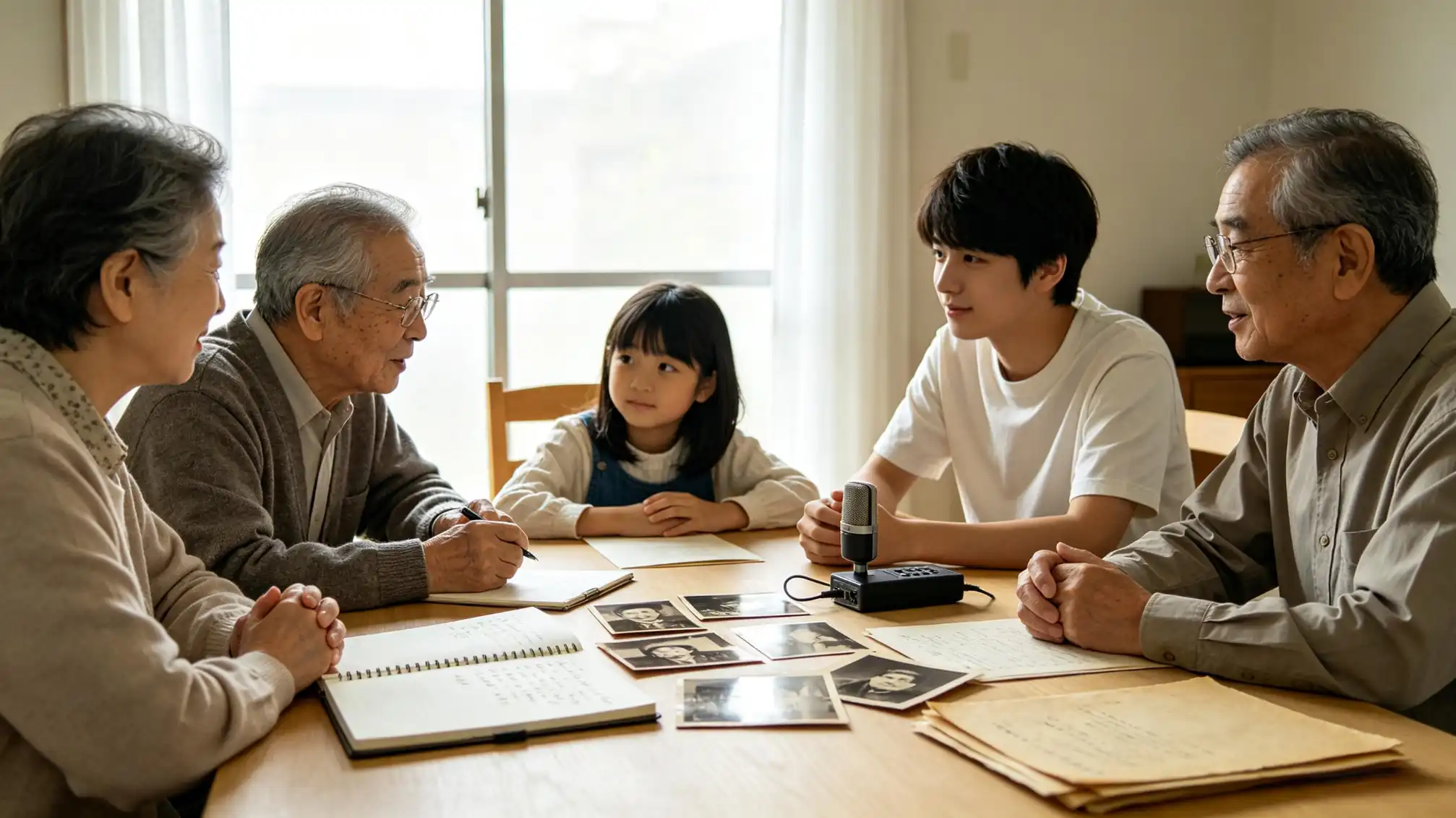
A phone on the table, face down, recording audio, is enough. Ask permission first, mention that you will share the file, and take one photo of the person at the end — future relatives will want to see who was talking. Once you have the material, tidy it up while it is fresh: a short written summary, a few direct quotes, and the names of everyone mentioned. You can keep those write-ups alongside the rest of your family material on the stories page, where the accounts stay organized and easy to revisit.
Three small habits make this sustainable: interview one person at a time, keep sessions to about forty-five minutes, and send a thank-you note with one specific thing you learned. That note is what gets you invited back for round two.