Family History Questions That Get Relatives Talking: A Relaxed Interview Guide
Most people do not need a formal oral-history project to learn their family story. They need a few good family history questions, a comfortable setting, and the patience to let a relative wander a little. The best interviews with parents and grandparents rarely feel like interviews at all. They feel like a kitchen-table conversation that happens to go somewhere memorable.
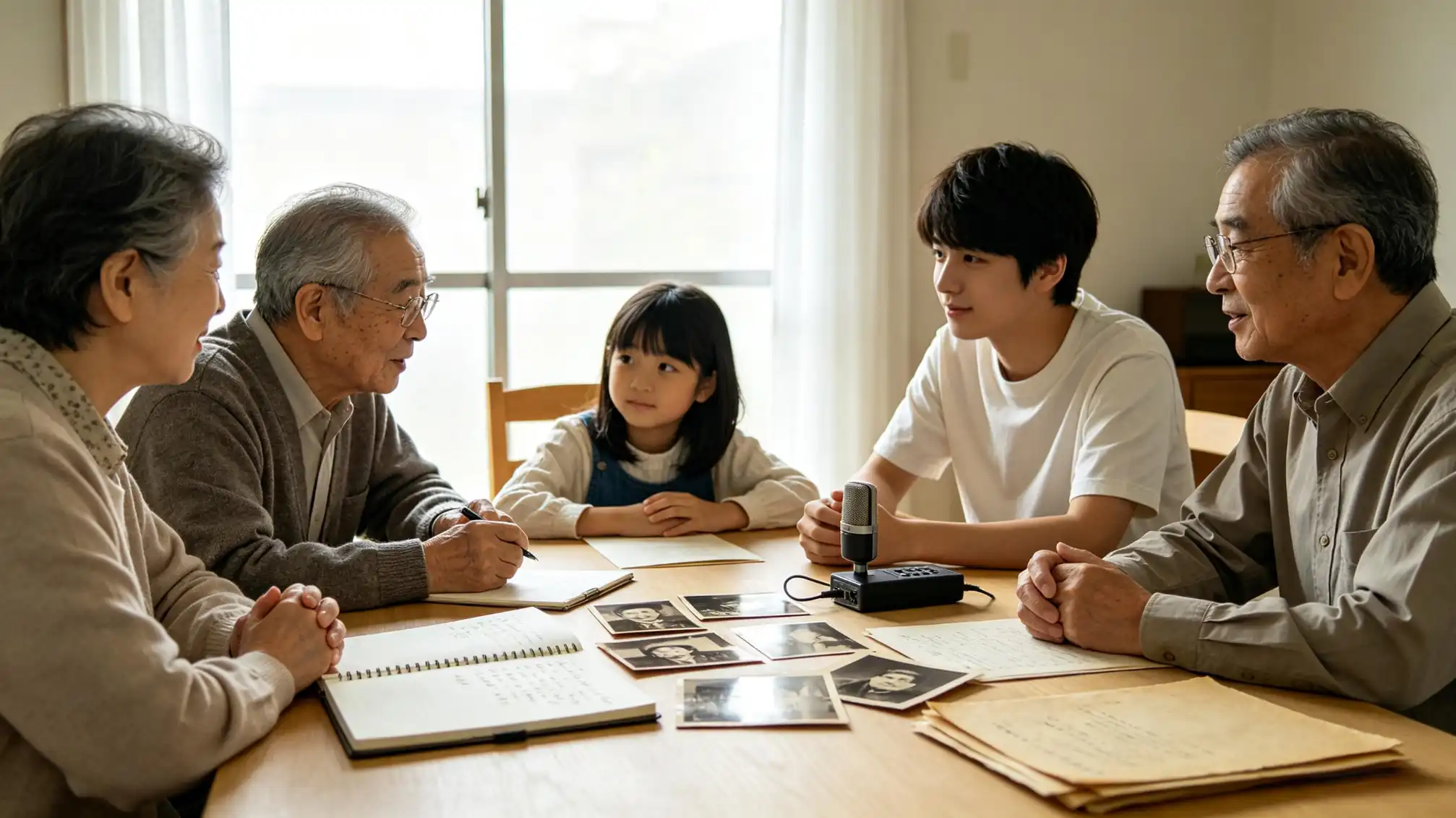
This guide focuses on question sequencing: what to ask first, how to follow up, and how to capture stories without turning a loved one into a research subject. Use the questions as prompts, not a script. A good family history interview is not a test of memory. It is an invitation to remember out loud.
Open with easy, sensory questions
Start where memories are vivid and low-stakes: childhood routines, streets, sounds, meals, and small rituals. These questions help relatives settle into recall before you ask about bigger events.
- What did a normal Saturday look like for you when you were young?
- What smells or sounds instantly take you back to your childhood home?
- Who was in charge of meals, and what was a dish everyone expected?
- What did your neighborhood feel like after school or on weekends?
Why these work
They are specific enough to trigger a scene but broad enough that the person can choose the memory. If your grandmother lights up talking about a bakery on her walk to school, do not rush to the next question. That bakery may lead to a story about her mother, a job, or a move.
Move from places to people
Once the conversation is warm, ask about the people around them. Family history questions about relatives work best when they invite description rather than a list of names and dates.
- What was your mother like when you were growing up? What did she do that still makes you smile?
- Who in the family was the best storyteller, and what story did they tell most often?
- Which relative did you feel closest to, and why?
- What did your grandparents do for work, and what did you understand about their lives then?
These questions also help identify the people you may want to interview next. If an aunt is mentioned three times as the family historian, she belongs on your list.
Tailor the questions to the relative
Parents can often answer questions about your own early years, while grandparents may hold the longer view. Adjust the wording instead of recycling the same list.
- For parents: What do you remember about the day I was born, or the first year you brought me home?
- For parents: What did you find hardest about raising children at that stage of your life?
- For grandparents: What was your parents' home like when you visited as a child?
- For grandparents: What family rules or traditions were passed down to you that you tried to keep?
With aunts, uncles, and cousins, ask what they saw from their side of the family: who hosted holidays, who kept in touch, who told the stories that everyone else repeated.
Ask about turning points, not just dates
Dates are useful later. First, get the shape of the story. Ask about decisions, moves, jobs, marriages, losses, and lucky breaks. The question What year was that? can wait until after the person has described what happened.
- What was the biggest decision you made in your twenties?
- Was there a moment when you felt your life changed direction?
- What did you do on an ordinary day in your first job?
- How did you meet the person you married, or how did you decide to build your life where you did?
- What did you worry about that people today might find surprising?
For grandparents especially, ask about what was normal rather than what was dramatic. The details of rationing, commuting, rent, childcare, or sending letters can be more revealing than a famous family event.
Use follow-up prompts to get past the first answer
The first answer to a family history question is often a summary. The second or third answer is where the texture lives. Keep a few gentle follow-ups ready.
Follow-ups that invite detail
- What do you remember seeing or hearing at that moment?
- Who else was there, and what were they like?
- What did you think would happen next?
- How did that change things for you afterward?
- Is there a part of that story people usually get wrong?
These prompts work because they do not challenge the memory. They simply ask for more of the scene.
Handle difficult memories with care
Not every family history question should be asked the same way. War, migration, illness, money trouble, estrangement, and loss may be part of the story. Ask gently, and leave room for a relative to decline.
Try: Is there anything about that time you are comfortable telling me about? or We can skip this if you would rather not go into it. If the person becomes emotional, pause the questions. A useful interview is not worth pressing someone past their comfort.
Keep the setting simple and the pressure low
You do not need professional equipment to start. A phone recorder or a notebook is enough, as long as the person knows what you are doing. Choose a quiet time, keep the session to about 45 to 60 minutes, and leave room for tea or a break. If you are talking with grandparents, avoid stacking too many questions into one visit; two shorter conversations often beat one long interrogation.
Also, resist correcting small details while they talk. If a date or name seems off, make a note and ask later. The goal is the story in their voice, not a perfect transcript on the first pass.
Capture the answers before they become an unfinished project
After the conversation, write down the best lines, the names that came up, and the questions you want to ask next. Label the recording with the date and the person's full name. If you want to turn notes into a shareable family story, you can use FamilyLove Stories to shape the material into something relatives can read and add to. The point is not to produce a polished archive overnight. It is to keep the memories moving.
A short recap message the next day helps, too: Thank you for talking about your first job. I loved the story about the bus fare. Can I ask you a few more questions next time? That small follow-up often leads to better family history questions on the second visit.
A question set you can actually use
If you want a simple starting point, group your family history questions into four buckets: childhood scenes, key people, turning points, and everyday details. Ask one or two from each, then follow the energy in the room. The best interview is not the one where you checked every box. It is the one where a relative says, I have not thought about that in years.