Family History, One Conversation at a Time: A Beginner's Guide to Capturing What Matters
Most people who want to start a family history begin with a blank chart and a quiet sense of guilt. They mean to interview their grandmother. They mean to label the shoebox of photographs. Then another year passes, and one more person who could have answered the questions is no longer there to ask.
The fix is not a better template. It is a smaller first move. Family history is best built from the inside out: one conversation, one photograph, one recorded voice at a time, with a simple habit for keeping what you gather. What follows is a realistic starting path for anyone who wants to preserve family stories and the people behind them.
Begin With What Is Already in the Room
Before you search a single database, take stock of what your family already holds. Most homes contain more primary material than their owners realise.
- Photographs, including the ones with names pencilled on the back — those inscriptions are evidence.
- Letters, postcards, telegrams, and the envelopes that carry postmarks and old addresses.
- Certificates, military papers, passports, and migration documents.
- Recipe cards, address books, and dedication pages inside books.
- Objects with a story attached: a ring, a tool, a sewing box, a set of keys.
Photograph or scan what you find, and label it the same week. A scan without a name, place, and approximate date becomes almost worthless within a month, because memory of the object fades faster than you expect. Then write down what you already know across three generations — names, places, rough dates, and how each person is connected. Do not worry about gaps. The gaps become your question list.
Ask Questions That Open Stories, Not Facts
"When were you born?" produces a date. "What did your street sound like in summer?" produces a world. If you want family stories rather than a bare family tree, learn to ask the second kind of question.
Three question types that almost always work
- Sensory questions. What did the kitchen smell like? What was the sound of the front door? What did your mother's hands look like when she was working? Sensory prompts reach memory that facts cannot.
- Turning-point questions. What was the hardest decision you ever made? What did your family argue about most? When did you first feel like an adult? These reveal character, not just chronology.
- Inheritance questions. What do you hope we never forget? What should we keep doing as a family? What did your parents get right that you tried to copy?
Then let silence do its work. After an answer, wait. Count to five before speaking. The second thing a person says, after the pause, is usually the thing worth keeping. Plan for about forty minutes and one person at a time; longer sessions exhaust both of you and produce thinner material.
Capture Voices, Not Just Facts
A written note is useful. A voice is irreplaceable. Ask permission, then record on the phone you already own, placed flat on the table between you rather than held to your ear.
- Begin each recording by saying the date, your own name, the speaker's full name, and the location out loud. The file's contents may outlive its filename.
- Name files consistently, for example 2025-03-14_Okafor_Margaret_childhood.
- Keep two copies in two different places — a computer and a cloud account, or an external drive kept at a relative's home.
- Transcribe only the first ten minutes. That is enough to make the recording searchable and to prove to yourself that the job is finishable.
If the person you most want to interview has already died, you are not out of options. Record the people who knew them, and ask those family members to describe the person rather than the dates. Memories held by siblings, cousins, and neighbours often fill the spaces a single witness leaves.
Treat the Family Tree as Scaffolding, Not the Goal
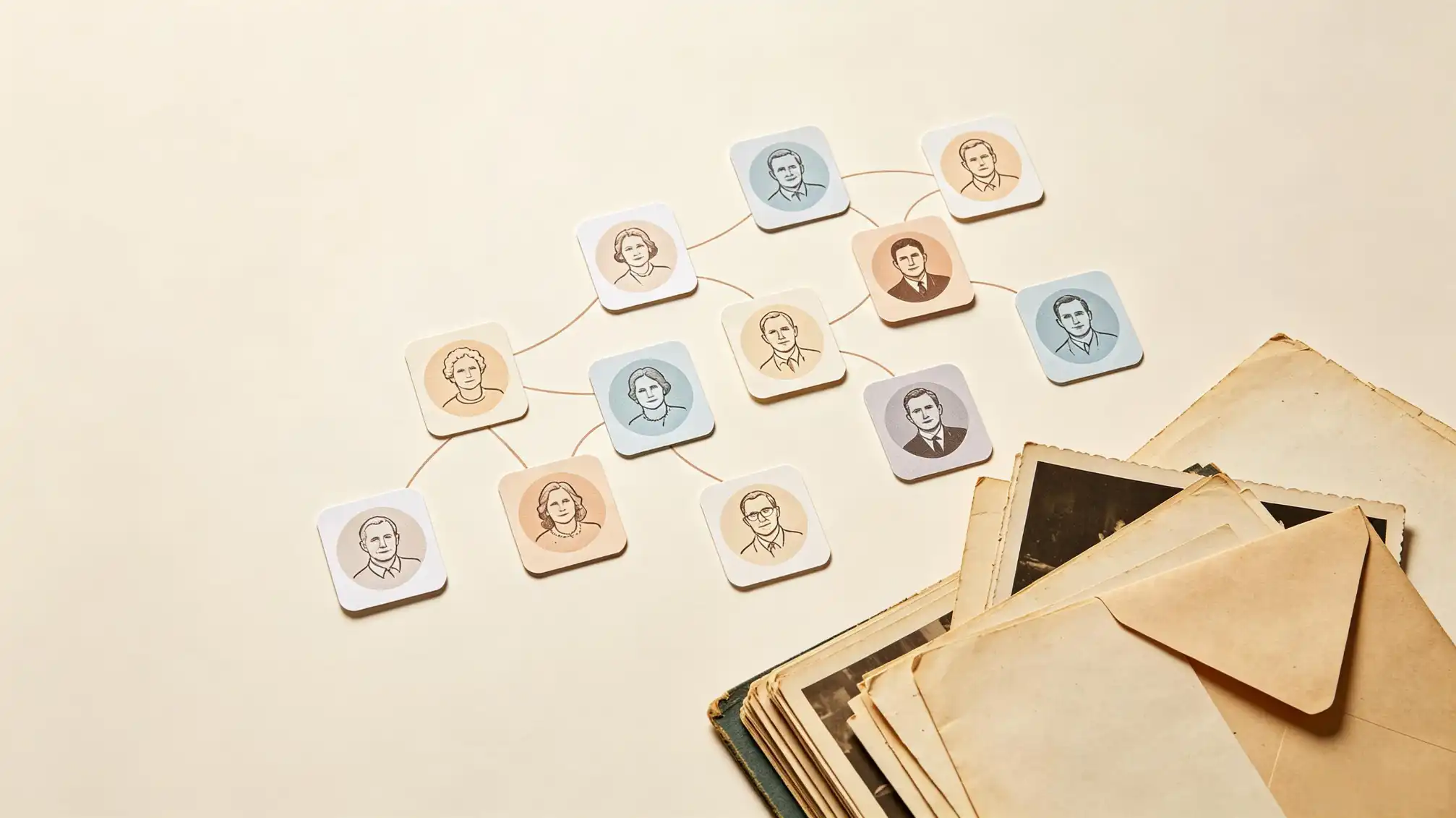
A family tree is how you keep relationships straight while you collect your ancestors' stories — it is not the project itself. Begin with yourself and move backwards one generation at a time, and record where each piece of information came from.
- Mark the difference between what you have documented and what you have only been told.
- Write down who said it, when, and in what context. Family lore is valuable, but it should be labelled as lore, not fact.
- Date each entry with the day you recorded it, not only the date of the event.
This discipline pays off later. Twenty years from now, a name without a source will send someone on a wrong trail, while a short note such as "told by Aunt Ruth, June 2025, over the kitchen table" keeps the story attached to a real, findable conversation.
Build a System Simple Enough to Keep
Complex systems fail first. Aim for three small assets rather than one elaborate archive: a single folder for files, a single master timeline document, and a single running list of open questions.
Use one naming pattern for everything, such as year-month-day, surname, first name, topic. Add new material to the timeline as soon as you gather it, and add new questions the moment an answer creates one. Within a month, this modest routine will be more useful than any software you might have spent weeks choosing.
Share Family Stories While People Can Still Respond
Family history is not a private hoard. The moment you share a short excerpt — a paragraph of a recorded memory, a captioned photograph, a single answer to a good question — relatives begin correcting, adding, and remembering. Those replies are the richest source you will ever get, and they cost nothing.
When you are ready to publish something, a simple place to put it makes all the difference. You can share family stories on Family Love and invite the people who were there to add what you missed. One correction from a cousin is worth more than a hundred searches.
Early Mistakes Worth Avoiding
- Waiting for the perfect tool. A notebook and a phone recording beat an unused subscription every time.
- Interviewing only the eldest relative. Cousins, in-laws, and neighbours hold details the eldest either never knew or has long since smoothed over.
- Paraphrasing instead of quoting. Keep the original words, including the odd phrasing and the dialect. That is where the person still lives.
- Collecting without sharing. Material that nobody sees does not become family history; it becomes storage.
- Chasing distant ancestors before recording living ones. Records can be found again. A ninety-year-old memory cannot.