{
"title":Family History Questions That Actually Get Answers From Relatives",
metaTitle": "Family Questions That Get Real Answers",
"metaDescription": "Practical family history questions to ask parents, grandparents, and relatives — plus follow-up prompts, recording tips, and simple ways to preserve what you hear.",
"summary": "Broad questions like \"tell me about your childhood\" usually stall an interview. This guide offers specific, scene-based family history questions for parents, grandparents, relatives, along with follow-up techniques, recording advice, and a simple way to preserve the answers before they fade.",
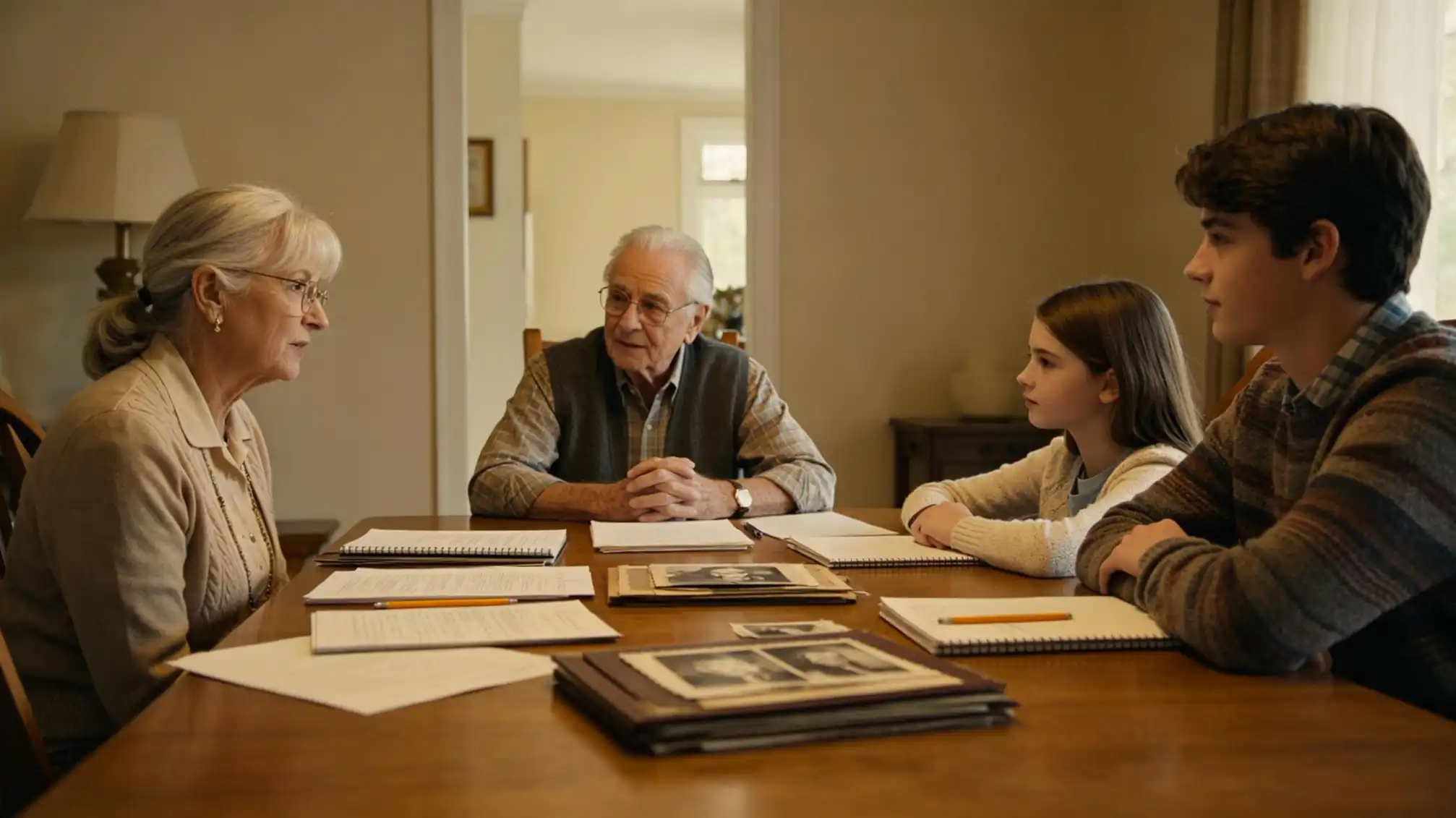
"contentHtml": "<h1>Family History Questions That Actually Get Answers From Relatives</h1>\n<p>Most family interviews don't fail because a relative refuses to talk. They fail because the question was too big. Ask a grandmother to \"tell you about her childhood\" and you'll likely get a polite shrug and a summary of three sentences. her what she could see from her bedroom window at age eight, and suddenly you have a street, a neighbor, dog, and a story about the winter the pipes froze.</p>\n<p trick isn't a longer list of family history questions. It's asking smaller ones — specific enough that memory has somewhere to land. Below is a working set of questions organized by theme, plus the follow-up habits that turn a stiff half hour into a conversation you'll want to keep.</p>\n<h2>Set the scene before you ask anything</h2n<p>Pick a time when your relative isn't rushed, and bring something to record with — a phone is fine. Say up front what you're doing and why: \"I'm trying to write down what I can everyone's still here to ask.\" Most people relax once they understand it's about keeping, not testing.</p>\n<p>Start with easy, factual questions so the rhythm of talking gets established. Names, places, dates, and jobs are low-risk and warm up recall. Save the emotional material for after the first twenty minutes, when the conversation has loosened.</p>\n<figure>\n<img src=\"https://r2.familylove.love/static/seo/interviewscene3.webp\" alt=\"Two relatives talking during a family history interview at a table\" />\n<figcaption>A relaxed, one-on-one conversation almost always beats a formal group interview.</figcaption>\n</figuren<h2>Warm-up family history questions</h2>\n<ul>\n<li>What's your full name, and were you named after anyone?</li>\n<li>Where were you born, and what do you actually remember about that house?</li>\n<li>What did people call you as a kid — and did you like it?</li>\n<li>Who were the adults in your life when you were small, and what were you told to call them?</lin</ul>\n<h2>Questions about childhood that unlock scenes</h2>\n<p>This is where the material lives. Aim for sensory detail rather than summaries.</p>\n>\n<li>What you see out of your bedroom window?</li>\<li>What sounds did your street make in the morning?</li>\n<li>What was your job in the household — dishes, coal, younger siblings, animals?</li>\n<li>What did a normal dinner look like, and who sat where?</li>\n<li>What did your family do on Sundays that nobody questioned?</li>\n>What was the worst trouble you got into, and who found out first?</li>\n<li>Was there a shop, a neighbor, or a relative's house you loved going to? Why?</lin<li>What did kids in your neighborhood do that your own children would find unbelievable?</li>\n</ul>\n<h>Questions that reach the grandparent layer</h2>\n<p>Many people interviewed about their parents and grandparents only have fragments. Ask about the fragments directly.</p>\n<ul>\n<li>What did your mother's voice sound like, and what did she say when she was worried?</li>\n<li>What did your father do for work, and did he talk about it at home?</li>\n<li>Did you know your grandparents? What do you remember about how they looked or smelled?</li>\n>What was never discussed in your family? Who decided that?</li>\n>Was there a family story everyone repeated? Who told it best?</li>\n<li>Were there relatives nobody visited? What did you understand about why?</li>\n</ul>\n<h2>Work, money, and hard seasons</h>\n<p>These questions feel intrusive at first, so ask them plainly and accept a short answer without pressing.</p>\n<ul>\n<li>What was your first paid job, and what did you spend the money on?</li>\n<liWas money tight when you were growing up? How could you tellli>\n<li>Did in the family move far away? What made them go?</li>\n>What was the hardest year you remember, and how did the family get through it?</li>\n>What did you learn to do that you hoped you'd never have to do again?</li>\n</ul>\n<h2>Love, marriage, and family lore</h2>\n<ul>\n<li>How did you meet your partner, and who spoke first?</li>\<li>What did your parents think of them?</li>\n<li>What do you remember about your wedding day — not the ceremony, but the day itself?</li>\n<li>What's the one piece of advice about marriage or raising children that turned out be true?</li>\n</ul>\n<h2Questions that point to paper trails</h2>\<p>Always close with practical questions about objects. They're easier to answer than emotional ones and they lead directly to documents.</p>\n>\n<liWho in the family kept the photographs, and where are they now?</lin<li>Are there letters, certificates, bibles, or military papers anywhere?</li>\n<li>Whose handwriting would I recognize on an old envelope?</li>\n<liIs there anyone still living who knows more about this than you do?</li>\n</ul>\n<h2>The follow-ups matter more than the list</h2>\<p>A question list gets you started; follow-ups get you the detail. When an answer is vague, try one of these instead of moving on:</p>\n<ul>\n<li>\"Walk me through that day — what happened first?\"</li>\n<li>\"Where were you standing when you heard that?\"</li>\n<li>\"Who else was in the room\"</li>\n<li>\" did you think was going to happen?\"</li>\n</ul>\n<pSilence is also a tool. Count to five before rescuing a pause; people often fill it with the honest version of the story. Avoid yes-or-no phrasing whenever you can, and never correct a detail mid-story — check dates later, keep the now.</p>\n<h>Keep what you collect</h2>\n<p>Record with permission, label the file with the date and who's speaking, and write short summary within a week while your memory of the conversation is fresh. Transcribe the best two or three minutes verbatim; those quotes are what relatives will read years from now. It also helps to spread the material around rather than hoarding it — posting a written version to a family page, or adding a short piece to <a href=\"https://wwwamilylove.love/stories\">the stories collection</a>, gives cousins and siblings a chance to correct names and add what they remember.</p>\n<p>Finally, treat this as an ongoing project rather than one big session. Ten minutes on the phone each month, with one theme per call, collects more than a single marathon interview — and it gives your relative something to look forward to.</p>\n<h1>Practical Steps</h1>\n<ul>\n<li><strong>Write it down and share it:</strong> turn your next conversation into a short piece and publish it to <a href=\"https://www.familylove.love/stories\">FamilyLove Stories</a> so relatives can add corrections and extra memories.</li>\n<li><strong>Get help and guidance:</strong> for structure, permissions, and preservation advice, seea href=\"https://www.familylove.love/docs\">the FamilyLove documentation</a>.</li>\n</>",
"images": [
"https://r2.familylove.love/static/seo/interviewscene3.webp"
]
}