Family Tree Template: A Practical Way to Organize What You Already Know
Most family history projects stall for the same boring reason: information lives in six places at once. Names sit in a phone contact list, dates sit in a shoebox of certificates, half a branch is written on the back of an envelope, and one cousin has everything in her head. A family tree template fixes that before you spend a single hour on research, because it forces you to decide where each fact belongs.
The trick is not finding a template. There are thousands. The trick is picking one that matches the information you actually have today — not the information you hope to have someday — and filling it in a sequence that doesn't force you to redraw the whole thing in three weeks.
Start With Structure, Not Research
New researchers usually begin by hunting for a great-grandparent's birth record. That feels productive, but it's backwards. Until you know how many generations you're tracking, which branches are missing, and what a complete entry looks like, you can't tell whether a record you found is relevant or a red herring.
A template gives you a visible standard for "done." A complete entry, at minimum, holds a full name, a birth date and place, a death date and place where applicable, and a note about where the information came from. Once that standard exists on paper, gaps become obvious. You can see at a glance that you know your grandmother's sisters' married names but not their birth years — and that becomes your next research task instead of a vague feeling that something is missing.
Choose the Format That Matches What You Already Know
Most downloadable templates fall into four shapes. Each solves a different problem, and picking the wrong one is the most common reason people abandon a chart halfway through.
Pedigree charts: best for a single direct line
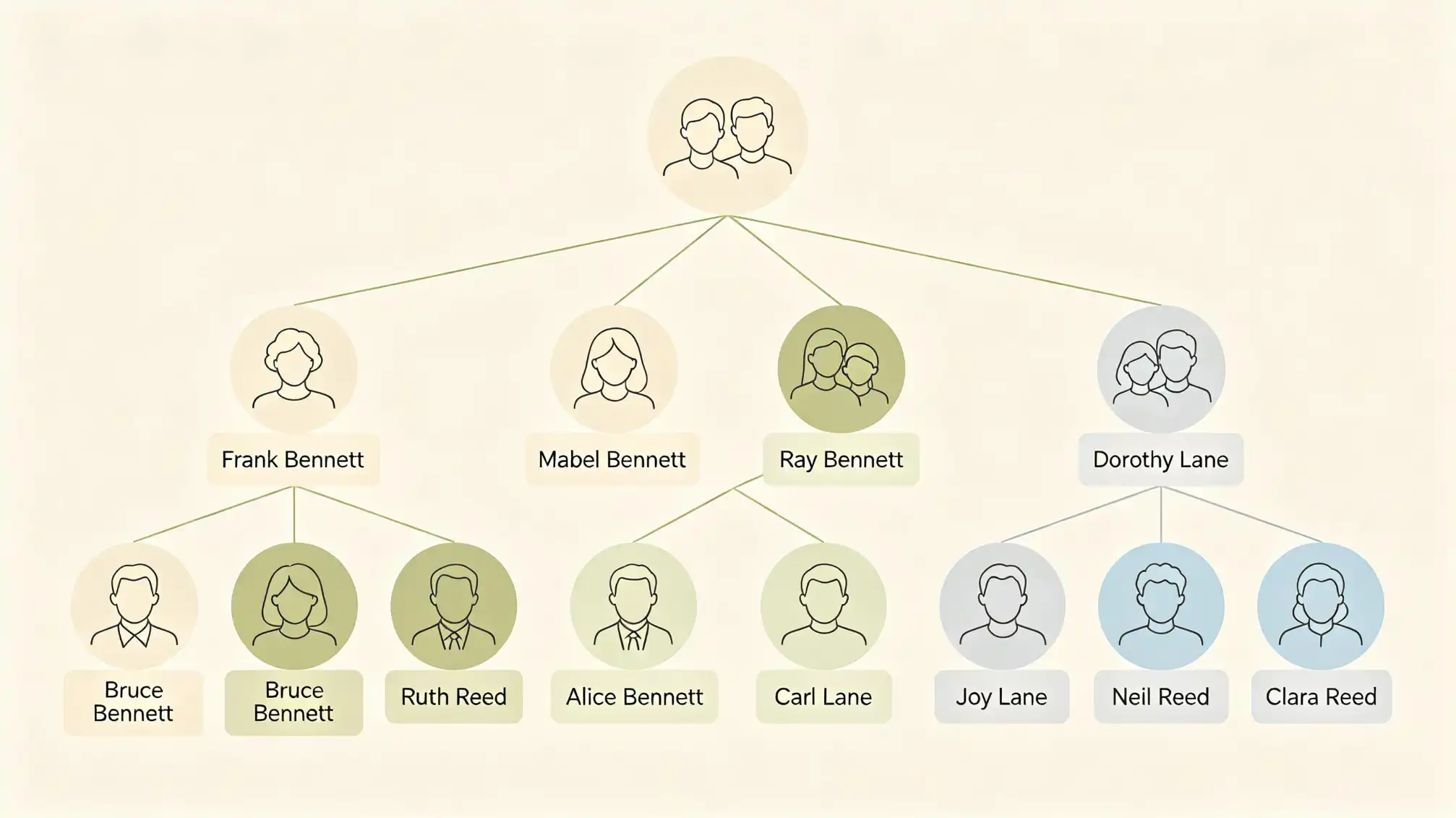
A pedigree chart follows one person backwards through parents, grandparents, and great-grandparents. It's the classic family tree shape and the easiest starting point if your goal is to trace your own direct ancestry. The limitation: it has no room for siblings, and it fills up fast — four generations give you fifteen people, and five give you thirty-one.
Fan charts: best for printing and sharing
Fan charts compress several generations into a circle. They look impressive framed on a wall and are excellent for family reunions, but they're poor working documents because the writing space shrinks with each generation.
Descendant charts: best for tracing a surname forward
These start with one ancestor and branch downward through children, grandchildren, and beyond. They're ideal if you're trying to identify living relatives or work out how two people with the same surname are connected.
Spreadsheet and table templates: best for real research
A plain table with columns for name, relationship, birth, marriage, death, location, and source doesn't look romantic, but it's the most practical family history template you can use. It sorts, filters, and grows without breaking. Many people run a spreadsheet as the master record and use a pedigree or fan chart purely as a presentation layer.
The Fill-In Order That Prevents Rework
Sequence matters more than formatting. Working in this order keeps you from rewriting the same names repeatedly:
- Fill in yourself first. Your own birth date and place anchor the whole chart and give you a reference point for every relationship.
- Add living relatives before deceased ones. Parents, siblings, aunts, uncles, and cousins are usually reachable by phone, which means faster and more reliable answers.
- Record names exactly as given, with variants. A grandmother listed as "Betty" on a birth certificate and "Elizabeth" on a marriage record will break searches later. Note both.
- Log the source next to every fact. Even "told me by Aunt Rosemary, March 2024" counts. Unsourced entries are the ones you'll re-research twice.
- Leave blanks visible. Don't delete a box because you don't know the answer — an empty box is a to-do item, and deleting it hides the gap.
- Add photographs and documents only after the text is stable. Images bloat a template and make it hard to scan while you're still filling in basics.
Does a Free Family Tree Template Hold Up?
Often, yes. A free family tree template in PDF, spreadsheet, or word-processor form will carry you through the first four or five generations without any problem, and it has an advantage paid software doesn't: you own the file and it will open in twenty years.
What free templates don't do well is scale. Once you pass roughly two hundred people, cross-referencing sources, spotting duplicate entries, and answering questions like "who is the common ancestor of these two cousins?" becomes painful by hand. The sensible approach is to start free, keep the master spreadsheet regardless of what tool you eventually adopt, and treat paid software as an efficiency upgrade rather than a requirement.
Turning a Filled Chart Into Something Relatives Can Actually Use
A completed chart is a reference, not a story version your family will genuinely value includes a short profile for each key person — where they lived, what they did for work, one or two details that make them more than a pair of dates. That's where a family history template earns its keep: a consistent set of prompts (birth, marriage, occupation, migration, notable events) applied to every person so the results read as a coherent record rather than a scrapbook.
If you'd rather build and store the tree digitally so relatives can view and add to it, you can set up your family page here and keep the template as your working master.
Mistakes That Make a Template Useless
- Treating the chart as the research itself, rather than a container for it.
- Merging people with similar names without confirming the link through records.
- Recording only the final conclusion and discarding the conflicting evidence that led there.
- Filling in an entire branch from a single relative's memory without labelling it as unverified.
- Choosing a decorative chart too early, then discovering it can't hold the generations you need.