Online Family Tree Tools: How to Choose One You Won’t Outgrow
Most people begin an online family tree with a modest goal: gather names, dates, and a few family stories in one. That goal changes quickly. A single birth certificate leads to a census record, a census record reveals a sibling, and soon you are managing sources, photographs, duplicates, settings, and relatives who want to help. The platform that felt simple on day one can become limiting on day one hundred.
That is why comparing digital family tree tools should start with the work you will do later, not just the chart you see. The best choice is not the site with the most decorative tree view. It is the one that makes your family history easier to, verify, share and preserve. Use the comparison framework below to judge any online family tree on substance rather than surface appeal.
Judge the tool by the tasks you will repeat
A family tree is not a static diagram. It is a working record of relationships and evidence. Before you compare features, list the tasks you expect to often:
- Adding people and defining precise relationships, including step-families, adoptions, and uncertain links.
- Attaching sources such as census entries, certificates, photographs, and personal interviews.
- Writing notes that reasoning, conflicts, or missing evidence.
- Inv relatives to view, comment, or contribute without everyone edit access.
- Exporting a copy of your in a usable format. If you are still organizing what you, begin with a simple relationship review on the family page. It gives you a practical reference point for the people, connections, details your chosen online family tree must handle. Then compare platforms against that real inventory instead of a feature list.
- Can you attach a source to a specific fact, not just to the person?
- Can you record “about1840” or “before 1901” without forcing a false exact date?
- Can you see who changed a record and when?
- Can you export your tree and open the elsewhere?
Evidence should be a first-class feature
Genealogy without sources becomes storytelling, and not always the reliable kind. A useful platform should make citations easy to add easy to find again. Look for dedicated fields for source type, citation detail, repository, date accessed, and media. Ideally, you can link one source to multiple facts and mark your confidence level when evidence conflicts.
This matters when you compare tools some platforms treat sources as an afterthought—a note field or a file attachment. That works for a small family tree, but becomes fragile when your family history grows. A strong online family tree keeps the person, the event, the source, and your reasoning connected. If you cannot answer “where did this date come from?” in a few clicks, the tool will slow down serious research.Collaboration needs boundaries
Family history is naturally collaborative, but open editing can damage data quickly. Compare how platform handles invitations and permissions. Can you give a relative read-only access? Can they comment without changing facts? Are edits logged? Can you revert a merge or review changes before they go live?
Good collaboration is not just a shared password and good intentions. It is a permission model. For a family tree to remain trustworthy, contributors need clear roles and a visible history of changes. This is especially important when cousins, siblings, or researchers in different countries work on the same genealogy project.
Portability is your insurance policy
No platform lasts forever, and no family history should be trapped one. Before committing, confirm that you can export your data in a standard genealogy format, usually GEDCOM, and that you can also download media and notes. Test the export while your tree is small. If the export is incomplete, difficult to open, or sources, treat that as a warning sign.
Portability also makes comparison easier. A platform that supports clean exports respects your work. A platform that locks it in may still be useful, but you should know the risk before you invest years of research.
Privacy and living people require special care
An online family tree often contains information about living relatives, birth dates, addresses, and family relationships Compare privacy controls carefully. you hide living people from public view? Can you control who sees photos or sensitive notes? What happens to the tree if the account owner stops paying or becomes inactive?
<>These questions are not legal fine print They affect whether relatives will trust you with information. A practical family history platform should make privacy settings understandable and easy to review, not buried in an account menu.Visual clarity still matters
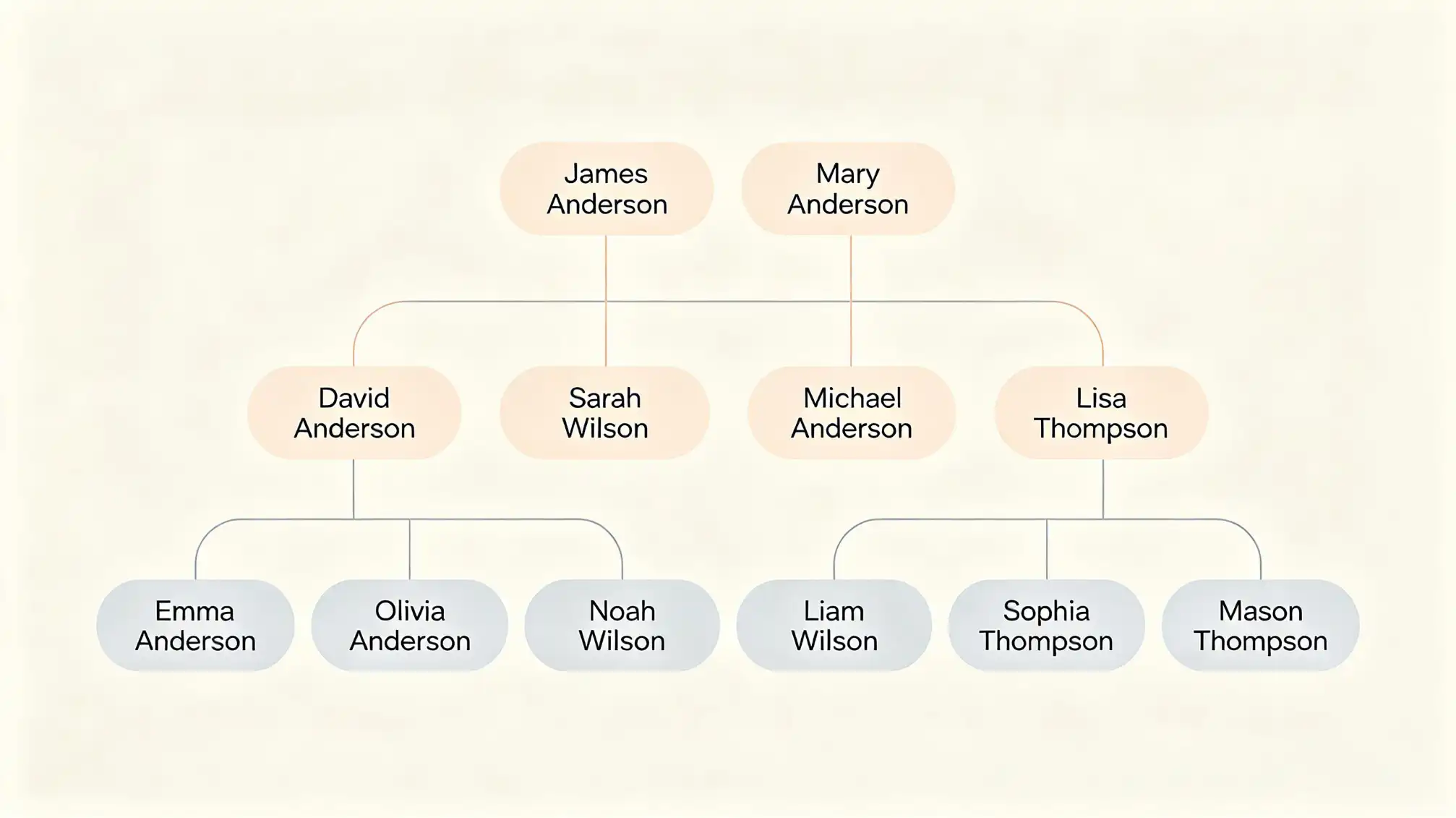
A modern family tree diagram helps you scan relationships quickly, but the underlying source data, permissions, and export options matter more than the chart style.
A clear family tree diagram is valuable. It helps you spot missing generations, duplicate people, and unusual relationship patterns. Different views—pedigree, descendant, fan chart, or hourglass—serve different research tasks. However, remember that the chart is only a of your data. The database behind it should be able to store uncertainty, sources, notes, and media without forcing everything into a tidy visual shape that does not reflect real families.
How to test a platform in thirty minutes
<3>Use a, real research taskDo not evaluate an online family tree with a fake “ Smith” entry. Add one real person, one source, one photograph, one uncertain date, and one living relative. Then try to correct a mistake, invite a viewer, and export the data. This short test reveals more than a long demo.
Common comparison traps
Watch for platforms that impress on the first screen but fail in daily use. Large record collections are useful, but they are not a substitute for a well-structured family tree. Mobile apps are convenient, but they may hide source permission settings. Free tiers can be excellent for starting, but check storage limits, privacy defaults and whether advanced features disappear laterpp>Also be skeptical of hints that merge people without review. A hint is a lead, not a conclusion. best genealogy tools help you evaluate evidence, not just collect matches. When you compare options, ask whether the platform encourages careful confirmation or rewards fast, unchecked growth.
Choose for the next five years, not the next five minutes
The right online family tree should make your family history more organized, more transparent, and easier to share with the people care about it. Prioritize evidence handling, permission controls, export options, and everyday usability. A beautiful chart is welcome, but it should sit on top of a platform that can support real research and real relatives. Compare deliberately, test with actual data, and choose a tool you can grow rather than one you will need to escape.