Family Tree Foundations: A Beginner's Guide to Mapping Your Ancestors
Nearly everyone begins with the same quiet question: who came before me? A family tree is that question made visible — a structured record of the people whose lives led to yours. But once you move past the idea and start building one, better questions appear. Which branch should you follow first? How do you tell a solid record from a hopeful guess? And how do you keep years of research from collapsing into a shoebox of loose notes and half-remembered names?
This guide covers the essentials so your first months of research feel productive rather than overwhelming.
What a Family Tree Really Records
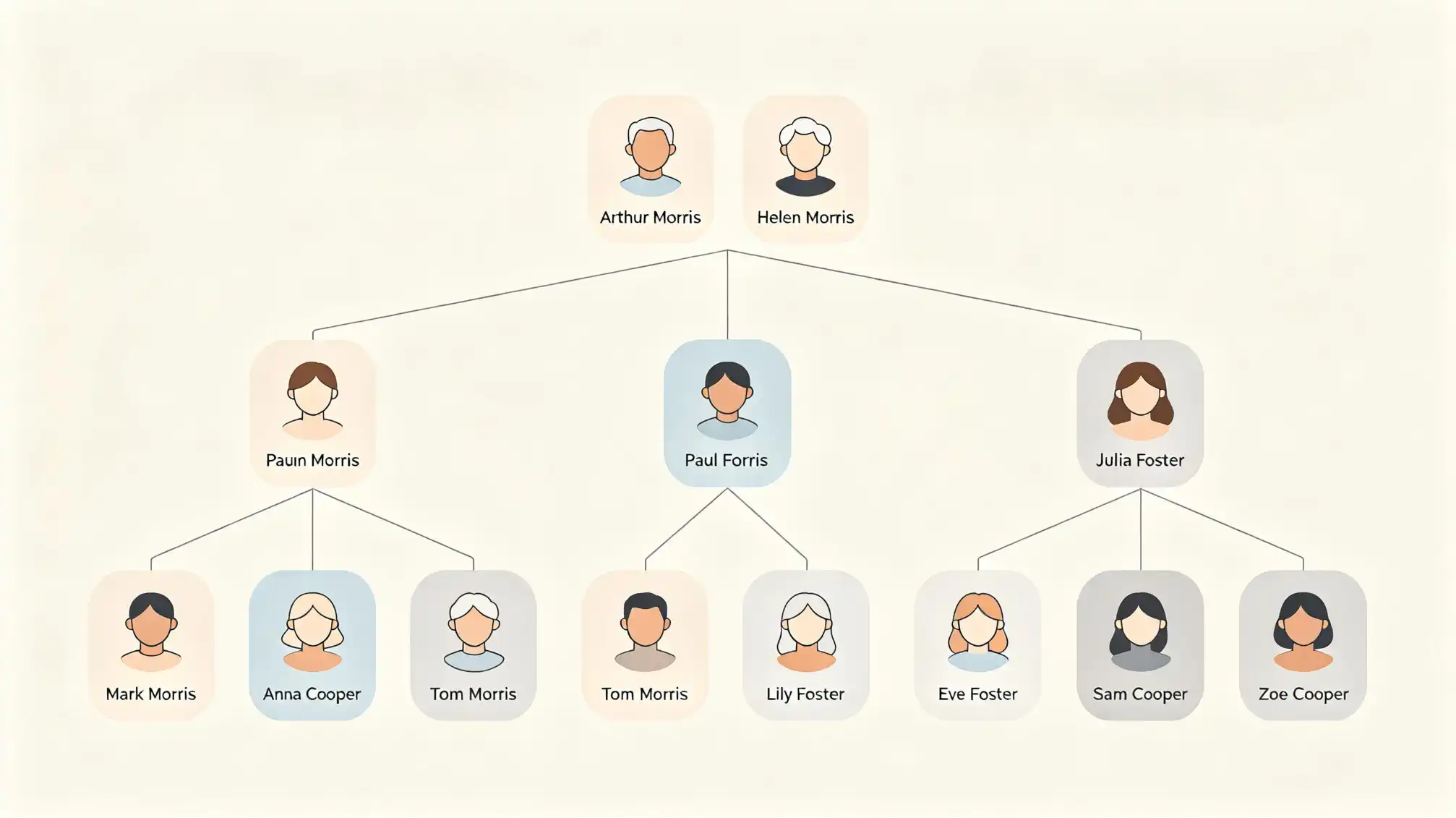
At its simplest, a family tree documents relationships: parents and children, siblings, marriages, and the generations that connect them. A useful tree goes a step further and records the evidence behind each relationship — names as they appear in records, dates with a place attached, and a note on where that information came from.
It helps to separate two terms that beginners often use interchangeably. Genealogy is research process: the searching, verifying, and reasoning. The family tree is the structure that holds the results. You can have a beautifully drawn tree built on shaky evidence, and you can have meticulous research stored in a plain notebook. The goal is to bring both together.
Three Building Blocks Every Researcher Needs
This is the classic fan or ladder shape most people picture: you the base, parents above, grandparents above. It is excellent for spotting gaps at a glance, because empty slots stand out immediately. Keep it limited to direct ancestors so it stays readable.
2. Family group sheets
A pedigree chart shows only one line of descent and hides siblings entirely. Family group sheets fix that by recording one couple and all of their children, with birth, marriage, and death details for each person. Siblings matter more than beginners expect — they often appear in records that your direct ancestor never generated, and their documents can break through a brick.
3. Source citations
Every fact should carry a trail back to where you found it. A census year, a page number, a cemetery plot, a relative's recollection — write it down while the document is still open in front of you. Future you will not remember, and neither will anyone you eventually share the tree with.
Start With What You Already Know
Before you open a single database, write down everything you can already confirm. Your own birth details. Your parents' full names, including middle names and maiden names. Approximate birth years, hometowns, occupations, and the migrations you have heard about at family gatherings. This first pass usually takes an afternoon and gives you a working skeleton.
Then talk to living relatives — and do it sooner than feels necessary. Older family members hold details no archive contains: nicknames, second marriages, the cousin who emigrated, the village name pronounced differently than it is spelled. Ask open questions rather than yes-or-no ones, record the conversation with permission, and note which memories are firm and which are hazy. Family stories are leads, not conclusions, and that distinction keeps your research honest.
While your tree captures the past, it is worth keeping a clear record of the people in your life right now. A shared family page such as the family space at familylove.love can hold the present-day details — birthdays, photos, the small events that never make it into official records — so your descendants inherit both halves of the story.
The Records Beginners Should Check FirstYou do not need to travel or subscribe to everything at once. These categories cover most of what you will need in the first year:
- Civil registration records — birth, marriage, and death certificates, usually held by a national or regional authority. These are the backbone of modern research.
- Census returns — taken every ten years in many countries, they place whole households in one place and time, revealing occupations, addresses, and children you did not know existed.
- Church and parish registers — baptisms, marriages, and burials, often the only option before civil registration began.
- Gravestones and cemetery indexes — dates carved in stone frequently survive where paper does not.
- Newspaper archives — obituaries, announcements, and court reports add context and colour no certificate provides.
- Immigration and naturalization papers — for anyone who crossed a border, these can name a hometown abroad.
Mistakes That Slow Beginners Down
A few habits cause most of the frustration in early family history research. The first is accepting a name match as proof. Two men with the same common name in the same county are not automatically the same person check age, occupation, spouse, and neighbourhood before merging them.
The second is climbing too fast. It is tempting to chase a line back five generations in a weekend, but each unverified link corrupts everything above it. Build outward one confirmed generation at a time. The third is ignoring spelling variation; your ancestors may appear under three different spellings across a lifetime, and a rigid search will hide them. Finally, do not skip the women in your tree. Tracing maiden names through marriage records is harder work, but it is where many of the most rewarding discoveries live.
Keeping Your Research Organized as It Grows
Consistency beats sophistication. Choose one format for dates and one convention for names, and stick to them. Give every document you download a descriptive filename that includes the person, record type, and year. Store digital copies in folders by surname or by branch, and back them up somewhere other than the device you search on. If you prefer paper, a simple three-ring binder with a section per family works just as well as expensive software.
Review your tree regularly — perhaps every few months — and re-check the facts you entered early on. Standards improve, new records come online, and errors that once looked invisible become obvious once you know the family better.
The Human Side Worth Remembering
Genealogy surfaces difficult material: estrangements, early deaths, migration forced by poverty or conflict. Handle what you find with care, especially when living relatives are involved. Share sensitive discoveries privately before publishing them, and remember that the people in your tree were not data points but neighbours, workers, parents, and survivors. Recording their stories, not just their dates, is what turns a chart into something worth passing on.