How to Start a Family Tree: A Beginner's Roadmap From Memory to Records
Starting a family tree can feel like standing at the edge of a very large forest. You know your parents, your grandparents, perhaps a great-grandparent or two, and then the names blur. The reassuring part is that you do not need to map the whole forest at once. You need a method: work backwards, write down what you already know, and let each answer point you toward the next question. This guide walks through that method in the order that actually works.
Start With the Living, Not the Distant Past
Many beginners rush straight to online databases and type a great-grandfather's name into a search box. That approach usually produces a confusing pile of possible matches with no way to tell which one belongs to your family. Reliable family history starts with people who can still answer questions.
Interview yourself first
You are a source. Before you contact anyone else, write down everything you know about your immediate family. Capture these details for every person you can:
- Full name at birth, plus any later names or spellings used
- Maiden names for women who married (record them in parentheses, for example: Mary (O'Brien) Halloran)
- Dates and places of birth, marriage, and death
- Occupations, employers, and military service
- Towns and addresses where the person lived, with approximate years
- Religious affiliation, which often points to the right parish registers
Then talk to your oldest relatives
Ask open questions rather than yes-or-no ones. Instead of asking whether Uncle Ray was in the army, ask what Uncle Ray did during the war. Let people talk, and record the conversation with permission. Family stories are not proof, but they are excellent research leads: a nickname, a village name, or a rumour of an emigration can be exactly the clue that unlocks a record.
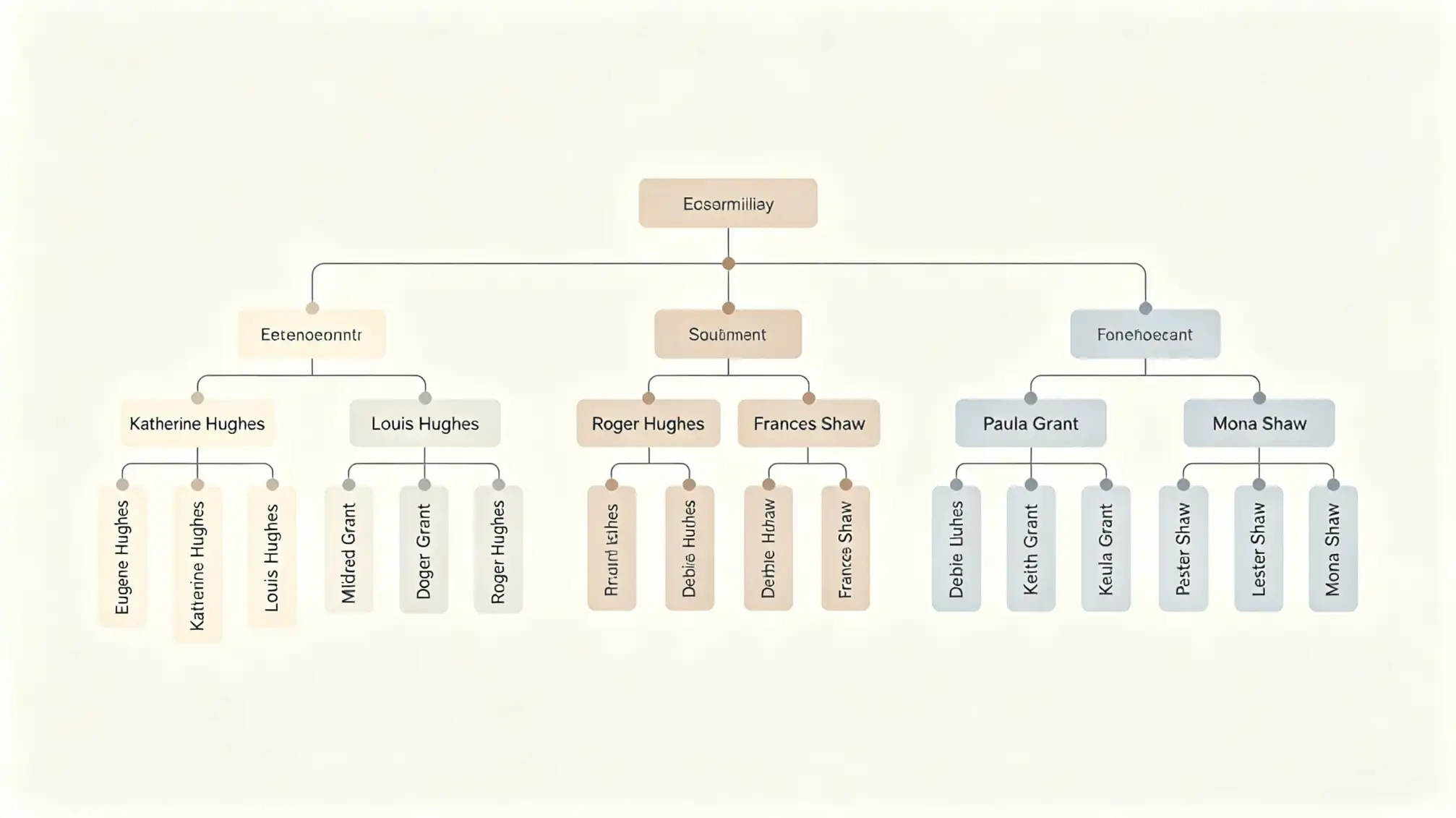
If you would like a shared space where several relatives can contribute photos, names, and memories as they come up, it helps to give the family a single place to gather rather than collecting fragments across a dozen chat threads. A simple shared family page, such as the one at FamilyLove Family, can keep everyone's contributions in one spot while you build the tree.
Choose One Format and Commit to It
Beginners often lose momentum because they are unsure whether to use paper, a spreadsheet, or genealogy software. Any of these works. What does not work is switching formats every week and keeping half the information in your head.
- Paper charts are excellent for seeing a family at a glance and for recording interviews. A four-generation chart plus a family group sheet for each couple covers most beginners for months.
- Genealogy software or an online tree makes it easier to search, cross-reference, and share. Look for one that lets you attach sources to each fact.
- A simple document or spreadsheet is fine if you are disciplined about consistent columns and dates.
Whatever you pick, agree with yourself on one naming convention and one date format, then use them without exception. Consistency now saves hours of cleanup later.
Set One Research Goal at a Time
A goal like learn my family history is too broad to act on. A useful goal is narrow and answerable, for example: identify the parents of my great-grandfather Thomas Nolan, born around 1890 in County Kilkenny. Write the goal at the top of a page, and work only on that until you can answer it or prove it cannot be answered with available records.
Build Backwards, One Generation at a Time
Genealogy moves from the known to the unknown. Confirm a person's birth, then their marriage, then their death, and only then move to their parents. Skipping a generation is the single most common cause of a family tree that is confidently wrong. If you cannot connect your great-great-grandmother to her parents, stop there and work on the gap rather than borrowing someone else's conclusion.
Collect Documents, Not Just Names
Names are cheap. Evidence is what makes a family tree trustworthy. As you research each person, look for records that were created close to the event:
- Census returns, which place a whole household in one time and place
- Birth, marriage, and death registrations, or baptism and burial records
- Immigration and naturalization papers
- Military service files and pension applications
- Wills, probate records, and land transfers
- Obituaries, newspaper notices, cemetery indexes, and city directories
Start with the cheapest and closest sources: the filing cabinet at home, photo albums, family Bibles, and the county or state archive where your relatives lived. Online databases are convenient indexes, but they are a map, not the destination. Order the original record whenever you can.
Keep a Simple Source Log From Day One
For every fact you record, note four things: who created the record, what it is, when it was created, and where you found it. A single line is enough. This habit means that in two years, when you cannot remember why you believe a particular birth year, you will have the answer. It also lets you distinguish between information given by someone who was present at an event and information repeated second-hand years later.
Five Mistakes That Slow Beginners Down
- Copying entire branches from another person's online tree without checking a single source
- Assuming a name match is your relative, when common names repeat constantly within one region
- Jumping several generations back before the nearer ones are confirmed
- Recording facts without recording where they came from
- Ignoring spelling variations, nicknames, and phonetic misspellings in older records
Pace Yourself for the Long Run
Family history is a long project, not a weekend task. Set aside a regular hour each week, keep your notes in one place, and celebrate small confirmations. The first time you hold a document that proves a great-grandparent's birthplace, the forest stops feeling so large.