Building Your First Family Tree: A Beginner's Roadmap to Family History
Most people begin with a single question: where did my family come from? The answer rarely arrives all at once. It comes in fragments — a name on a birth certificate, a photograph with no caption, a story an aunt repeats at every gathering. A family tree is the structure that holds those fragments together, turning scattered memories into something you can verify, correct, and pass on.
If you are just starting out in family history, this guide explains what a family tree really records, what it does not, and how to build one that stays trustworthy as it grows.
What a Family Tree Actually Records
At its core, a family tree is a record of relationships. It answers a small set of questions for each person: who were their parents, who did they marry, when and where were they born, and when and where did they die. Names alone are decoration. It is the links between people — and the evidence behind those links — that make the tree useful.
That distinction matters more than beginners expect. Family stories tell you what a family believed about itself. A carefully built tree tells you what can be documented. Both have value, but only one can be checked against a source, and only one will survive a disagreement between two cousins who remember things differently.
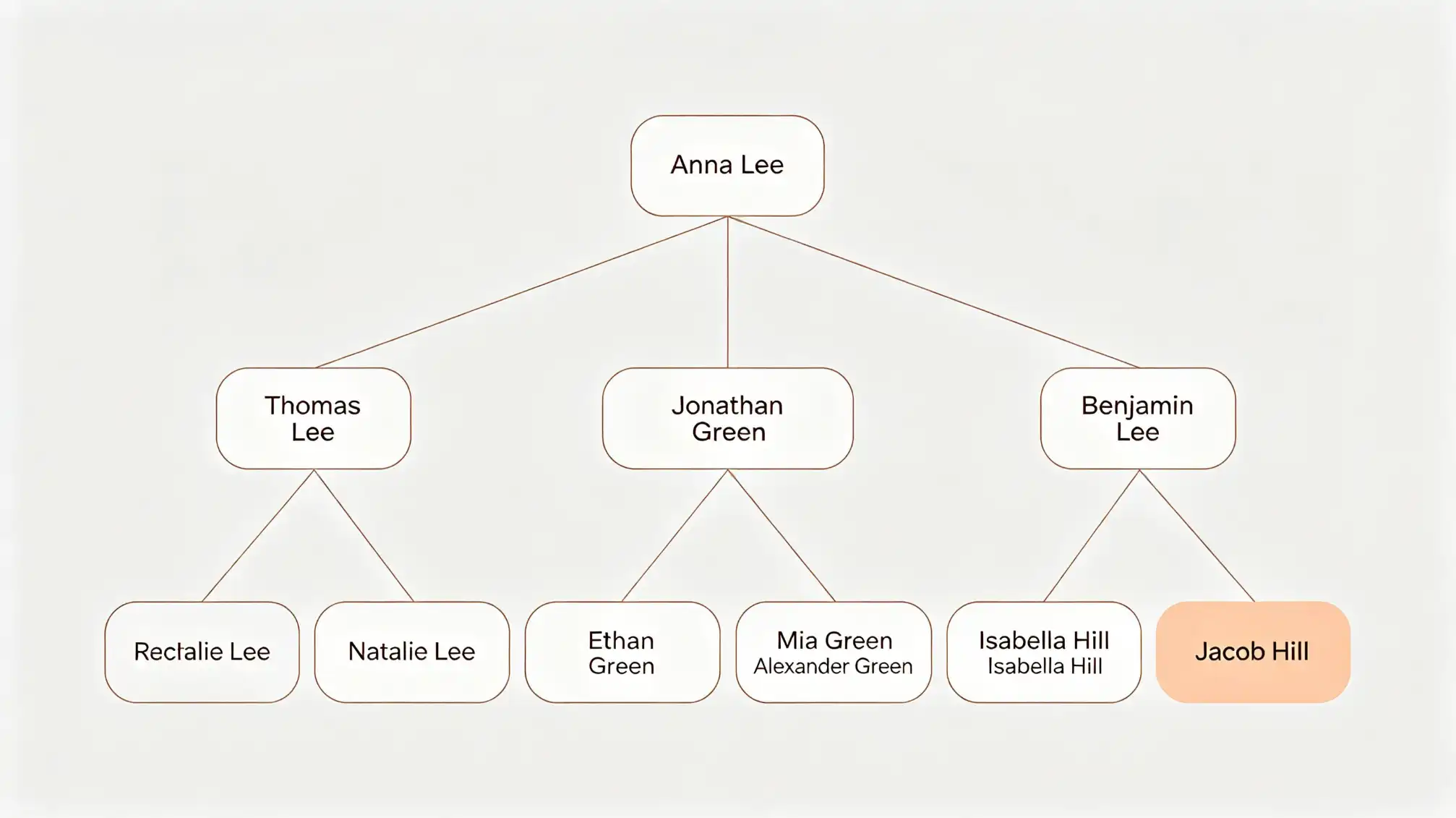
In practice, most trees today exist in two forms: a digital database on a genealogy platform, and a simple chart you can print, frame, or share with relatives. The chart is the visible part. The sources underneath it — census returns, certificates, parish registers, obituaries, immigration lists — are the foundation. Without them, you have a diagram. With them, you have research.
The Four Branches You Will Actually Research
New researchers often imagine a tree as one long line stretching back through a single surname. In reality, you will work across four distinct branches: your father's paternal line, your father's maternal line, your mother's paternal line, and your mother's maternal line. Each one leads into different surnames, different towns, and often different record systems entirely.
This is why progress tends to feel uneven. One branch may reach back to the 1700s because the records survived intact. Another may stall at a great-grandparent whose birthplace nobody living can confirm. That imbalance is completely normal, and it is not a sign that you are doing something wrong.
Start With the Living, Not the Dead
The most common beginner mistake is opening a genealogy website before opening a conversation. Your oldest living relatives are an irreplaceable source. They hold names, nicknames, migration routes, and small details that no archive will ever index — and their memories will not be available forever.
Ask Questions That Produce Facts
- Where exactly were you born, and where did your parents live before that?
- What were your grandparents' full names, including middle names and maiden names?
- Did anyone in the family emigrate, serve in the military, or officially change a surname?
- Which photographs, letters, or certificates are still stored in someone's house?
- Were there siblings who are rarely mentioned, and what happened to them?
Record the Answers Immediately
Write down what you hear the same day, and note who told you and when. A date and a name attached to a memory transforms it into a lead you can follow. If two relatives disagree, record both versions rather than choosing a winner — the conflict itself often points toward the record that will settle it.
Reading the Records Behind the Names
Once living sources are exhausted, the work shifts to documents. The golden rule is to research backwards, one generation at a time. Confirm a parent-child relationship with a reliable record before moving to the previous generation, or you risk building an entire branch on a mistaken assumption.
Civil registration, census records, church registers, military files, newspapers, and probate documents each answer different questions. A birth certificate confirms parentage; a census places a whole household in one place on one night; a newspaper notice may reveal a maiden name or a sibling you did not know existed. Spelling was rarely standardized, so search variants and listen to how a surname sounds.
As your notes accumulate, patterns emerge. Certain families cluster in the same parish for generations. Others move every few years. Those patterns are the beginning of a real family history, not just a list of names and dates.
Mistakes That Send Beginners Back to the Start
- Copying an online tree without checking whether any source is attached to it.
- Assuming a surname was always spelled the way your family spells it today.
- Jumping back two or three generations because a famous or convenient name appears.
- Ignoring siblings, who often appear in records when the direct ancestor does not.
- Failing to note where each fact came from, so it cannot be re-checked later.
Every one of these problems is avoidable with a single habit: for each fact you add, record the source. Future you — and every relative who inherits your research — will thank you for it.
Making the Tree Something Your Family Can Use
A family tree becomes far more valuable when it is shared. Photographs get labelled, half-remembered stories surface, and distant cousins appear with documents you would never have found alone. Building the tree is a personal project; growing it is a family one.
If you would like a place to collect those contributions, the family section at familylove.love/family is a natural next step — somewhere to gather names, photos, and notes so your relatives can add what they know while they still can.