Tracing Your Ancestors: A Research Plan That Actually Holds Up
Most family history projects stall for the same reason: the research begins with a database search instead of a plan. A surname typed into a search box returns hundreds of plausible matches, and without a structure for judging them, the trail goes cold within weeks. Tracing your ancestors is less about finding one dramatic record and more about building a chain of evidence, generation by generation, that a stranger could follow and reach the same conclusion you did.
What follows is a working method for the first year or two of serious genealogy research: what to collect, what to ignore for now, and how to keep your family tree from filling up with guesses.
Begin With the People Who Are Still Here
The single richest source of information about your ancestors is usually sitting in a chair across from you. Parents, aunts, uncles and grandparents hold names, dates, occupations, migration routes and relationships that appear in no index. Start there, not online.
Ask open questions rather than yes-or-no ones. Where was the family living when you were a child? Who left home first, and why? Was anyone in the family known by a nickname, a middle name, or a name that changed at Ellis Island? What did people do for work, and what did the family talk about at funerals? Record the conversation if you are given permission, and write up notes the same day while details are fresh.
Pay attention to the throwaway remarks. A casual mention that a great-grandfather was raised by an aunt often explains a missing parent in the records years later. It also helps to keep what you gather somewhere relatives can read and correct — an archive such as the family stories section works better than a private notebook, because other people add details you never thought to ask about.
Build a Backbone Family Tree Before Chasing Documents
Before you spend money on subscriptions, sketch a skeleton family tree covering your direct lines only: you, your parents, grandparents, great-grandparents, and their parents where known. For each person record four things — full name as used in life, key dates, places, and the source of each fact.
Resist the urge to add every cousin, in-law and collateral line at this stage. A wide, shallow tree is fragile; a narrow, deep one gives you a stable spine to hang later discoveries on. Ideally, use a genealogy program or an online tree that lets you attach sources to individual facts, because as soon as you have more than fifty people, memory stops being a reliable filing system.
Work Backward, One Generation at a Time
The standard discipline of genealogy is to move from the known to the unknown. Confirm one generation with reliable records before stepping into the previous one. Skipping ahead because a name looks right is the fastest way to attach an entire wrong branch to your tree, and unpicking it later is far more painful than the original research would have been.
Match Two Independent Sources to Every Fact
One record is a lead; two independent records that agree are evidence. A birth date copied from one index into three online trees is still a single source. Look for different record types — a civil registration entry plus a baptism register, a census entry plus a headstone inscription — and note where they disagree instead of quietly choosing the tidier version.
Keep a Research Log From Day One
Write down what you searched, when, and what you found — including the searches that turned up nothing. Negative results are valuable: they stop you repeating the same dead end in two years' time, and they narrow the range of places a person could have been.
Where Records Really Live
Once you are working on closed generations, the records you need are scattered across national archives, county record offices, church registers and private collections. The categories that solve most problems are consistent:
- Civil registration of births, marriages and deaths, usually from the mid-nineteenth century onward
- Census returns, typically every ten years, which place whole families in one household
- Parish registers of baptisms, marriages and burials, often reaching back to the sixteenth century
- Immigration, naturalisation and passenger lists
- Military service files, pension records and draft registrations
- Wills, probate inventories and land transfers
- Newspaper archives, cemetery indexes and local history society collections
Home sources belong on that list too, and they are the ones people skip. Photograph albums, letters, school reports, prayer books, medals and the backs of old photographs often carry dates, places and relationships written in a hand nobody thought to credit.
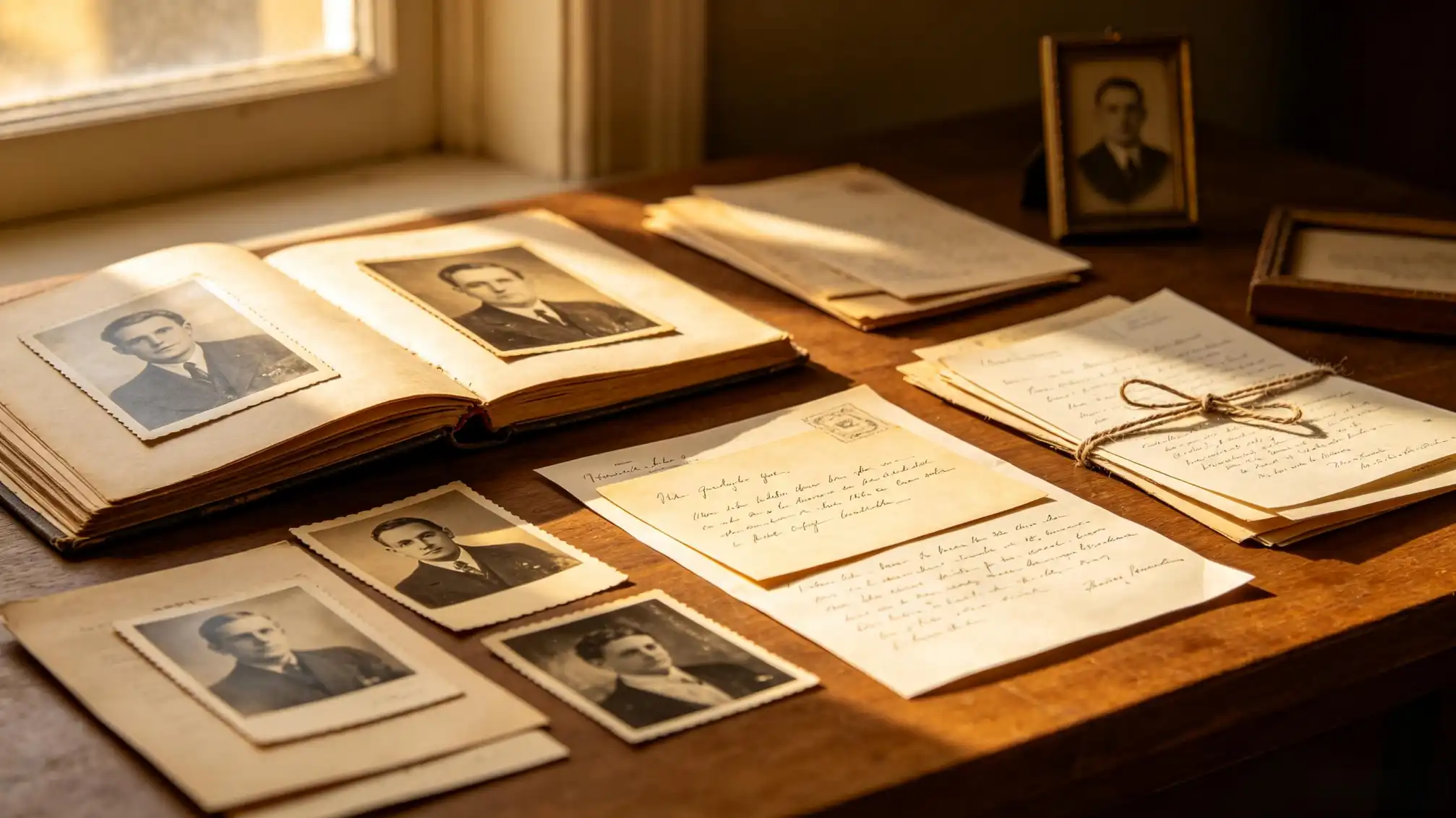
When you handle these items, work in one room at a time, keep families of documents together, and label every scan with the name of whoever identified it. An unlabelled photograph becomes an anonymous face within one generation.
Getting Past the Brick Walls
Every researcher eventually meets a person who seems to appear from nowhere. Before concluding that the records were destroyed or the name is wrong, test a few ordinary explanations. Surname spellings shifted constantly before standardised literacy, and phonetic variants — Baker and Barker, O'Brien and Bryan — are the same family more often than beginners expect. Boundary changes move a village between counties and countries. A person may appear in a census under a stepfather's surname, or under a first name used in childhood rather than the formal name on a birth certificate.
Widen the search in concentric circles: the parish next door, the market town, the port, the county where an older sibling settled. Broaden the record types too — a tax list or a newspaper notice can pin a family to a place when the obvious records are silent.
Write It Up So It Survives You
Research that exists only as an online tree with no notes will not survive a subscription lapse, let alone you. Produce something readable: a short narrative for each direct ancestor, a source list, and copies of the key documents. That written account is the real deliverable of a genealogy project, and it is what turns a list of names into a family history that the next generation can actually use.