How to Start Your Family History Before the Stories Slip Away
Most families don't lose their history in one dramatic moment. It fades quietly — a grandmother's recipes nobody wrote down, a great-uncle's migration story that only ever got told at the dinner table, a face in a photograph that no one alive can confidently name. The good news is that family history doesn't require a research trip, a paid subscription, or a degree in genealogy. It requires one conversation, started soon, and a simple habit of keeping what you hear.
This guide is written for the person who has been meaning to start for a while. You don't need to be the family archivist. You just need to be the one who asks first.
Begin With the Living, Not the Dead
New researchers often start by chasing a name from the 1800s. It feels like the "real" work. But the most valuable material you will ever collect is sitting in a living room right now, and it is perishable. Documents survive for centuries. Memories do not.
So flip the order. Start with the oldest person in your family who is willing to talk, and work backwards from there. Every conversation you record today becomes a source that a future researcher — possibly your own grandchild — can verify against a birth certificate later.
Pick one storyteller, not all of them
Trying to interview six relatives at once produces polite, surface-level answers. Choose one person. Tell them plainly: "I'd love to record a bit of what you remember, so it isn't lost." Most people say yes. Almost everyone feels quietly honoured to be asked.
Start with an easy question
Never open with "Tell me about your life." It is too big, and it invites a blank stare. Open with something small and sensory instead: What did your street sound like on a summer evening? What did your mother cook when money was tight? Small questions unlock big memories. You can widen the conversation later.
Record in the Format Your Family Actually Uses
The best format is the one that survives and gets shared. Consider what your relatives will realistically open ten years from now.
- Audio — the easiest to capture and the least intimidating for a shy narrator. A phone voice memo is genuinely enough. Voice carries tone, laughter, and accent in a way text never will.
- Video — best for gestures, expressions, and showing old photographs on camera. Slightly more pressure, so use it once the person is comfortable.
- Written notes — worth doing alongside the recording, because transcription is easier when you have names and dates in front of you. Write down proper nouns immediately; they are the first thing you forget.
Whatever you choose, capture the date and the full name of the speaker at the start of every file. "Interview" is not a title. "Rosa Delaney, age 84, recorded by her granddaughter, 12 March" is.
The Questions That Actually Open People Up
Good family stories rarely come from yes-or-no questions. Aim for prompts that invite a scene. Keep a short list in your pocket so you never freeze mid-conversation:
- What was the first home you remember, and who lived there with you?
- What did your parents do for work, and how did that shape your childhood?
- Who in the family was the best cook, and what did they make?
- What was the biggest sacrifice you saw someone make for the family?
- What is something everyone in the family believed that turned out not to be true?
- Which family story do you think has been exaggerated over the years?
- What do you hope your grandchildren know about you?
Follow the emotion, not your list. If your narrator's voice changes — a pause, a laugh, a sudden quiet — stay there and ask one more gentle question. That's where the real material lives.
Keep a Simple Place for Everything You Collect
The fastest way to kill a family history project is over-engineering it. You do not need a filing system with fourteen categories. You need three things:
- One folder for all recordings and scans, backed up in two places — your device and a cloud account.
- One document listing who you interviewed, when, and what was covered. This is your index.
- One naming rule you never break: year, surname, first name, topic. It sounds dull. It will save you hours.
Label photographs the day you scan them, while the person who can identify faces is still on the phone with you.
Let the Family Tree Follow the Stories
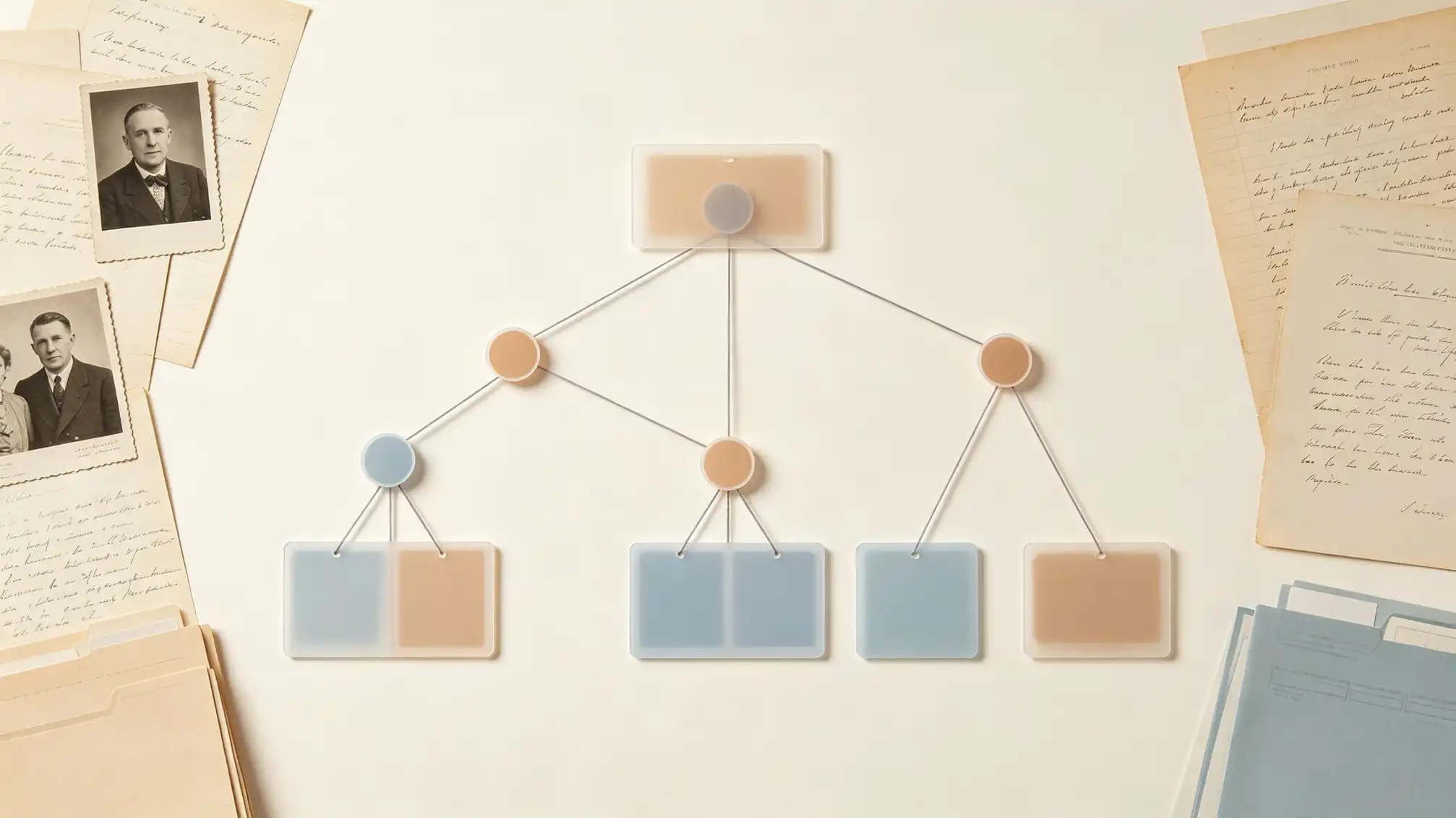
A family tree is a map, not the journey. Build it as a by-product of what you learn, not as a prerequisite. When an interview reveals a birthplace, a sibling, or a marriage year, add it. Over time, the chart fills in — and every branch on it is anchored to a voice you recorded rather than a guess you copied from someone else's research.
This approach also protects you from the classic beginner's trap: adopting an entire online tree because three names matched. Your ancestors deserve better evidence than that.
Invite the Wider Family In
Family history is a group project that one person usually ends up carrying. Share the load early. Send out one recording per month to the wider family, ask a cousin to transcribe, ask an aunt to identify a photo. Momentum builds when people see their own memories already there — and it's often easier to contribute once there's a visible collection to add to. If you'd like your relatives to add their own recollections directly alongside yours, the shared stories space at FamilyLove is a natural place to keep them together.
Three Fears That Stop People — and Why They Don't Matter
- "My family doesn't like being recorded." Then don't record yet. Take notes and ask permission later. The memory still gets saved.
- "I'm not a historian." You're not trying to be. You're trying to be a witness. Accuracy can be checked later; a lost voice cannot be recovered.
- "I'll start when I have time." Time is exactly what isn't guaranteed. Fifteen minutes this weekend beats a perfect plan for next year.
Start This Week, Not Someday
Make one call. Ask one question. Save one file. That's the whole beginning — and it's the part most families never get around to. Everything else, from transcripts to tree branches, grows out of that first fifteen minutes.