{
"title": "How an Online Family Tree Turns Scattered Records Into Real Family History",
"metaTitle": "Online Family Tree: Turn Scattered Records Into Family History",
"metaDescription": "Comparing digital family tree tools? See how an online family tree keeps sources attached, prevents duplicates, and makes your family history verifiable and shareable.",
"summary": "An online family tree is less about collecting more names and more about making the information you already have usable. This guide explains what genuinely changes when your tree moves online, the evaluation criteria that separate good tools from frustrating ones, and the privacy and ownership questions most people skip before they commit to a platform.",
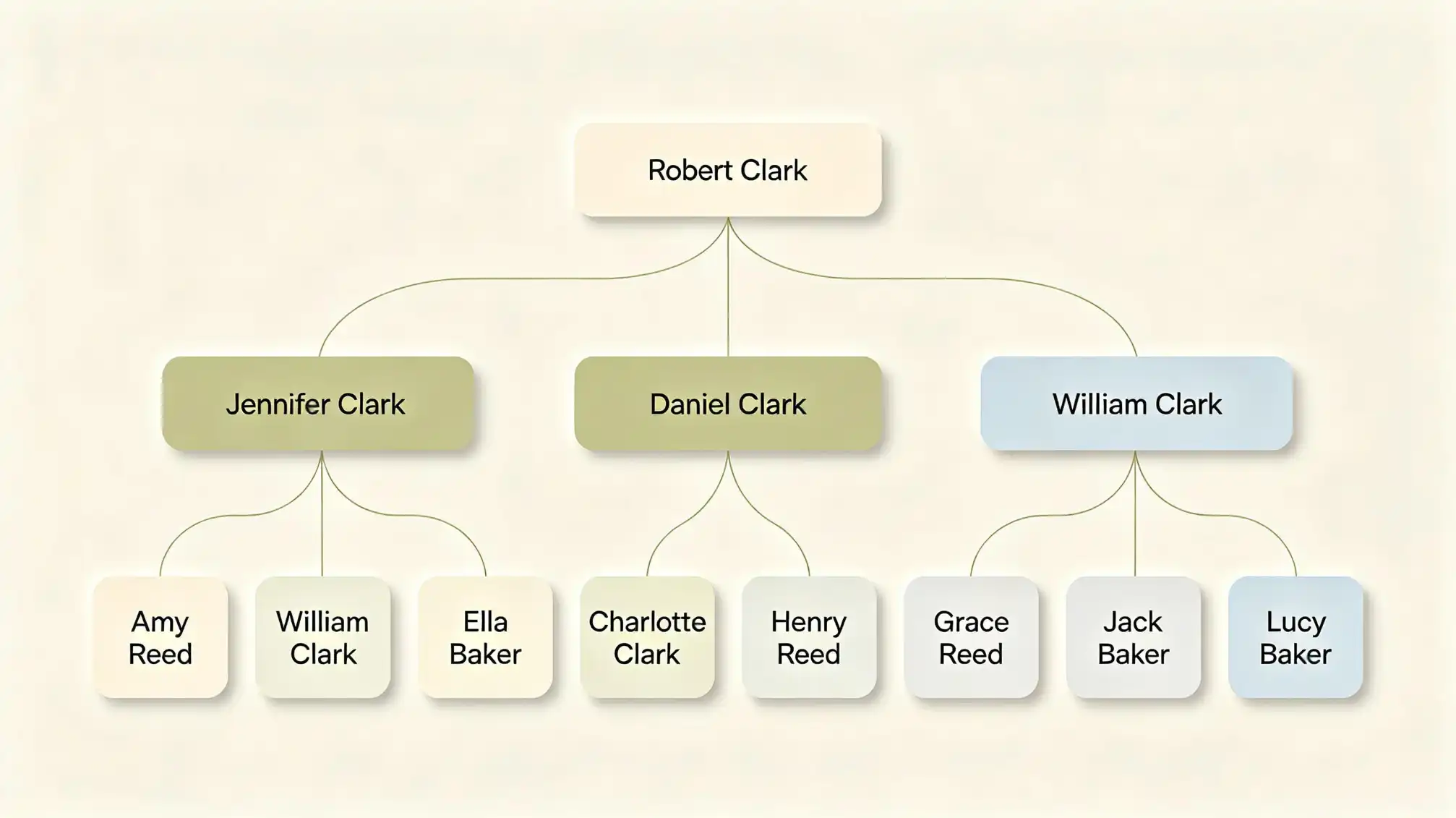
"contentHtml": "<h1>How an Online Family Tree Turns Scattered Records Into Real Family History</h1>\n<p>Most people who start researching their roots do not begin with a plan. They with a story — a's maiden name, a photograph with nothing written on the back, a birthplace that never quite matched the census. Within a few weeks that curiosity produces a folder of screenshots, a notebook of half-finished dates, and growing suspicion that the same great-uncle has been entered twice under two different spellingsp>\n<p>An <strong>online family tree</strong> solves a very specific problem: gives all of that scattered information one place to live, one structure to obey, and one version of the truth that everyone can check. That is a different benefit \"finding more ancestors.\" It is about what you already know usable — searchable, verifiable, and shareable — so that the next hour of research builds on the one instead of repeating it.</p>\<figure>\n<img src=\"https://r2.familylove.love/static/seo/modernFamilyTreeDiagram2.webp\" alt=\"Diagram of an online family tree showing connected generations and linked records\\n<figcaption>A structured tree shows how each person connects, so gaps and duplicate entries become obvious at a glance.</fig>\n</figure>\n<h2>What Actually Changes When Your Tree Lives Online</2>\n<p>Desktop genealogy software still has loyal users, and for good reason: it works offline and you physically hold the file. But if you are comparing tools today, the differences that matter are practical rather than sentimental.</p>\n>\n<li><strong>Search that spans the whole tree.</strong> Finding a person in a paper chart or a printed report means scanning pages. In a digital tree you can locate every individual born in a particular parish, or every record attached to one surname, in seconds.</li>\n<li><strong>Structure that enforces logic.</strong> Dates, places, and relationships live in defined fields. A child cannot be born before parent, and an unsourced date is visibly unsourced.</li>\n<li><strong>Access from anywhere.</strong> You can add a detail from a library computer, an archive reading room, or a phone while standing in front of a headstone.</li>\n<li><strong>Backups you did not have to remember.</strong> Good platforms store revisions. If you merge the wrong two people, you can usually undo it.</li>\n<li><strong>A link instead of an attachment.</> Sharing ten years of research becomes one URL, not a 40MB file that bounces back from a relative's inbox.</li>\n</ul>\n<h2>Three Practical Wins for Anyone Comparing Tools</h2>\<h3>1. Duplicate people become visible</h3>\n>Duplicates are the quietest problem in <strong>genealogy</strong>. The same ancestor appears as \"Mary Ann Cooper,\" \"Maryanne Cooper,\" and \"M. A. Cooper,\" each with a slightly different birth year copied from a different index. In a digital tree these entries sit in the same space, and most platforms will flag a candidate match. In a paper system, they simply coexist for years.</p>\n<h3>2. Sources stay attached to the claim</h3>\n<p>The professional standard in <strong>family history</strong> is simple: every fact should point to something you can check Online trees make this habit cheaper. Instead of writing \"see parish register, page 47\" in margin, you attach the citation, the image, and a short transcription directly to the person and the event. Six months later you will not remember which index you used — the tree will.</p>\n<h3>3. Relatives can correct you before you publish</h3>\n>Inviting a cousin to view a branch usually produces two reactions: they spot a misspelled surname, and they remember a detail no record contains. Collaborative commenting turns your tree into a review process rather than a finished monument, which is exactly what early-stage research needs.</>\n<h2>What to Evaluate Before You Commit to a Platform</h2>\n<p>Most platforms look similar during a five-minute trial. The differences surface later. Check these before you invest years of work:</p>\n<ul>\n<li><strong>Import and export.</strong> GEDCOM support both ways is the single most important safeguard against being locked in.</li>\n<li><strong>Privacy controls for living people.</strong> You should be able to hide details for anyone still alive, ideally by default.</li>\n<li><strong>Pricing model.</strong> Compare subscription versus one-time purchase against how you actually research — intensively for a year, or slowly for a decade.</li>\n<li><strong>Source citation fields.</> If citing a source feels like an afterthought, the tool will quietly discourage good habits.</li>\n<li><strong> limits.</strong> Photographs, scans, and audio interviews add up faster than expected.</li>\n<li><strong>Match.</strong> Automated suggestions are useful only if they show the evidence behind the rather than asserting a conclusion.</li>\n</ul>\n<h2>Privacy, Ownership, and the Questions Most People Skip</h2n<p>Anything published online can be indexed, copied, orublished by another researcher. That is not a reason to avoid digital tools; it is a reason to decide deliberately what is public. A reasonable default is to keep living relatives private, publish only what you have, and store sensitive documents — medical records, adoption papers, anything involving a who has not consented — in a private area or offline.</p>\n>It is also worth asking who owns your data and what happens if the service shuts down. A platform that lets you export complete file at any time answers both questions. A platform that does not is a risk you are taking on behalf of every relative in your tree.</pn<h2>Build Small, Correct Foundation First</h2n<p>The temptation when you open a new account is to upload everything at once. Resist it. Start with yourself, your parents, and your grandparents, entering dates and places fully and attaching a source to each one. That small core becomes a reference point: when a new ancestor is proposed, you can whether the connection is consistent with what you already trust.</p>\n<p>When you are ready to widen the circle, invite the people who hold the memories. The <a href=\"://www.familylove.love/family\">family</a> section is a sensible place to set up relatives as contributors so they can add photographs, correct spellings, and fill in the stories that records never capture. Research is faster when the people who knew these ancestors are part of the process rather an audience at the end of it.</p>\<p>Finally, treat your tree as a working document, not a finished archive. A well-kept online family tree is honest about what is proven, what is likely, and what is still a guess — and that honesty is what makes it useful to the next generation.</p>\n<h1>Practical Steps</h1>\n<ul>\n<li>Set up your family contributors and start building the tree with relatives you can verify: <a=\"https://www.flove.love/family\">https://www.familylove.love/familya></li>\n<li>For help and guidance getting started, choosing a platform, and keeping your records organised, see <a href=\"https://www.familylove.love/docs\">https://www.familylove.love/docs</a></lin</ul>",
"images": [
https://r2.familylove.love/statico/modernFamilyTreeDiagram2.webp"
]
}