Family Memories That Stick: Building a Shared Space Your Whole Family Actually Uses
Every family has them. The story about the road trip that went sideways. The photo nobody can date. The recipe card in your grandmother's handwriting, living in a drawer no one opens. We don't love these things any less than we should — we just don't have a place to put them.
That is the real problem behind most fading family memories. It isn't a lack of feeling. It's a lack of a shared space: one obvious, easy-to-reach place where photos, stories, and history collect instead of scatter. Build that space, and the memories stop depending on one person's memory to survive.
Here's how to do it without turning it into another chore nobody signed up for.
A Shared Space Is an Agreement, Not a Shelf
Most families already have a shared space. It's usually a group chat with four hundred unlabeled photos and three unanswered questions about who the baby in the picture is. Or it's a closet shelf of albums that only one person is allowed to touch.
A real shared family space has three qualities. It's easy to add to, so nobody has to be the family historian to contribute. It's easy to find things in, so a curious ten-year-old can wander through it. And it's safe, meaning there's a copy somewhere that won't disappear when a phone dies or a hard drive gives up.
Get those three right and the rest is just habit.
Start With What Already Exists — Not With a Shopping List
Don't begin by buying albums, scanners, or an expensive subscription. Begin by gathering. Ask every household in your family to put everything they have in one place: the shoebox, the phone camera roll, the framed portraits in the hallway, the letters in the tin, the videos from the old camcorder.
You don't have to sort it yet. The first win is simply knowing what your family actually owns. Most families are stunned by how much is already there — and how much of it is duplicated across three different houses.
Caption It Like You Mean It
An uncaptioned photo is a mystery with a time limit. The people who could explain it are the same people whose memories are the only index it has. So make captions the rule, not the bonus.
- Who is in it, using full names and the nicknames people actually use.
- When — even the year is a victory. A guessed decade beats a blank.
- Where and, best of all, why the photo was taken.
A single sentence is enough. "Dad's 40th birthday, backyard, the year of the burnt cake" tells your grandchildren more than a perfectly restored scan ever could.
Make Your Family History Something You Can See
Family history often stays abstract — names and dates floating in a document nobody browses for fun. The fix is visual. Map the relationships. Show the lines. When people can see where they sit on the tree, the stories attached to those names suddenly have somewhere to land.
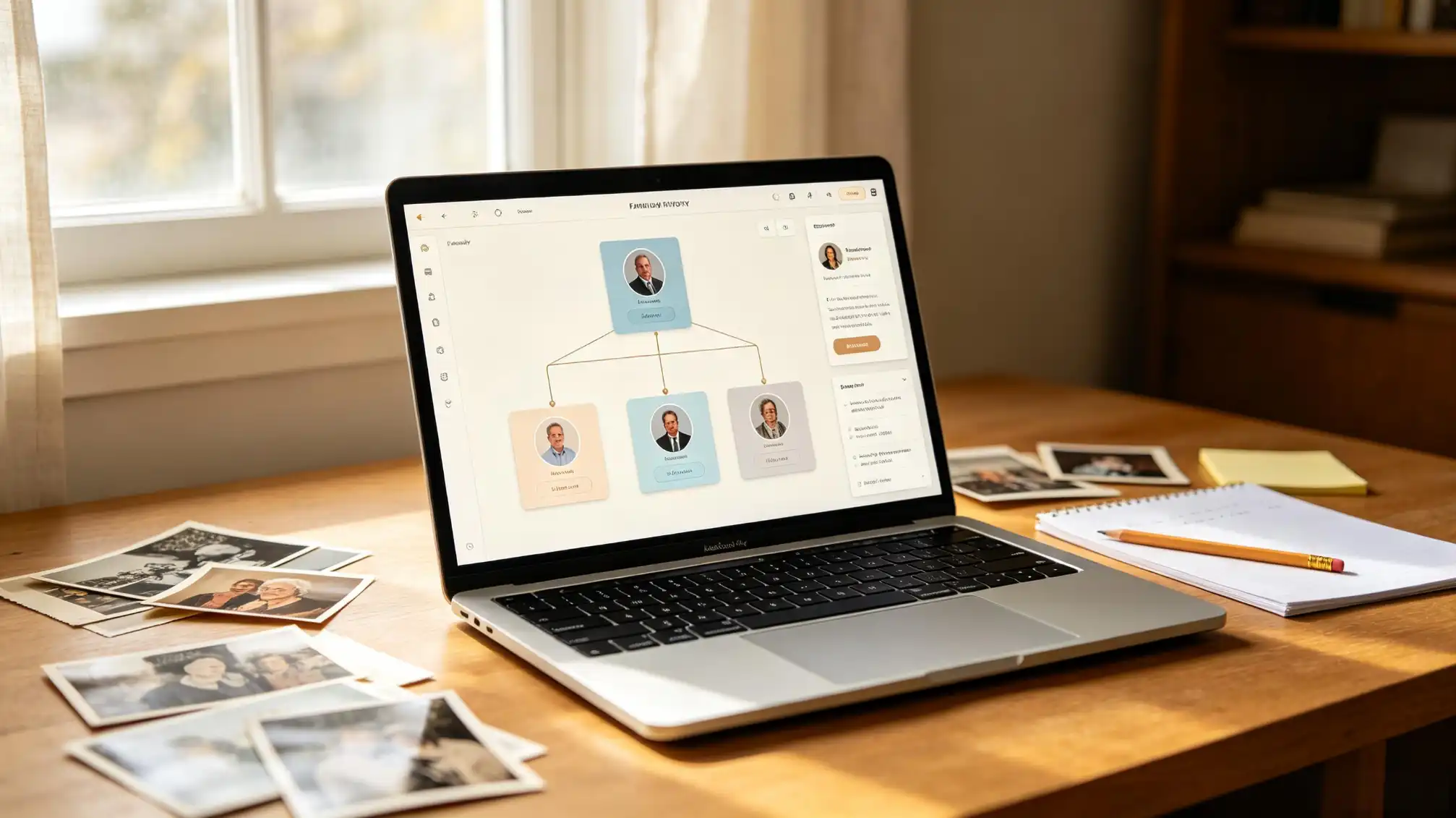
Set aside one evening, open the tree on the family laptop, and let everyone fill in what they know. Cousins will correct each other. Someone will remember a great-aunt nobody has mentioned in twenty years. That conversation is the work — you're not just recording your family history, you're actively recovering it.
A Ten-Minute Ritual Beats a Big Project
Big archiving projects fail because they need a free weekend that never comes. Small rituals survive because they fit inside a normal Tuesday.
Pick one evening a month — Sunday dinner works beautifully — and give it three questions: Who has a new photo? What did we find in the old pile? Who should we call and ask about it? Ten minutes, once a month, and your shared space keeps filling itself.
Rotate the job of host. When the teenager runs the session, the memories stop feeling like history and start feeling like theirs.
Turn Photos Into Stories Worth Retelling
Photos hold moments. Stories hold meaning. The families who keep their memories longest are the ones who write a few sentences next to the pictures — the sound of someone's laugh, the argument in the parking lot, why that ordinary afternoon is the one everyone still brings up.
Writing them down is easier when there's a natural home for them, and recording a story takes far less time than you'd expect. When your family is ready to add the words alongside the pictures, a good place to start is sharing them on family stories, where a short written memory can sit beside the photo that inspired it. Do that for a handful of pictures and you've quietly built something your family will read for decades.
Give Every Generation a Job
Shared spaces die when one person carries them alone. Distribute the work by strength:
- Grandparents: names, dates, and the stories behind the faces.
- Parents: scanning, uploading, and keeping the structure tidy.
- Teenagers: digitising, editing, and finding the funny stuff nobody else noticed.
- Kids: asking the questions. Their curiosity pulls out memories adults forgot they had.
When everyone owns a piece, no single loss — a move, a divorce, a death — can take the whole collection with it.
Protect It Like It Matters
Keep two digital copies in two different places, and keep the physical originals somewhere dry and away from sunlight. Label the boxes. Tell two people where everything lives. This is the least romantic part of preserving family memories and the only part that guarantees they'll still be there in thirty years.
Then close the laptop, put the albums back on the shelf, and go ask your mother about the burnt cake. The best family archive is still the one that starts with a conversation.