Grandparents Family History: Turning Sunday Chats Into Stories You Can Keep
Most families don't lose their history in a fire. They lose it slowly, in small gaps — the name of a great-aunt nobody wrote down, the reason one branch of the family left a town and never went back, the recipe that came from a grandmother whose voice you can still hear but whose story you never quite asked about. The good news is that grandparents family history is rarely locked inside an archive. It is usually sitting across the kitchen table, waiting for someone to ask.
This guide is for families collecting oral history while there is still time, and still energy, for it. Not a rigid interrogation. Not a genealogy project that swallows entire weekends. Just a warm, repeatable way to turn ordinary visits into family stories you can actually keep.
Start With a Memory, Not a Date
Genealogy forms want dates. Conversations don't work that way. If you open with "What year was Grandpa born?" you'll get a number, a shrug, or a correction. If you open with "What did your kitchen smell like when you were ten?", you'll get a doorway.
Sensory prompts do the heavy lifting in oral history because they pull memory out sideways, before the person has time to decide whether their answer is "important enough." Smells, songs, the walk to school, the sound of a radio in the background — these details are the scaffolding that names and dates later hang on. Once a grandparent is describing a room, they will happily tell you who was standing in it.
Set the Scene Before You Ask a Single Question
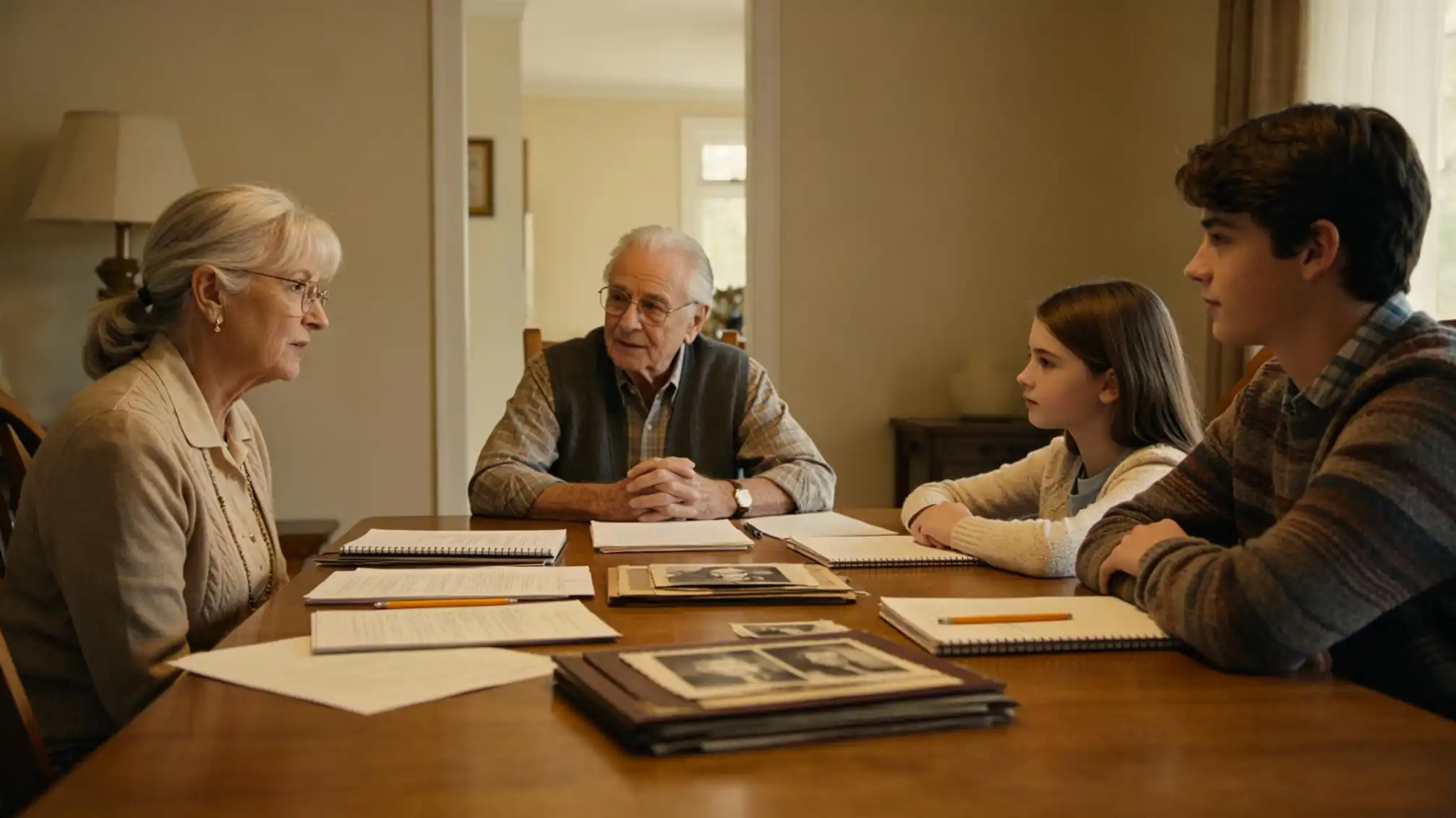
A memorable interview is mostly logistics. Before you press record, handle the practical bits so nobody has to think about them later:
- Ask permission first. "Would it be okay if I recorded us talking, just so I don't forget the details?" Almost everyone says yes, and nobody feels ambushed.
- Choose a quiet hour, not a big occasion. After a holiday meal is the worst time — everyone is tired and the room is loud. A slow weekday morning works far better.
- Record on your phone, simply. A voice memo app in your pocket beats an elaborate setup you'll never use twice. Put the phone slightly off to the side so it isn't staring at them.
- Keep sessions to 30–45 minutes. Memory tires. Two short visits will give you more than one marathon.
- Invite, don't interrogate. If they wave a question away, let it go and come back another day.
Warm-Up Family History Questions That Don't Feel Like Homework
Begin somewhere light. These are the questions that get the tape rolling and often produce the most quotable lines:
- What did your street sound like on a summer evening?
- Who was the best cook in the family, and what did they make?
- What was your first job, and what did you spend the first paycheck on?
- What music did you play over and over as a teenager?
- What was a treat for you as a child that would seem ordinary now?
Notice that none of these ask for a year. They ask for a world.
Questions That Go Deeper Into Relatives and Real Life
Once the conversation is warm, you can move toward the material you'll want years from now. Group your questions loosely rather than reading from a list — the goal is a story, not a survey.
About relatives and the shape of the family
- Who in the family did you feel closest to, and why?
- What do people in our family always seem to do, no matter the generation?
- Was there a relative everyone talked about? What was the story they told?
- Who in the family was misunderstood, and what did you understand about them that others didn't?
- What's a family habit or saying that came from someone specific?
About home, work, and ordinary days
- Describe the home you grew up in, room by room, if you can.
- What did a normal Saturday look like for your family?
- How did your parents earn a living, and did that shape your childhood?
- What did you learn to do because no one else would do it?
- What did you believe your life would look like by now?
About the harder chapters
Go gently here. Hard questions are best asked when trust is already built, and it is completely fine to say, "You don't have to answer this one."
- What was the hardest year you remember, and how did the family get through it?
- Was there something you wanted that you never got the chance to do?
- What do you wish your own parents had told you?
- What do you hope our family never forgets?
Listen More Than You Ask
The most common mistake families make is correcting. A date is wrong, a name is muddled, and someone jumps in to fix it — and the story stops flowing. Resist. Write down your questions for later; let the memory move at its own pace.
Three phrases will carry you through an entire afternoon: "Tell me more about that." "What happened next?" and "What was that like for you?" Silence is also a tool. If you wait three extra seconds after an answer, people almost always add the detail you were hoping for.
And follow the tangents. When a grandparent suddenly starts talking about a neighbour, a dog, or a bus route that has nothing to do with your question, that is usually the real story surfacing on its own.
Turn the Recording Into Something the Family Can Hold
A voice memo buried in your phone is not yet family history. Within a day or two, name the file properly, add a sentence or two about who was speaking and what year it was, and — most importantly — write down the three or four best lines while you still remember the tone of voice behind them.
This is also where the collection becomes something the whole family shares. Posting a short excerpt, a photo of the person who told it, and a line of context is how a private chat turns into a piece of family history that cousins and grandchildren can read years from now. You can browse examples and share your own on the family stories page, which is a natural home for the memories you gather.
Keep going, too. One recording becomes two, and two become a small archive. The families who end up with a real oral history are almost never the ones with the best equipment — they are simply the ones who asked again the following month.