{
"title": "Grandparents Family History: How to Capture the Stories Behind the Names",
"metaTitle": "Grandparents Family History: Capture Stories That Last",
"metaDescription": "A warm, practical guide to collecting grandparents family history. Get the family history questions that unlock real memories, plus tips for recording family stories.",
"summary": "A practical, warm guide to gathering grandparents family history through relaxed conversation rather than interrogation. It covers why stories matter more than dates, how to set the scene, the family history questions that unlock real memories about childhood, relatives, work and turning points, how to record without making it feel like an interview, and what to do with the family stories once you have them.",
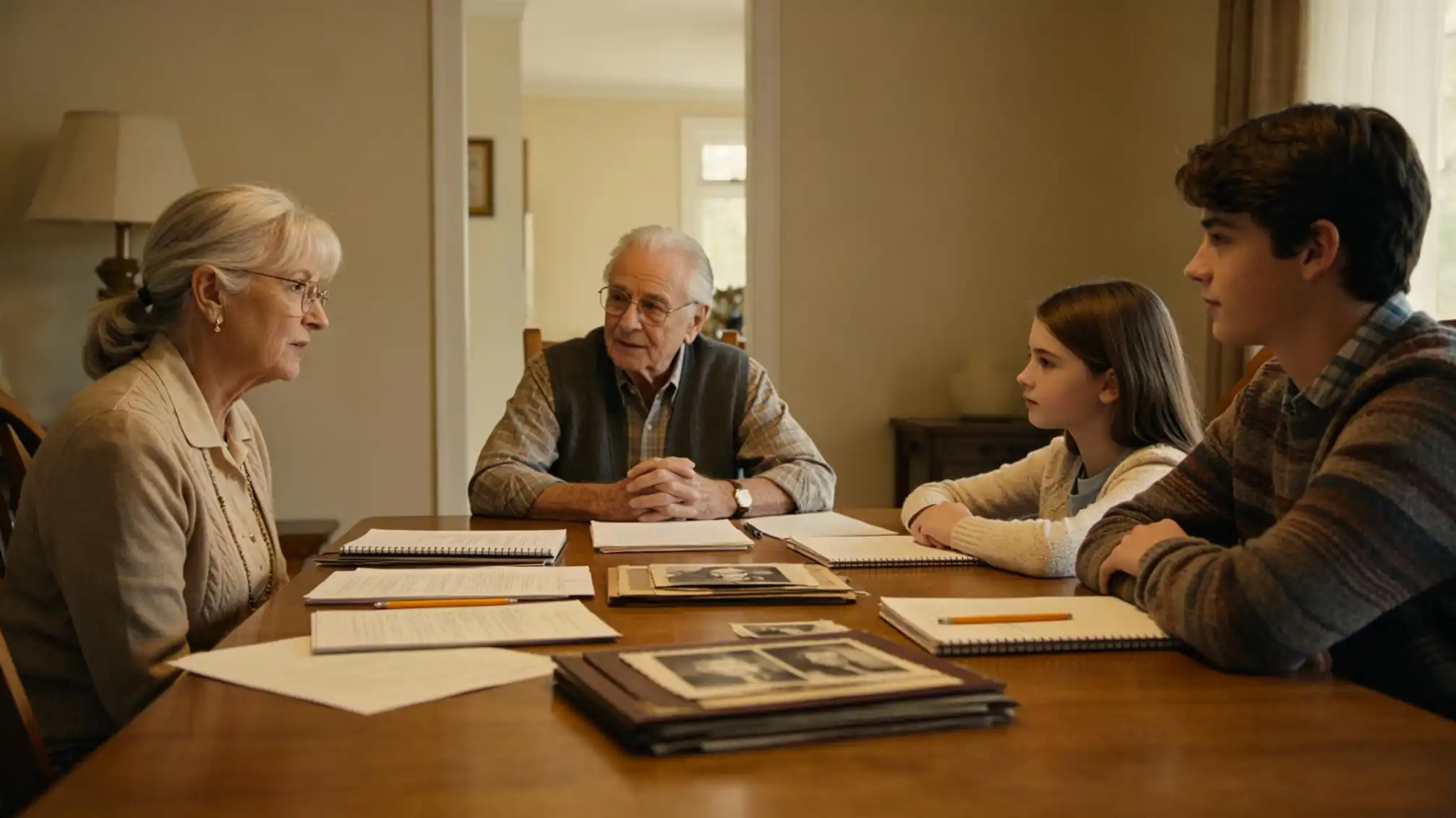
"contentHtml": "<h1>Grandparents Family History: How to Capture the Stories Behind the Names</h1>\n\n<p>Somewhere in your family there is a story about a grandfather who walked twelve miles to a first job, or a grandmother who kept a letter folded inside a sewing tin for fifty years. You may have heard a fragment of it at a holiday table. You probably meant to write it down. Then the plates got cleared, everyone went home, and the details blurred a little more.</p>\n\n<p>Collecting grandparents family history is less about completing a chart and more about catching those fragments before they drift. Names and dates matter, of course — but the texture is what your children and their children will ache for later. The sound of a voice. The reason a family left a town. The recipe nobody ever wrote down.</p>\n\n<p>What follows is a gentle, workable approach: how to set the scene, what to ask, how to listen without turning it into an interrogation, and what to do with the answers once you have them.</p>\n\n<figure>\n <img src=\"https://r2.familylove.love/static/seo/interviewscene3.webp\" alt=\"An older relative sharing family stories during a relaxed recorded conversation at home\" />\n <figcaption>A kitchen table, a cup of tea, and an open question are usually all it takes to begin collecting grandparents family history.</figcaption>\n</figure>\n\n<h2>Why the Stories Matter More Than the Dates</h2>\n\n<p>A birth certificate tells you that someone was born in 1934. It cannot tell you that the house was so cold the children slept in their coats, or that the family dog was named after a disliked neighbour as a private joke. That second kind of detail is what turns a list of names into a family.</p>\n\n<p>There is also a quieter benefit. Older relatives are often the only living bridge to a generation that never had a chance to explain itself. When you ask, you give them permission to be the expert on their own life — and many people who seem reluctant at first simply have never been asked properly.</p>\n\n<h2>Set the Scene Before You Ask Anything</h2>\n\n<p>Family history questions land badly when they arrive out of nowhere, notebook in hand, like a form to be filled in. Set the scene instead:</p>\n\n<ul>\n <li>Choose a familiar, unrushed moment — after a meal, during a drive, while sorting old photographs.</li>\n <li>Ask one question, then stop talking. Silence is not awkward here; it is where memory catches up.</li>\n <li>Bring an object. A photo, a ring, an old tool. Objects pull memories out faster than questions do.</li>\n <li>Keep sessions short. Thirty focused minutes beats two exhausting hours.</li>\n <li>Ask permission before recording, and explain simply why you want to.</li>\n</ul>\n\n<h2>Family History Questions That Open Real Memories</h2>\n\n<p>The trick is to ask about moments, not summaries. \"Tell me about your childhood\" invites a shrug. \"What did your street sound like in the morning?\" invites a scene.</p>\n\n<h3>Beginnings: childhood, home and everyday life</h3>\n\n<ul>\n <li>Where exactly did you sleep as a child, and who else was in the room?</li>\n <li>What was the first meal you remember cooking, or being taught to cook?</li>\n <li>What did you do for fun that cost nothing?</li>\n <li>What did your parents say when they were worried but didn't want you to know?</li>\n</ul>\n\n<h3>The relatives you never met</h3>\n\n<p>This is where the richest material usually hides — the relatives who exist only as a name your grandparent says with a particular tone.</p>\n\n<ul>\n <li>Who in the family made everyone laugh, and what did they do?</li>\n <li>Who was difficult, and why did people forgive them?</li>\n <li>Which relative did you feel closest to, and what did they teach you?</li>\n <li>Was there anyone the family stopped speaking to? What happened?</li>\n</ul>\n\n<h3>Work, love and turning points</h3>\n\n<ul>\n <li>What was your first job, and what did the money go towards?</li>\n <li>How did you meet the person you married, and what did you notice first?</li>\n <li>What is the biggest decision you ever made, and how long did you think about it?</li>\n <li>What year changed everything for you?</li>\n</ul>\n\n<h3>What they want remembered</h3>\n\n<p>Finish gently. These questions often produce the most quotable lines of all:</p>\n\n<ul>\n <li>What do you hope we still do as a family in fifty years?</li>\n <li>What do people get wrong about the way you grew up?</li>\n <li>If you could tell your great-grandchildren one thing, what would it be?</li>\n</ul>\n\n<h2>Record Without Making It Feel Like an Interview</h2>\n\n<p>A phone recorder on the table is fine. A tripod and a list of forty questions is not. The best recordings feel like eavesdropping on a conversation.</p>\n\n<p>Four practical habits help. First, repeat back what you hear — \"so you'd have been about nine when the shop closed?\" — which confirms details and invites correction. Second, write down names and places as you go, spelling them aloud, because that is exactly where future searching gets stuck. Third, ask \"what happened next?\" more than any other phrase; it keeps the thread moving without steering it. Fourth, note the tangents. The story about a neighbour's dog is often more useful ten years from now than the date were chasing.</p>\n\n<h2>Turning Conversations Into Family Stories</h2>\n\n<p>Raw recordings are fragile — they live on a phone, or in a drawer of cassettes nobody can play. Once you have a couple of hours of material, spend twenty minutes doing three things: label the files with names and dates, write a short summary of each conversation, and mark the three moments you would want to read again.</p>\n\n<p>Then give them a home. You can publish and preserve what you have gathered on a shared family page, so cousins and relatives can add corrections, photographs and their own memories. That is where the process stops being an archive task and becomes something the family actually reads — the kind of shared <a href=\"https://wwwamilylove.love/stories\">family stories</a> collection that grows every time someone new contributes.</p>\n\n<h2>When the Answers Are Hard to Hear</h2>\n\n<p>Not every memory is warm. Illness, migration, money trouble, estrangement and loss often sit close to the surface, and some relatives will not want to go there — or will there unexpectedly and then need to stop.</p>\n\n<p>Follow their lead. If they pause, do not fill the with a brighter question. Say something simple like, \"that sounds like it was very hard,\" and let them decide whether to. You can also offer to turn the recorder off. What matters is that the conversation stays theirs; the material is a gift, not a right.</p>\n\n<h1>Practical Steps</h1>\n\n<ul>\n <li><strong>Start your shared record:</strong> gather what you already have — photos, voice notes, half-remembered details — and publish it on a <a href=\"https://www.familylove.love/stories\">family stories</a> page so relatives can add their own memories and corrections while your grandparents are still around to confirm them.</li>\ <li><strong>Get help and guidance:</strong> for templates, recording tips and advice on preserving oral history safely, visit <a href=\"https://www.flove.love/docs\">https://.familylove.love/docsa> before your next conversation.</lin</ul>",
"images": [
"https://r2.familylove.love/static/seo/interviewscene3.webp"
]
}