Tracing Your Ancestors: A Practical Roadmap from Living Memory to the Archive
Most people begin looking for their ancestors with one name and a vague sense of a place. What separates a search that stalls after two weeks from research that reaches back five generations is rarely luck. It is sequence. You move from the known to the unknown, from the recent to the distant, and you record every finding so the trail behind you stays intact for the next person.
That sequence is what this guide sets out. Work through it in order and you will spend far less time chasing the wrong John Smith.
Start with the living, not the dead
The most accurate and cheapest source of family history is sitting in your relatives' kitchens. Before you pay for a single subscription, interview the oldest people in your family. Do it now, because this source has an expiry date.
Ask for specifics, not stories. A useful interview gathers:
- Full names, including women's maiden names — these are the single most common brick wall in genealogy.
- Places of birth, marriage, and death, as precisely as the person can manage (town, not just county).
- Occupations, which often point directly to the records that will name a father.
- Religious denomination, which determines whether you search parish registers, nonconformist registers, or both.
- Siblings, who matter because one sibling's record often names the parents that your direct ancestor's record omits.
- Migrations and dates — when did the family move, and why.
Record the conversation if your relative agrees. Write up your notes the same day, separating what they witnessed from what they were told. Family memory is valuable but it drifts, and unattributed recollection will mislead you later.
Build a working family tree before you search archives
Create a tree that holds what you have actually confirmed, not what you hope is true. A working tree is a research tool, not a monument. Keep two clear states for every fact: confirmed by a document, or unverified. Every unverified claim should carry a note explaining where it came from.
Be strict about place names
Record places as they were called at the time of the event, then add the modern equivalent in brackets. Borders move. A village that was in one county in 1850 may sit in another today, and the records went with the historic administration, not the modern one.
Work one generation at a time
The temptation is to jump to a famous ancestor or a distant country. Resist it. Confirm a parent-child link with a document before you go looking for that parent's own parents. Skipping generations is how people end up with an elaborate tree built on someone else's mistake.
Collect the documents already in the house
Before any archive, search your own family. Certificates, baptism cards, military discharge papers, union cards, letters, address books, and above all photographs are often still in a drawer somewhere. These are primary sources with the enormous advantage of being free.
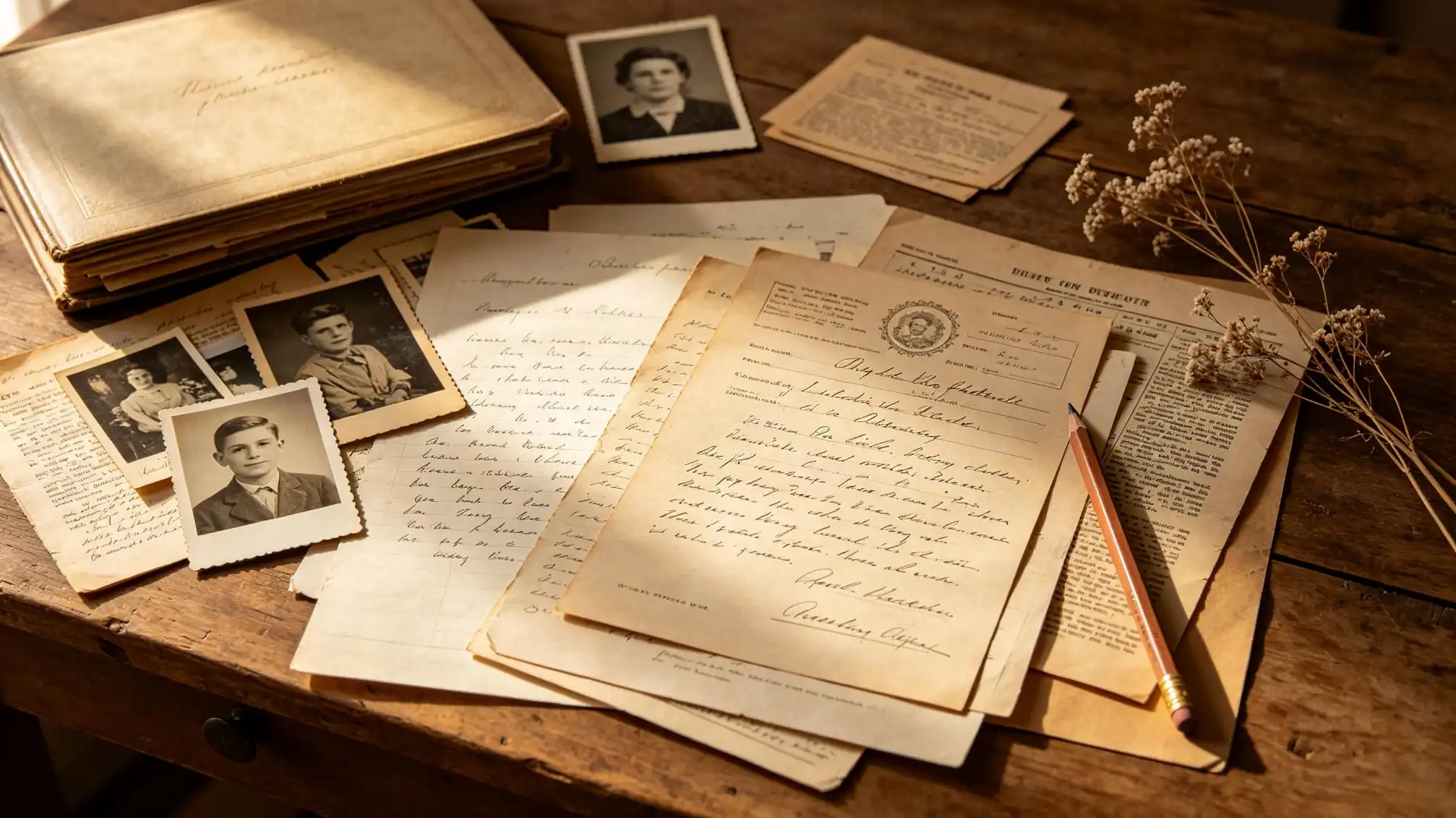
Scan everything at a high resolution and, crucially, ask a living relative to identify the people in each image. An unnamed photograph is a puzzle; a named one is evidence. Note the photographer's name and address printed on the mount — that alone can place a family in a town and a decade.
Climb the documentary ladder, rung by rung
Once family sources are exhausted, move to public records in a fixed order. Each rung gives you enough detail to attempt the next one.
Civil registration
Government-issued birth, marriage, and death certificates are the backbone of modern genealogy. They typically give names, dates, places, occupations, and — on marriage and death records — parents' names. Start here whenever the events fall within the period your country registered them.
Census and household records
A census places a whole family in one house on one night, which lets you confirm sibling groups and track movement between decades. Follow a family forward and backward through each available census before you move to earlier records.
Parish and church registers
Before civil registration, baptism, marriage, and burial registers are usually the only continuous record. They are handwritten in older scripts and often in Latin or a regional language. Read the register's opening pages first — they explain the format and any gaps.
Land, tax, probate, and military records
These fill gaps and add colour. A will can name children you never suspected existed. A tax list can place a family in a parish a decade before the registers begin.
Expect the three walls
Nearly every researcher hits the same three obstacles, and each has a standard response.
- Spelling. Names were written as they sounded by clerks who had no reason to be consistent. Search phonetic variants, then search by first name and place alone.
- Borders and jurisdictions. A record may be held in a neighbouring county, a diocese, or a national archive. Check where the records were kept, not where the family lived.
- Gaps. Registers burn, floods happen, and censuses have missing pages. When a record is genuinely lost, reconstruct the family from siblings, neighbours, and witnesses named on other documents.
Use DNA and online trees as tools, not verdicts
DNA testing is excellent at confirming a suspected relationship or pointing to an unknown region. It is poor at naming an ancestor on its own. Treat a match as a research lead: build a tree for the match, find the shared couple, and document the connection before you add it to your own tree.
Public trees are the same. Another researcher's tree is a hypothesis, not a source. Always ask for the underlying document.
Write it up, or it did not happen
Research that lives only in your head or in an unstructured folder dies with your attention span. Write short narratives for each family — who they were, where they lived, what they did — and attach the documents that support each claim. This is also the moment to preserve the stories that records cannot capture. You can publish and keep those narratives on a dedicated page such as FamilyLove Stories, which gives relatives a place to read and add to what you have found.
Finally, cite everything. A date without a source is a rumour, and the person who inherits your research will thank you for the difference.