Family History Questions That Open Doors: A Practical Guide for Interviewing Parents and Grandparents
You don't need a genealogy degree or a professional microphone to capture your family's past. You need a quiet hour, a cup of tea, and questions that invite storytelling instead of interrogation. The difference between an awkward interview and one that your grandchildren will treasure comes down to how you ask.
Most people start with facts: birth dates, wedding years, job titles. Those answers fit neatly on a chart, but they leave out everything that makes a relative worth listening to. The best family history questions are open, sensory, and a little bit brave. Below is a working set you can use this weekend, arranged in the order a real conversation usually flows.
Why Most Interviews Stall in the First Five Minutes
"When were you born?" produces a date. "What did the house you grew up in smell like in winter?" produces a scene. Closed questions get short answers and then silence, which makes everyone uncomfortable. Open questions give your relative somewhere to walk, and they usually take the conversation somewhere you didn't expect.
Your goal isn't to extract a full biography in one sitting. It's to collect a handful of vivid moments and enough detail to come back and ask better questions later.
Warm-Up Questions That Loosen the Room
Start easy. These are low-stakes questions that get your relative talking about themselves without feeling exposed.
- What's the first memory you have, the earliest one you can still picture?
- Who was your best friend growing up, and what did the two of you get up to?
- What was your favourite meal as a child, and who made it?
- What did you want to be when you grew up, before anyone told you what was realistic?
Notice how none of these require dates. They require images. That's the point.
Childhood and Place: Questions That Rebuild a World
This is where grandparents come alive. Place-based questions pull out details that photographs can't show — sounds, routines, neighbourhood characters, the small economics of daily life.
- Walk me through the house you grew up in, room by room. Which room did everyone gather in?
- What did your street or neighbourhood look like then? Who lived next door?
- What were the jobs you had around the house, and who assigned them?
- What was school like — the building, the teachers, the walk there?
- Was there a family rule you hated at the time but understand now?
- What did your parents argue about, if they argued at all?
That last one often gets a laugh, then a real answer. Permission to be honest about ordinary friction is what separates a family history from a highlight reel.
Work, Money, and Hard Seasons
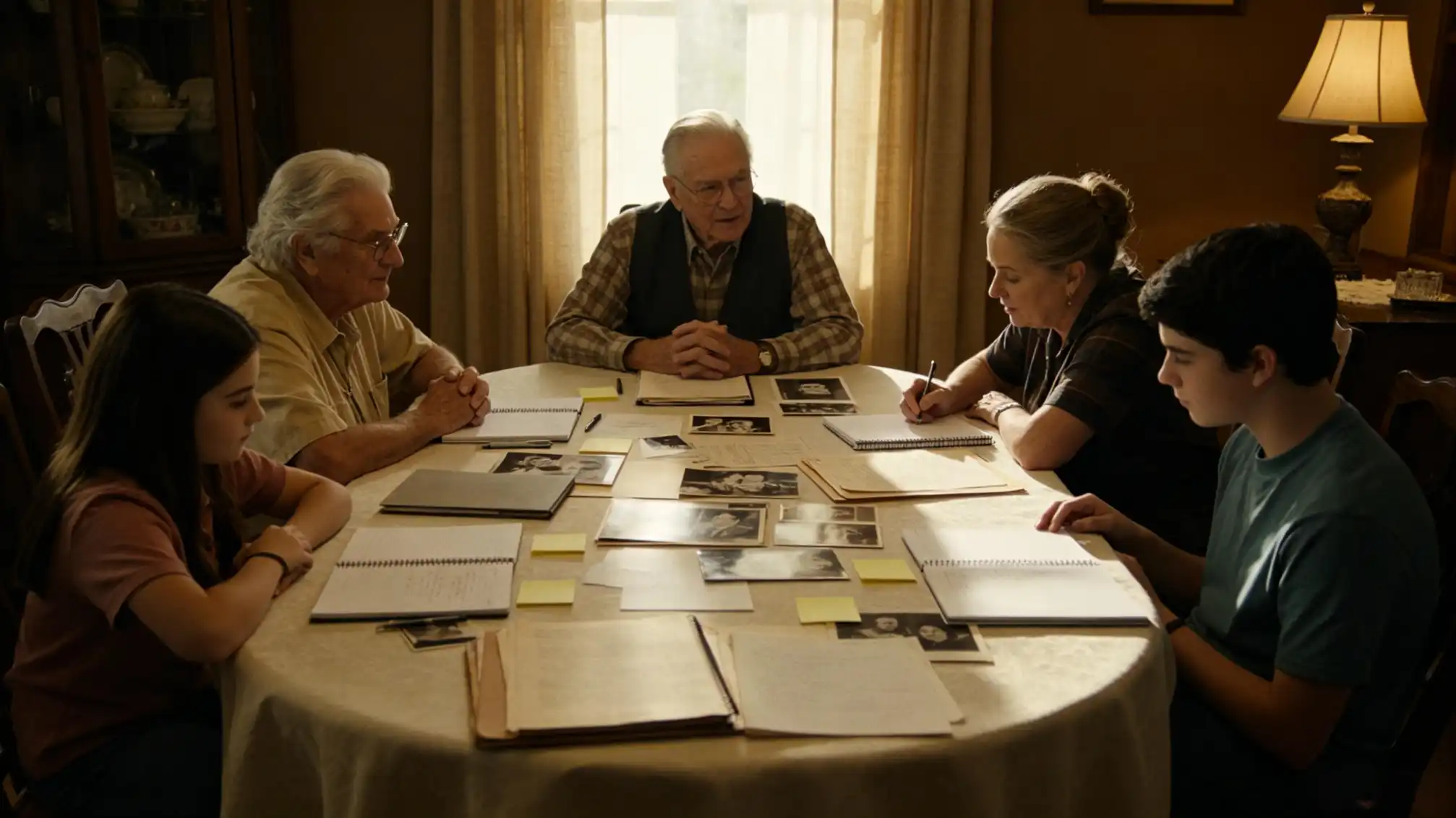
Money and hardship explain more about family decisions than almost anything else, yet they're rarely discussed. Ask with respect and no pressure to answer.
- What was your first paid job, and what did you do with the money?
- Was money tight when you were young? How did the household manage it?
- What was the hardest year of your life, and how did you get through it?
- Did anyone in the family lose a job, a farm, or a business? What happened next?
- What did you learn about money that you tried to pass on — or deliberately didn't?
If your relative deflects, let it go and return another day. Some doors open on the third knock, not the first.
Love, Marriage, and Family Patterns
These questions reveal the relationship culture your family inherited, which is often the most useful thing to understand about yourself.
- How did you meet my grandmother/grandfather? What was the first thing you noticed?
- What did your parents' marriage look like from the inside?
- Who in the family was the peacemaker, and who was the one everyone worried about?
- What advice about marriage or parenting did you ignore — and were you right to?
- What do you wish someone had told you before you started a family?
Questions for the Stories Nobody Volunteers
Every family has a quiet chapter: a death, a falling-out, a migration, a name that isn't mentioned. Approach these last, once trust is established, and always offer an exit.
- Is there a story about our family that people stopped telling? I'd like to understand it.
- Who in the family do you miss most, and what do you remember about them?
- Was there a moment when you had to choose between family and something else?
- What do you hope we remember about you?
That final question is the one that most often produces tears — and the paragraph people quote at funerals. Ask it.
The Follow-Up Moves That Turn Answers Into Stories
Great interviewers aren't the ones with the longest question list. They're the ones who know what to say next. Keep three prompts in your pocket:
- "What happened next?" — pushes past the summary into the sequence of events.
- "What did that feel like at the time?" — adds emotion and colour, which is what makes a memory stick.
- "Who else was there, and what did they say?" — brings other relatives into the frame and opens new threads to follow.
Then stay quiet. A pause of five seconds often produces the sentence your relative was deciding whether to say.
Recording, Notes, and What to Do With It All
Ask permission before you record, and explain simply why: it's easier to listen when you're not scribbling. A phone on the table works fine. Afterwards, write a one-page summary while it's fresh — names, places, dates, and the two or three stories worth retelling.
The most common regret people share is not the quality of the audio, but that they never did anything with it. If you'd like a place to turn a recording into something relatives can actually read, browse the family stories collection and use it as a model for writing up your own.
Common Mistakes to Avoid
- Correcting your relative's memory. Their version of events is the point.
- Asking ten questions at once and letting them answer only the easiest.
- Interviewing only in a group. Relatives edit themselves when siblings are listening.
- Waiting for the perfect moment. The best time to ask your grandparents anything is soon.
Pick five questions, set aside forty minutes, and start with your oldest relative. You will not regret it, and you will be surprised how quickly a list of questions becomes a story you didn't know you were part of.