Tracing Your Ancestors: A Practical Roadmap From Family Memory to Old Records
Most people begin by typing a name into a search box and end up with a confusing pile of near-matches. Researchers who succeed do the opposite: they work backwards from what they can prove, in a fixed order, and only then reach for the archives. What follows is that order — a method for anyone investigating older generations of their family, and for turning scattered clues into a family history you can actually defend.
Start With Living Memory, Not With Databases
The fastest, cheapest and most accurate source of information about your ancestors is usually the oldest relative willing to sit down with you. An hour of conversation can save you months of guessing at spelling variations and birth years.
Interview before you search
- Ask for full names, including the maiden names of every woman in the line — these are the single most common blocker in genealogy.
- Record places, not just dates: a village, a street, a farm name or a church parish is often more useful than a birth year.
- Ask about occupations, military service, migration and any family scandal. Unusual details are easy to trace; common names are not.
- Request copies of anything held at home: certificates, letters, service papers, address books, funeral cards, bibles.
- Ask who else in the family has already researched the line, and whether they kept notes.
Photographs are evidence, not decoration
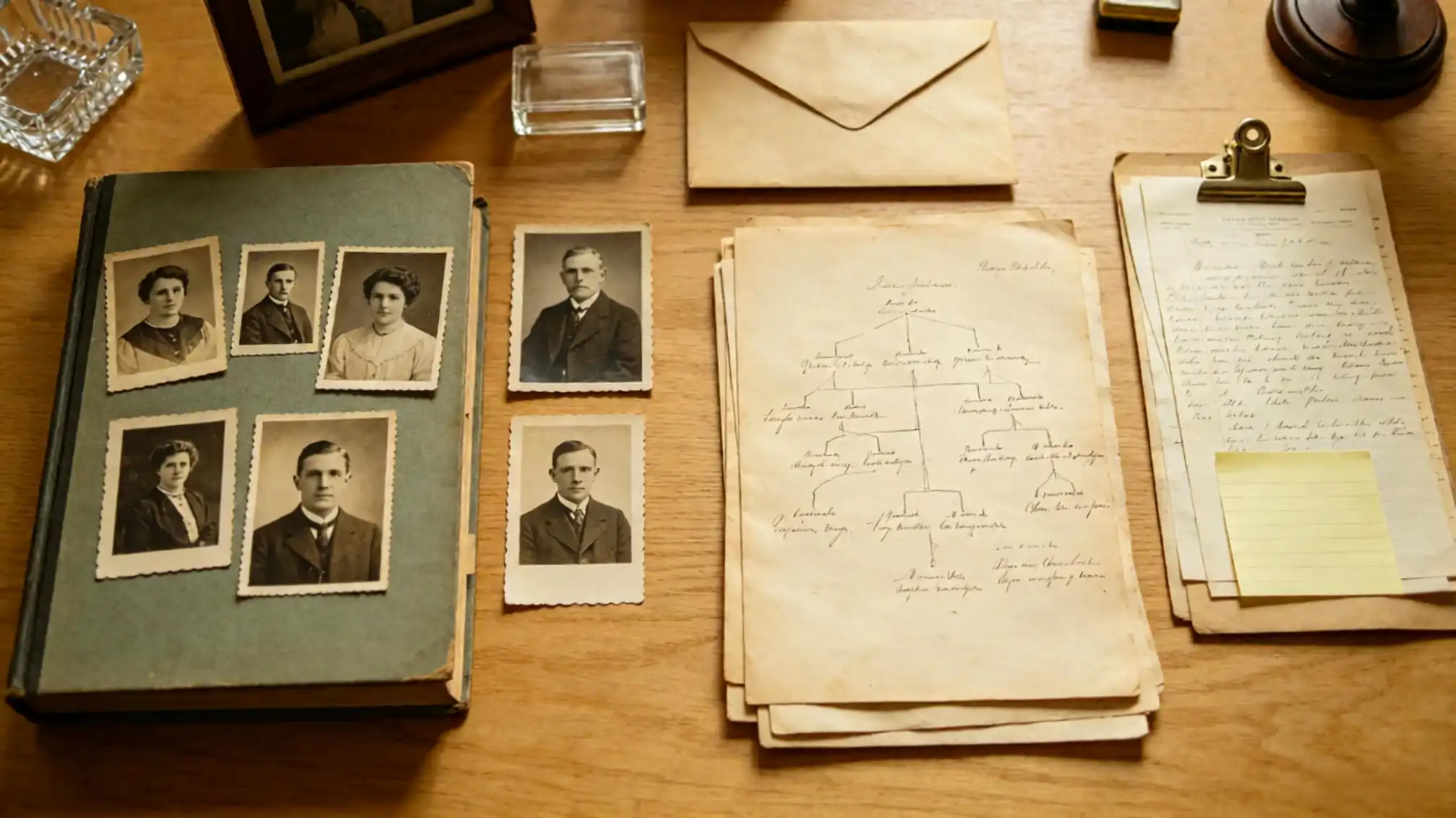
Before you interview anyone, gather the photographs. Turn each one over. Studio stamps, photographer addresses, dates and pencilled names on the back frequently identify a branch that written records alone cannot. Photograph both sides at high resolution, label the digital files with the names you can confirm, and mark anything uncertain as unconfirmed rather than guessing. If an image is unidentified, show it to several relatives separately — independent agreement is stronger evidence than one confident claim.
Build a Working Family Tree Before You Go Further
A working tree is not a finished product; it is a control document. Enter only what you can attribute to a source, and mark everything else clearly as unproven. Keep four core fields consistent for every person: full name as recorded, date and place of birth, date and place of marriage, date and place of death. Where you lack a date, write unknown rather than leaving the field blank — a blank field gets forgotten, a marked gap gets researched.
Two rules prevent most beginner errors. First, never merge two people with the same name until a document proves they are the same person. Second, never attach a parent to a child on the basis of surname alone, especially before the nineteenth century, when naming patterns were regional rather than fixed.
Climb the Record Ladder in Order
Records become harder to interpret the further back you go, so work from the most reliable to the least. For each ancestor, exhaust the lower rungs before climbing.
- Civil registration — birth, marriage and death certificates give parents' names, addresses and occupations, and usually confirm the previous generation outright.
- Census returns — household lists place a family together on one night and reveal ages, birthplaces, occupations and siblings.
- Church registers — baptisms, marriages and burials predate civil registration and often extend the line by a century or more.
- Wills and probate — these name relationships explicitly and can resolve disputes that no other record addresses.
- Military and immigration files — service records and passenger lists confirm movement between places and sometimes include a physical description.
- Newspapers, directories and land records — useful for filling gaps, confirming addresses and adding context to a life.
Expect Names to Be Spelled Differently
Your ancestors rarely wrote their own names down. A clerk or priest wrote what they heard, so phonetic spellings, translations and abbreviations are normal rather than exceptional. Search variants deliberately: swap vowels, drop silent letters, try the initial only, and test both anglicised and original forms. A family can appear under three different spellings in three consecutive records and still be the same household.
First names are equally unstable. People were baptised under one name and known by another; stepchildren sometimes took a stepfather's surname; middle names were often a grandmother's maiden name. When a search returns nothing, assume the spelling is wrong before assuming the record does not exist.
Follow the Place, Not Just the Surname
Surnames are shared by thousands of unrelated people. Places are far more selective. Once you know a parish, a town or even a street, your search becomes dramatically more efficient. Plot every address you find on a map and look for patterns: families often moved only a few miles per generation, following work in mining, weaving, farming or the docks. Understanding local industry tells you where records were kept and why a family left.
Migration is also a research tool. If an ancestor vanishes from one parish, check the nearest market town, the nearest port, and the places older siblings had already moved to. People rarely relocate to somewhere they know nobody.
Use Cluster Research to Break Brick Walls
When a direct line stalls, stop searching for that person and research everyone around them: siblings, cousins, in-laws, neighbours, witnesses on marriage certificates, and the people buried in adjacent graves. These associates usually left records your ancestor did not, and their documents frequently name the relationship you are missing. Witness names on a marriage entry, in particular, are one of the most underused clues in genealogy.
Keep a Research Log
Record every search you run, including the ones that failed. Note the collection, the date you checked it, the search terms used and the result. This prevents the slow, demoralising habit of repeating identical searches years later, and it lets you see which sources have genuinely been exhausted and which have only been skimmed.
Preserve and Share What You Recover
A family history locked in one person's software is fragile. Write up each generation in plain language while the details are fresh, attach your sources, and publish the stories so other relatives — and future researchers working the same line — can find and correct them. Family history is most accurate when more than one person can verify it.