Genealogy for Newcomers: Build a Family Tree You Can Trust
Beginning genealogy can feel like standing at the entrance of a vast archive with no map and no guide. There are databases to learn, records to request, and family stories that may or may not match the paperwork. The good news is that you do not need to know everything before you start. You need a method. This guide walks you through a calm, repeatable approach to tracing your ancestors, from your first conversation with a relative to the moment you share a finished family tree with the next generation.
Why Genealogy Is About People, Not Just Names
Genealogy is the study of how you are related to the people who came before you. A family tree records names, dates, and relationships. Family history goes further: it asks what your ancestors did, where they moved, what they believed, and what challenges they faced. When the two work together, a list of names becomes a story you can pass on to children and grandchildren.
Keeping that distinction in mind helps you avoid the most common beginner trap: collecting names without checking whether they belong to the right person. Two men named John Miller born in the same county in the same decade are not automatically the same John Miller. Careful genealogy is patient, evidence-based, and genuinely curious. It rewards researchers who ask better questions rather than those who simply gather more names.
Begin with the Family You Already Know
The most valuable records are often not online. They live in your relatives' memories and in boxes in your own home. Start there before you subscribe to anything.
Talk to living relatives first
Ask open-ended questions rather than yes-or-no ones. Where did you grow up? What did your parents do for work? Did anyone in the family change their name? Record the conversation if you have permission, and take notes on places, nicknames, and maiden names. Those small details are often what make later searches succeed, because they give you the exact spelling or location a database needs.
Search your own home for clues
Birth and marriage certificates, photo albums, family bibles, military discharge papers, letters, and funeral cards can provide the exact dates and places you need. Scan what you find, label each file with a name and date, and store a backup copy somewhere safe. Resist the urge to reorganize everything at once. A simple folder for documents and another for photographs is enough to begin.
Build the Backbone of Your Family Tree
Before you go deep, set up a system that can grow with you. A little structure now prevents a great deal of confusion later.
Choose one home base for your research
Pick a single place where your master family tree lives: a reputable genealogy program, an online tree, or even a well-organized spreadsheet. Use other tools for notes and scans, but keep one master copy so you always know which version is current. Duplicate trees on different platforms inevitably drift apart.
Record names and places consistently
Use a woman's maiden name as her primary name and note married names separately. Write dates in one format throughout, such as 12 March 1898. Record place names as they existed at the time of the event, and add the modern equivalent in your notes if it helps you locate the area today.
Cite every source as you go
A citation answers four questions: who created the record, what it is, when it was created, and where you found it. Citing sources feels slow at first, but it lets you re-check a fact months later and gives your family tree credibility. An unsourced tree is only a guess, however confident it looks.
The Research Cycle: Ask, Find, Record, Verify
Experienced researchers repeat the same loop. Ask a specific question. Find a record that might answer it. Record what you learn. Then verify by finding a second, independent source that supports the same conclusion.
Work backward, one generation at a time
Start with yourself and move back to parents, grandparents, and great-grandparents. Birth, marriage, and death records, census returns, and church registers are the foundations of most family history research. Each record should connect to the next generation by name, date, and place. Skipping a generation usually creates more problems than it solves.
Use online databases with a clear question
Broad searches produce noise. Instead, search for one person with a narrow date range and a specific location. When you find an index entry, look for the original image if it is available, because transcription errors are common. If a record is not online, check local archives, libraries, and historical societies, many of which offer research assistance by email.
What to Do When Your Genealogy Hits a Wall
Every researcher eventually reaches a missing record or an ancestor who seems to appear from nowhere. This is normal, and it is usually a signal to change your approach rather than give up.
Research siblings, neighbors, and associates
Ancestors rarely moved alone. Tracing brothers, sisters, in-laws, and neighbors can reveal the birthplace or parents you are missing. This cluster approach is one of the most effective techniques in genealogy, because people appear in each other's records as witnesses, sponsors, and travel companions.
Keep a research log
Write down what you searched, where you searched, what you found, and what you plan to try next. A log stops you from repeating the same dead ends and helps you see patterns across records that would otherwise stay invisible.
Preserving Family History for the Next Generation
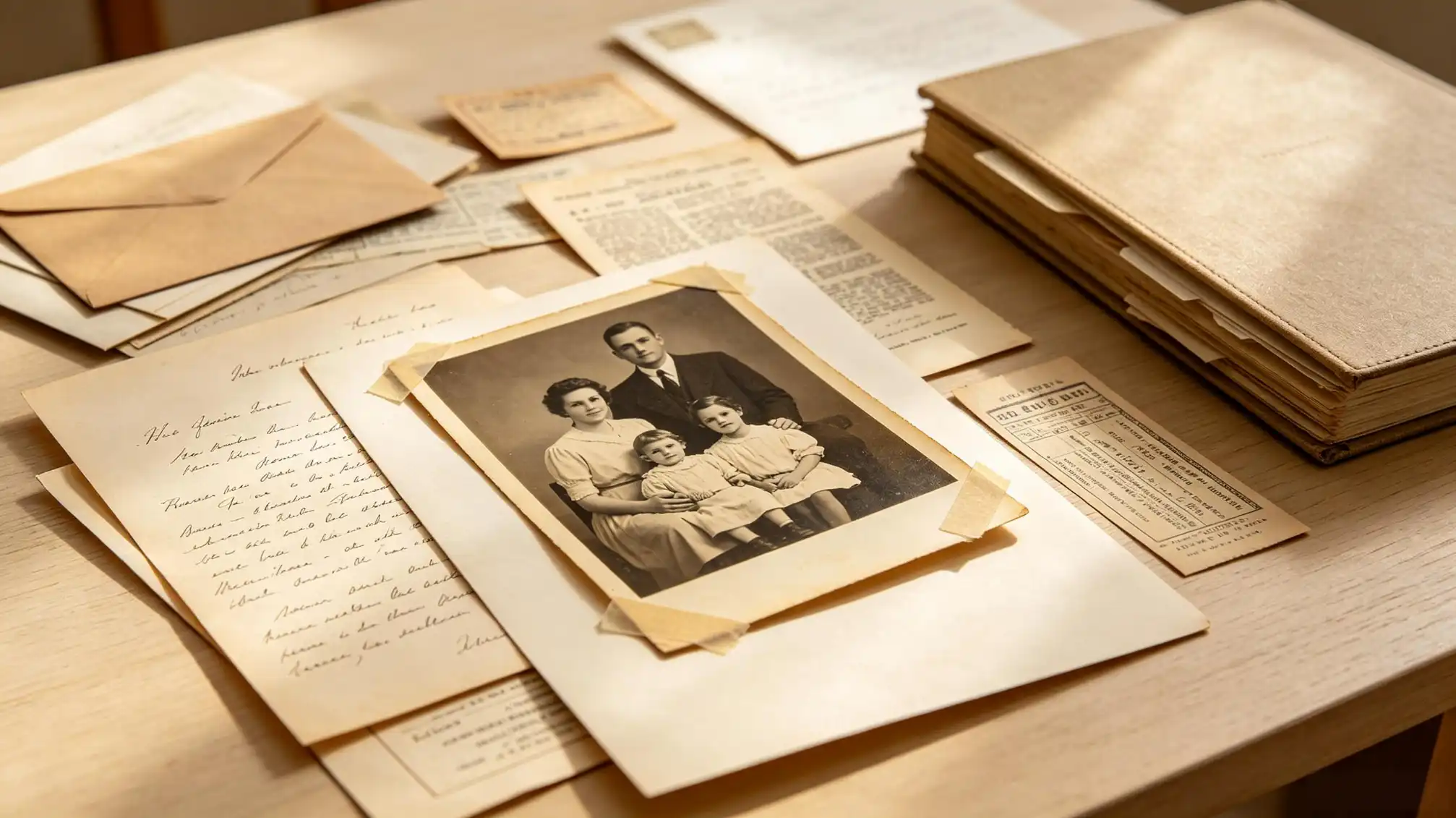
Research only matters if it survives. Scan photographs and documents at a high resolution, name the files clearly, and follow the 3-2-1 backup rule: three copies, on two types of media, with one stored off-site. Record older relatives telling their own stories while you still can, and write short summaries of what you have learned so that non-researchers in the family can follow along.
Sharing is part of preservation. When you are ready to turn your findings into something your relatives can actually enjoy, publishing them through FamilyLove Stories at https://www.familylove.love/stories gives your family a simple place to read, comment, and add their own memories alongside your research.