Genealogy Without Guesswork: A Beginner's Roadmap to Your Family Tree
Most people begin their genealogy journey the same way: they type a grandparent's name into a search box and hope a tidy tree appears. What they usually get instead is a list of near-matches, a subscription prompt, and more questions than answers. The good news is that dependable family history work rarely starts on a website. It starts on your own street, with the people who still remember the stories. What follows is a practical order of operations for your first months of research, so that every name you add to your family tree rests on evidence rather than assumption.
Begin With Living Memory Instead of Search Boxes
Your oldest living relatives are a primary source that no archive can replace, and they are available right now. Before they become a photograph on a shelf, they can tell you the nicknames nobody wrote down, the town that was renamed twice, and the reason one branch of the family stopped speaking to another.
Approach these conversations as interviews rather than chats. Ask open questions: What was your childhood home like? Who in the family was the storyteller? What was the first job you ever had? Record the answers if you have permission, and write down the date of the conversation. Then follow up with specifics: full names of parents and siblings, approximate birth years, places of birth, marriage, and death, and any military service or migration you hear mentioned.
One useful habit is to ask the same three questions of every relative you speak with. Where two people give the same answer independently, you have a strong lead. Where they disagree, you have found the exact spot where an ancestor needs documenting rather than guessing. Many families find that a shared space for writing these recollections down keeps momentum going long after the initial enthusiasm fades.
The Record Types That Answer Most Beginner Questions
Once you exhaust living memory, a handful of record groups will resolve the majority of your early questions. You do not need to master all of them at once.
- Vital records — birth, marriage, and death certificates. These establish names, dates, and parents, and they are usually held by the state or country where the event occurred.
- Census returns — household snapshots taken every ten years in many countries. They place your family tree in a specific house, occupation, and neighbourhood at a known moment.
- Immigration and naturalisation papers — ship manifests, border crossings, and citizenship files often reveal a village of origin, which is the single most valuable clue for research overseas.
- Religious records — baptisms, marriages, and burials kept by churches and parishes, frequently surviving where civil records were never kept or were destroyed.
- Cemetery and funeral records — headstones, plot registers, and obituaries that connect spouses, children, and maiden names in one document.
A simple rule keeps you efficient: work backwards one generation at a time, and confirm each link before moving to the next. Jumping straight to a famous surname or a distant century is the fastest way to attach the wrong family to your tree.
Give Your Family Tree a Structure That Scales
Choose one research tool early — a desktop programme, an online platform, or even a well-organised spreadsheet — and commit to it for at least a year. Scattered notes on envelopes are how research gets lost.
Adopt consistent conventions from day one. Enter names in the order the culture uses them, and record women under their maiden names wherever you can identify them. Write dates in a single unambiguous format, and always attach a place to every event, right down to the town or parish. When you are unsure of a detail, mark it clearly as uncertain rather than leaving an empty field; future you will thank present you for the honesty.
Every person in your tree should eventually have at least one source attached. A source can be a certificate number, a census page reference, or the date and name of the relative who told you the story. This one habit separates a real family history from a collection of plausible names.
Verify Before You Believe
Online trees are wonderful for hints and terrible as evidence. Anyone can copy anyone else's mistake, and a wrong parent can be duplicated thousands of times across a platform.
Treat every online tree, index, and transcription as a clue pointing you toward an original document, not as proof. When you do find an original record, read it in full rather than extracting just the name. Witnesses, informants, neighbours, and addresses on the same page often unlock the next generation. If two records conflict, note both and keep researching; do not silently choose the more convenient version.
It also helps to ask why a record exists. A death certificate is only as accurate as the grieving relative who supplied the details. A baptism entry may precede a birth record by days or follow it by years. Understanding the purpose of a document tells you how much weight to give it.
Organise and Preserve What You Gather
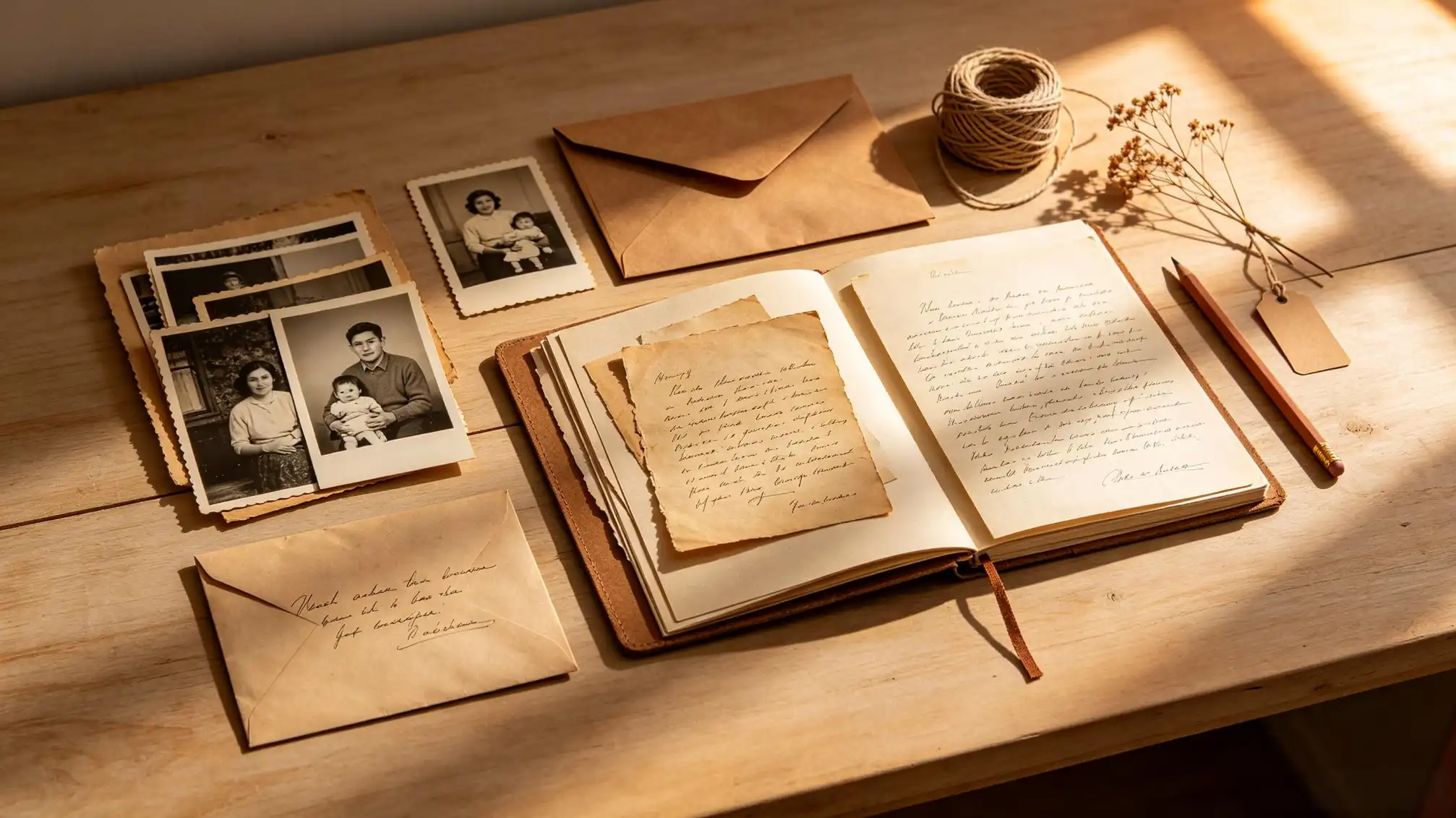
Research that cannot be found again is research you will repeat. Keep a simple filing system, whether digital folders named by surname and record type, or a physical binder divided by family line.
Scan photographs, letters, and certificates at a high resolution, and label each file with a meaningful name and date. Store one copy in the cloud and one on a separate drive. Record the stories that accompany the documents, too — the reason a family left a village, the trade handed down through three generations, the recipe nobody wrote down. Photographs without context lose most of their value within two generations.
Finally, share your findings rather than hoarding them. Publishing research invites corrections, reconnects distant cousins, and gives other researchers a chance to fill your gaps.
Mistakes That Slow Beginners Down
- Chasing every hint a platform offers instead of finishing one family line.
- Accepting an indexed transcription in place of the original record.
- Ignoring spelling variations, which were common and often phonetic.
- Forgetting to note where a fact came from, then having to redo the work.
- Waiting until every question is answered before writing anything down.
Genealogy rewards patience and consistency far more than clever searching. A steady hour each week, spent on one family and one question at a time, will build a tree that lasts.