Genealogy for Newcomers: How to Begin Your Family History with Confidence
Most people start researching their roots because of one stubborn question: who were these people I come from? A photograph with no caption, a surname nobody can explain, a grandmother who rarely spoke about her childhood. Genealogy is the practice of answering those questions with evidence rather than assumption — and you do not need a paid subscription, a history degree, or a perfect filing system to make real progress in your first month.
What follows is a calm, ordered route into family history work, written for people starting from zero. It is designed to help you avoid the two most common outcomes for new researchers: drowning in disorganised notes, or building an impressive-looking family tree that is quietly wrong.
Begin with the Living, Not the Records
New researchers tend to jump straight into online databases. Resist that urge. In your first few weeks, the richest source of information is a person sitting across from you or on the other end of a phone call. Living relatives carry names, nicknames, migration stories, and approximate dates that no archive will ever hold in quite that form.
Mine your own home first
Before you contact anyone, collect what already exists in your house. Family history usually begins in a drawer, not a database:
- Birth, marriage, and death certificates kept in folders or envelopes
- Family bibles, prayer books, and inscribed gifts
- Photo albums, slides, and sleeves of loose prints
- Military papers, union cards, and old passports
- Funeral cards and newspaper obituaries
Note what each item tells you and where you found it. Provenance — who owned the document and how it reached you — is often as useful as the document itself, because it tells you which branch of the family to trust and which to verify.
Interview relatives while you still can
Ask open questions rather than yes-or-no ones. "What was your mother like?" will give you far more than "Was your mother born in 1932?" Record the conversation if your relative agrees, and always note the date of the interview, because memories shift and you will want to know when a detail was shared.
Push gently for specifics: full names including middle names, maiden names, the towns people left and the towns they arrived in, occupations, religious affiliation, and the order of siblings. Nicknames are a particular trap — the "Aunt Peggy" everyone remembers may appear in every official record as Margaret.
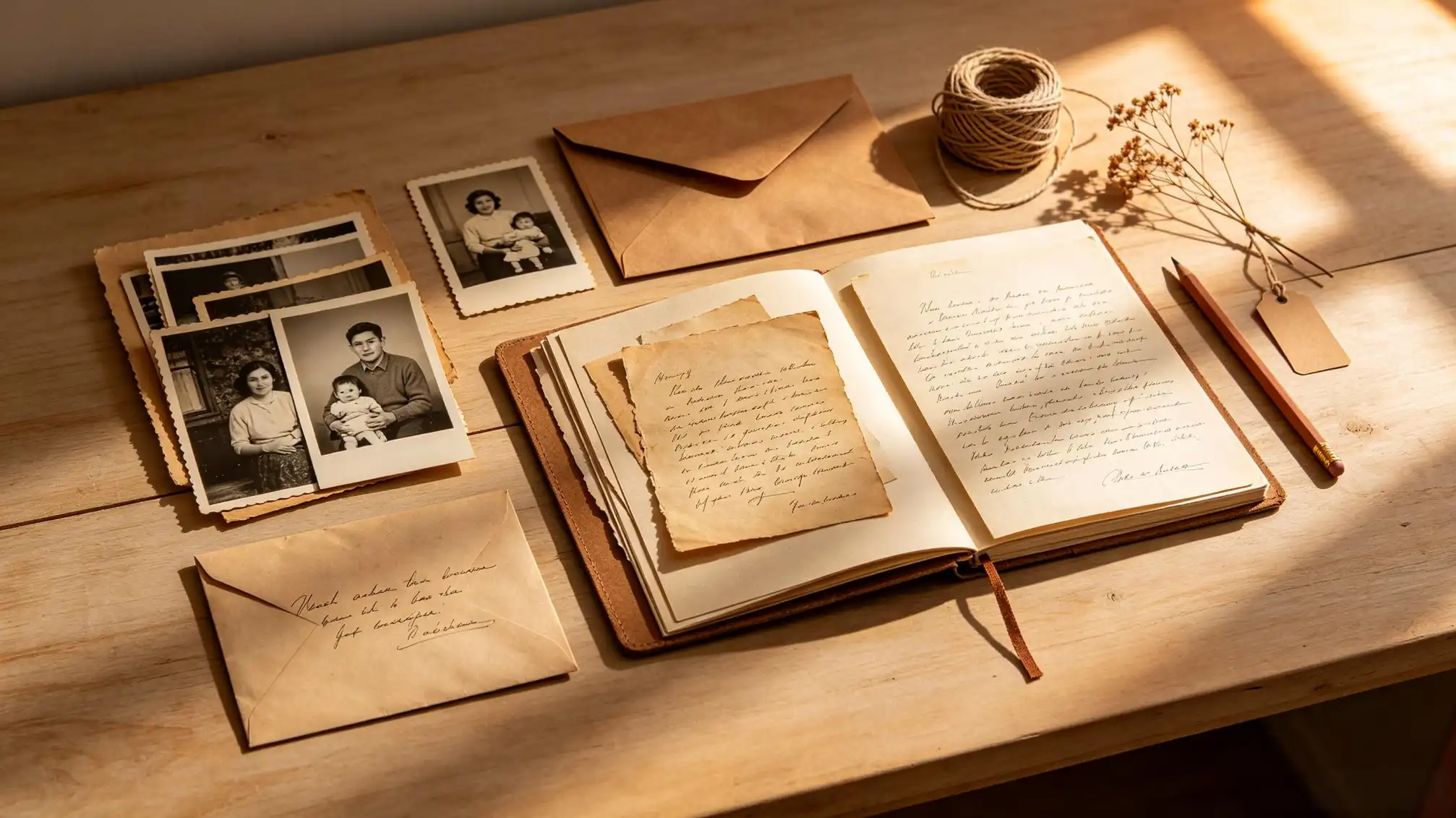
Once those stories are gathered, many families find it meaningful to write them down and keep them in one place. A shared story collection, such as the one at familylove.love/stories, is a natural home for recollections that sit alongside your research notes.
Build One Family Tree — Not Five
Choose a single place to hold your family tree and commit to it. Whether that is a notebook, a spreadsheet, or dedicated genealogy software, one master copy prevents the confusion that comes from three half-finished charts. Start with yourself and work backwards one generation at a time, entering only what you can support with a source.
- Enter people in the order you discover them, not the order you hope they fit
- Keep uncertain information clearly marked as unverified
- Never merge two people simply because their names match
- Record the source for every fact as you add it, not later
A tree that grows slowly and accurately is worth far more than one that grows fast and wrong. Later, when you hit a brick wall, you will be able to trust your own foundations.
Write Names, Dates, and Places the Consistent Way
Genealogy has quiet conventions that save enormous time later. Adopt them from day one: write surnames in capital letters (SMITH, Anne), record dates as day-month-year, and always use the full place name including county and country. Abbreviations and local shorthand become meaningless once you are looking at records from another region or century.
Respect the original spelling of a name as written in a record, even when it looks wrong, and note spelling variations in a separate field. Scribes wrote what they heard, and families themselves were inconsistent — the same person may be recorded as Kaczmarek, Kaczmark, and Katz over thirty years.
Search Records in a Sensible Order
Work from the most recent and most accessible records backwards. Each record type exists because a government, church, or institution needed it, so learning why a record was created tells you what it can and cannot prove.
- Civil registration of births, marriages, and deaths
- Census and household returns, which place a whole family together
- Church baptism, marriage, and burial registers
- Immigration, naturalisation, and passport files
- Military service and pension records
- Land, tax, probate, and newspaper records for earlier periods
Read each document completely, including witnesses, neighbours, and informants. Those extra names often reveal family connections that the main entry never states outright.
Keep a Research Log — The Step Beginners Skip
Every search you run, including the ones that find nothing, belongs in a log. Note the date, the source you consulted, the exact search terms, and the result. Six months from now, when a new database appears, you will not waste an evening repeating work you already did — and a negative result is genuine evidence that a person was not recorded where you expected.
Three Mistakes That Cost Beginners Years
Copying other people's trees
Online trees are leads, not proof. Treat every unsourced entry from another researcher as a hypothesis to test against original records.
Trusting a single index entry
Indexes contain transcription errors. If a detail matters, order or view the original image whenever it exists.
Ignoring the women
Female ancestors are usually recorded under a husband's or father's name, which makes them harder to trace. Track maiden names deliberately, and search marriage records before birth records when a woman's origins are unclear.
When to Ask for Help
Every researcher eventually reaches a wall — a border crossing with no paperwork, a language they cannot read, a record office in another country. That is normal, not failure. Local historical societies, national archives help desks, and experienced researchers in genealogy forums can often solve in an hour what would take you a year alone. Share your research log when you ask; it shows exactly what has already been ruled out.