Family Tree Template: A Practical Way to Map Your Family History
Starting family research is exciting, and it becomes overwhelming surprisingly fast. Names, dates, half-remembered places, and conflicting family stories pile up quicker than anyone can organize them. A family tree template solves the first and most discouraging problem: it hands you a structure, so your energy goes into research instead of formatting.
This guide covers how to pick the right template, prepare your information before you write anything down, fill in the chart cleanly, and keep it accurate as your tree grows from a single page into a real family history template.
Why a Template Beats Starting From Scratch
Draw-it-yourself charts look charming on paper, but they usually collapse around the third generation. A prepared template gives you built-in consistency: standard box sizes, predictable line paths, and space for the details you will actually want later.
- Structure first: every person gets the same fields, so nothing important is left out.
- Faster starts: you begin with your parents and grandparents instead of designing a layout.
- Cleaner sharing: relatives can read a standard chart without a legend.
- Easier updates: adding a new generation means extending the grid, not redrawing everything.
- Better comparison: two versions of the same template make it obvious what changed.
Most people also find that a template reduces errors. When the format is fixed, you notice immediately that a birth year does not match a parent's marriage date.
Pick the Right Chart Type Before You Print Anything
Family tree templates come in several shapes, and each answers a different question. Choosing the wrong one is the most common reason people abandon a project halfway through.
Ancestor (pedigree) chart
This is the classic design that branches left to right from you toward your grandparents and beyond. It is ideal when your main goal is to trace a direct bloodline and you want the fastest path to a specific ancestor.
Descendant chart
Instead of looking backward, this layout starts with one ancestor couple and spreads forward through children, grandchildren, and cousins. It is the better choice for reunions, surname research, and understanding how living relatives connect.
Fan chart
A fan compresses five or six generations into a single circular page. It is beautiful for framing and excellent for spotting missing branches at a glance, though there is little room for notes, so treat it as a summary rather than a working document.
A practical approach: keep a descendant chart as your main working file, then export a pedigree or fan chart when you want to show someone the results.
Gather the Details Before You Fill In a Single Box
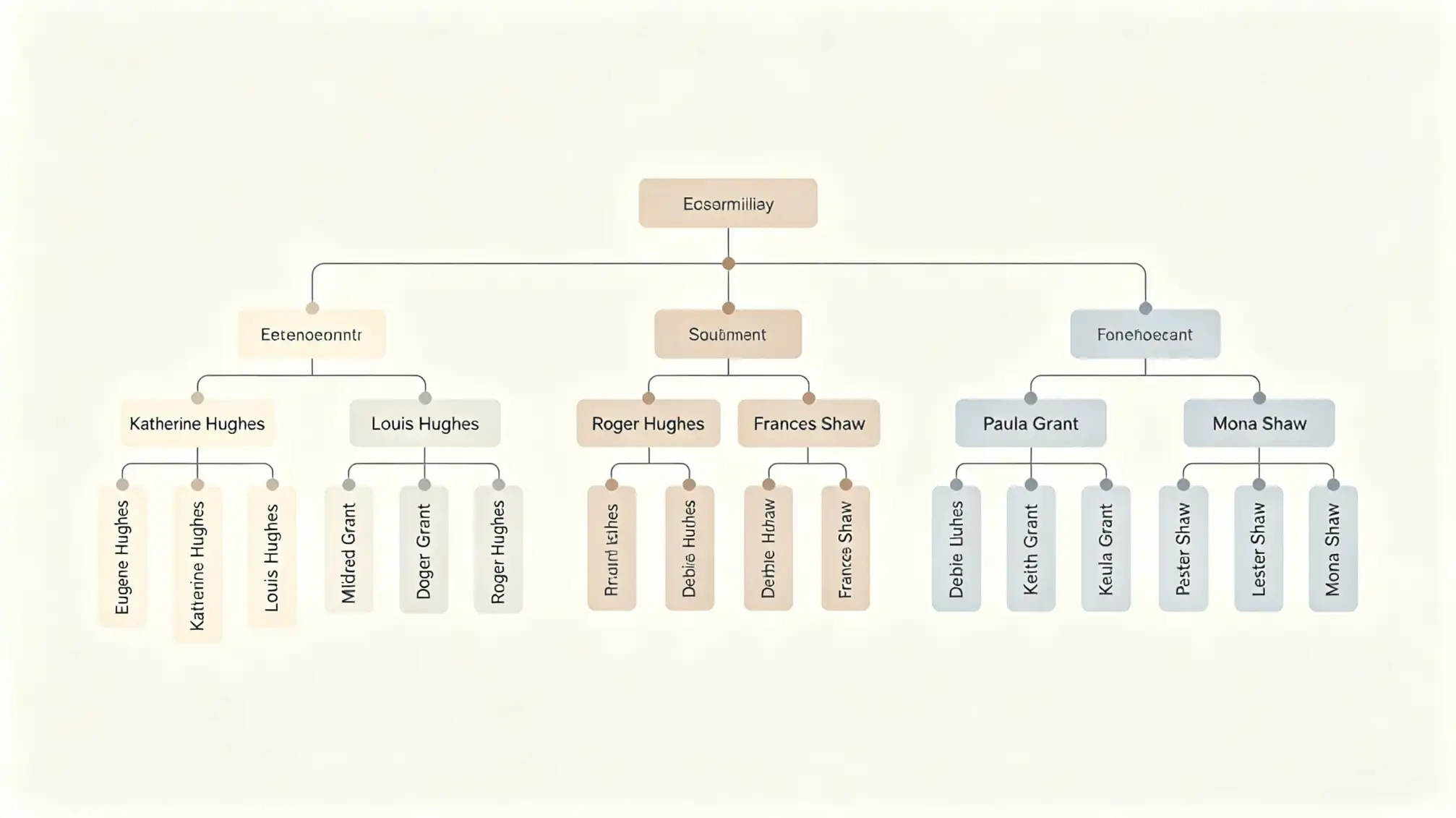
The temptation is to start typing names immediately. Resist it for one afternoon. Spend that time collecting raw material, because reworking a half-filled chart is far more tedious than building it correctly the first time.
- Full names, including maiden names and any spelling variants used in old records.
- Birth, marriage, and death dates with the place attached, not just the year.
- Relationships that are easy to forget: step-parents, adopted children, second marriages.
- Photos, documents, and letters, scanned and labeled with who appears in them.
- Open questions you want to chase later, written down so they are not lost.
Talking to older relatives is the highest-value hour you can spend. Ask open questions, record the conversation if they agree, and write down nicknames and hometowns exactly as they say them. If you want a structured way to log relatives and keep those conversations organized, the family hub at familylove.love/family is a useful place to start recording them.
How to Fill In a Family Tree Template Without Making a Mess
Once your raw information is on the table, the filling-in stage should be mechanical. A few habits keep the result readable years from now.
Use one naming convention for everyone
Decide up front whether you will write Margaret Ann Doyle or Doyle, Margaret Ann, and apply it to every person. Consistency matters more than which style you choose.
Write dates in one format
Pick either 12 March 1954 or 1954-03-12 and never mix them. Ambiguous dates such as 03/12 are a genuine problem when relatives in different countries read the chart.
Leave deliberate gaps, not blanks
An empty box looks unfinished, while a box marked unknown with a question mark tells future-you that the gap was noticed and still needs work. This small habit turns your template into a research to-do list.
Record sources as you go
Add a short note for anything you did not hear directly: census year, certificate number, or the relative who supplied the story. Without sources, a second cousin will eventually challenge your dates and you will have no way to check.
Turning a Free Family Tree Template Into a Living Record
A free family tree template is a perfectly good starting point, and most researchers never need to pay for anything. The catch is that a static chart cannot grow indefinitely. Once you pass four or five generations, or once you want to attach photographs and document scans, move the data into a digital file or a dedicated genealogy program.
Keep the template as your presentation layer and the digital file as your source of truth. When they disagree, fix the digital version first, then reprint or re-export the chart. That way your printed pages always reflect your best current evidence.
Common Mistakes That Force You to Redo the Whole Chart
- Copying a relative's online tree without checking it, and inheriting their errors.
- Merging two people with the same name because they lived in the same town.
- Assuming a surname spelling stayed constant across generations, when it rarely did.
- Skipping sources early, then facing hundreds of unsupported entries later.
- Filling in only direct ancestors during a reunion project, leaving cousins unconnected.
Each of these is fixable in an afternoon if you catch it early, and painful if you catch it after printing fifty pages.
Sharing, Printing, and Backing Up Your Work
Print at a size people can actually read. A chart squeezed onto letter paper is unreadable past three generations; a large-format print or a two-page spread works far better at a reunion. Label every page with a version date, because relatives will inevitably compare copies.
Then back up your file in at least two places, including one off your own computer. Family trees are irreplaceable when the only copy is on a laptop that fails.