Reading Your Family Tree: A Beginner's Guide to Charting Ancestors
Most people begin with fragments: a grandmother's maiden name written on the back of a photograph, a village someone mentioned once, a birth year that may or may not be accurate. A family tree is the structure that lets you organise those fragments into something reliable — a documented map of how the people in your family connect to one another across generations.
That distinction matters. A tree is not a scrapbook or a memory exercise. It is a working document in which every name sits in a specific relationship to another, and every date and place can be traced back to a source. Understanding that structure before you add your hundredth person will save you years of correction later.
What a Family Tree Actually Records
At its core, a family tree captures three layers of information, and beginners often collect only the first.
- Identity: names, including maiden names, variant spellings and name changes across borders.
- Events: births, marriages, deaths and the places where each occurred.
- Relationships: who is a parent, a child, a sibling, a second spouse — the connective tissue that makes the chart meaningful.
When all three layers are present, a tree becomes something you can reason with. You can see that a family moved between two towns within a single decade, or notice that a surname disappears from one branch after a certain generation. Those patterns are where real family history begins.
Why Building One Changes How You See Your Family History
Genealogy is often described as a hobby of names and dates, but the work itself is closer to reconstruction. Once your tree has shape, questions appear that you would never have thought to ask: why did one branch leave a farming region for a port city? Which ancestors lived through the same event in different countries? Which family stories have a document behind them, and which have only repetition?
A tree also makes your research shareable. Relatives who would never read a research log will happily look at a diagram and correct you on the spot — and those corrections are frequently the most valuable information you will get all year. If you want relatives to contribute directly to a connected record rather than a file on your laptop, you can build your family profile here and invite them to add what they know.
The Four Details That Give a Name Meaning
A name on its own is nearly useless for research. Before you move past any individual, try to record four things:
- At least one date — even an approximate year narrows a search dramatically.
- At least one place — jurisdictions matter more than modern country names, since records were kept locally.
- At least one relationship — the person they married, the parent who appears on a certificate, the sibling they travelled with.
- At least one source — a note on where the information came from, even if it was simply an aunt's recollection.
If you cannot fill all four, mark the entry as unconfirmed. That single habit keeps speculative branches from quietly becoming family legend.
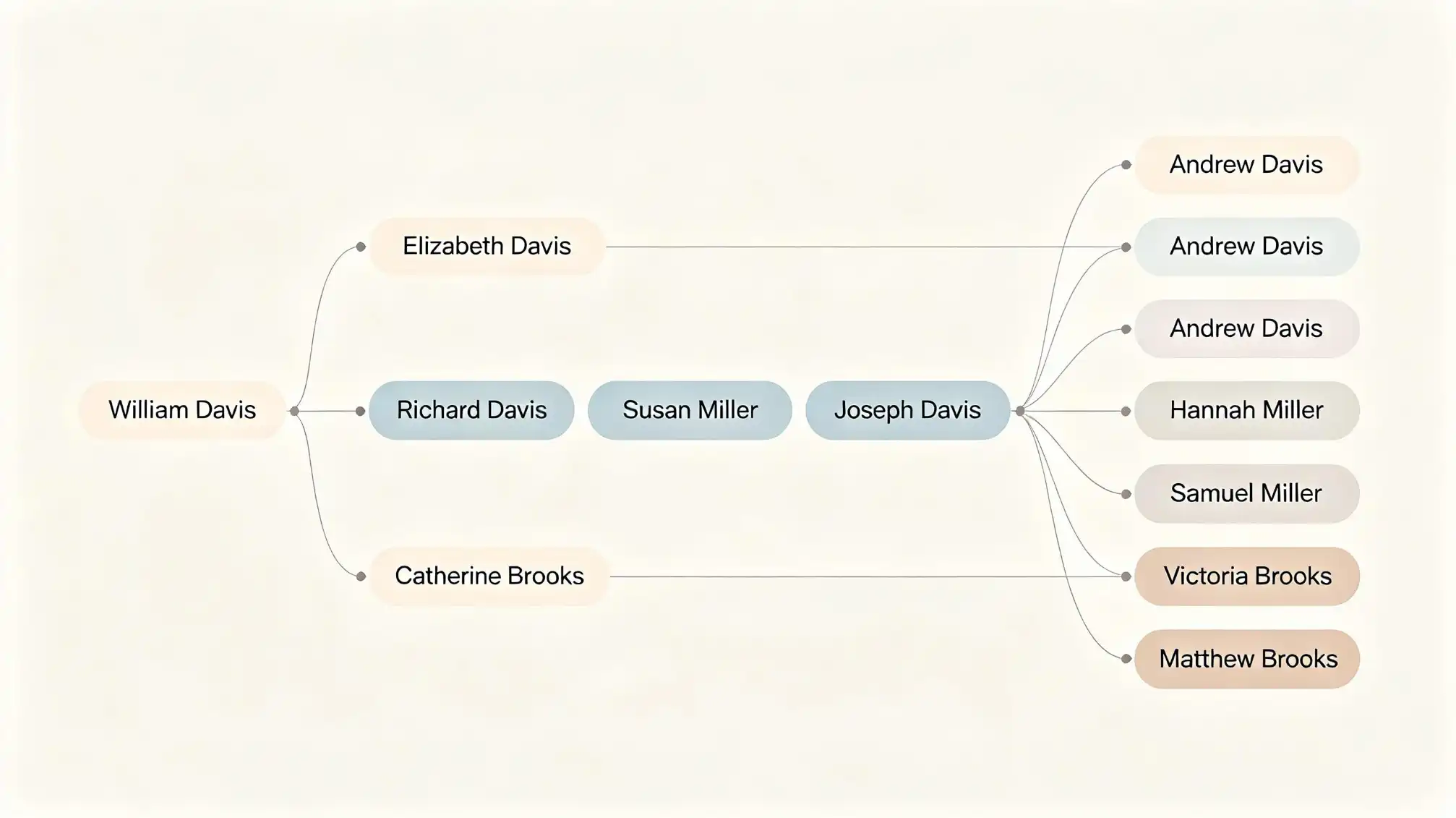
Choosing a Shape: Diagrams, Fan Charts and Digital Trees
The word tree suggests branches, but the format should follow your question rather than tradition.
Ancestor charts
These run backwards from you through parents, grandparents and beyond. They are the best format for a focused research project, because every position is defined and every gap is obvious.
Descendant charts
These run forwards from a and are ideal when tracing a surname, a migration or a family that spread widely. They also help you spot cousins you did not know existed.
Fan charts and digital trees
Fan charts compress many generations into a printable circle and are useful for spotting how far back each line reaches. Digital trees add the layer paper cannot: linked sources, photographs and notes attached to each person, plus the ability to update one record without redrawing the whole chart.
How to Start Without Drowning in Records
The most common early mistake is jumping straight to online databases and searching a surname that half the county shares. Work in the opposite direction instead.
- Start with yourself and move back one generation at a time.
- Interview living relatives before chasing documents — names, places and approximate dates are easier to verify than to discover.
- Collect home sources first: certificates, photograph inscriptions, prayer books, military papers, letters, family bibles.
- Only then move to civil registration, church records and census returns, working outward from what you already know.
Each step confirms the generation before it, which means your tree grows slowly but almost never has to be rebuilt.
Mistakes That Stall Beginners
- Accepting hints without checking. A suggested record that matches a name and a decade is not proof of identity.
- Ignoring spelling variants. Names were written phonetically; a single ancestor may appear under three spellings in three documents.
- Using modern place names. Borders and administrative districts shift, and records live in the jurisdiction that existed at the time.
- Merging two people with the same name. Common names in small communities produce genuine coincidences that careful research can separate.
- Keeping everything in your head. Notes taken the day you find a record are worth more than a memory a month later.
None of these are fatal, but each one costs time. A simple rule prevents most of them: record what a document says, not what you expected it to say.