How to Build a Family Tree: Begin With the Relatives You Already Know
Most family tree projects stall for the same reason: people begin by chasing a famous ancestor from four centuries ago and run out of momentum before they reach their own grandparents. The faster and far more accurate route is to work outward from the generation sitting at your kitchen table. This guide walks you through how to build a family tree that starts with your parents, expands naturally to your grandparents, and stays reliable enough to pass down.
Why the Closest Generation Comes First
Your parents and grandparents are living sources. They can confirm spellings, correct dates, explain why two cousins share a first name, and tell you which branches of the family stopped speaking in 1962. No archive can do that. Once those voices are gone, you are left reconstructing relationships from paper, which is slower, more expensive, and often impossible.
There is a second reason to start close: a tree built from the bottom up stays internally consistent. You know your own details with certainty, so every generation you add is anchored to a fact rather than a guess.
Step 1: Capture the Two Generations Above You
Before touching any software, open a notebook and record what you already know. Write your full name, birth date and place, then your parents' full names, then your four grandparents. Note maiden names, nicknames, and any spelling variations — those variants are what you will search for later.
Ask Better Questions Than "When Were You Born?"
Dates are the least interesting thing a relative can give you. The real value is in the connections between people. Try these prompts:
- Who in the family was everyone most likely to visit on holidays, and why?
- Did any relative change their name, and do you know the reason?
- Who were your grandparents' siblings, including the ones who moved away or died young?
- Which family stories get repeated every reunion, and who originally told them?
- Do you know where any birth certificates, photo albums, or military papers are kept?
Record the conversation if your relative agrees — a phone recording catches details your notes will miss. When you are finished, read your notes back and confirm each name and date out loud. This single habit prevents more errors than any other part of the process.
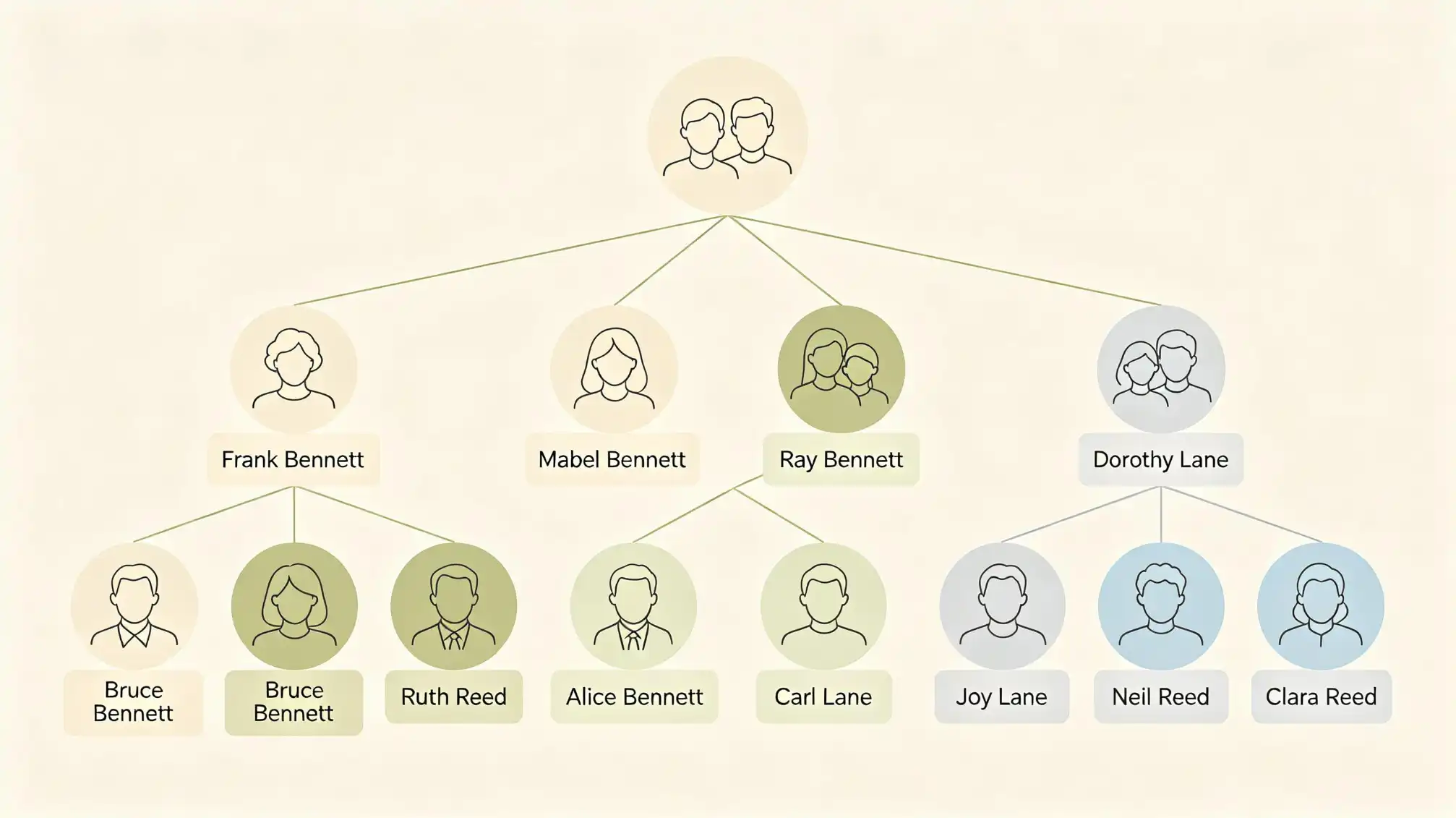
Step 2: Choose a Structure Before You Add More Names
A family tree grows in two directions at once — upward through ancestors and sideways through siblings, spouses, and cousins. Pick a structure early so you are not reorganizing everything six months in.
Numbering That Survives Growth
The classic ancestor system gives you a stable reference for every person: you are number 1, your father is 2, your mother is 3, and each subsequent generation doubles. Every father takes an even number and every mother takes the next odd number. The advantage is that you can tell at a glance which generation someone belongs to and which line they descend from.
If your tree includes cousins, siblings, and blended families, add a short identifier instead — for example, a family code plus a sequence number. What matters is consistency, not elegance.
Step 3: Fill the Gaps With Documents, Not Assumptions
Memory gets you impressively far, but documents settle arguments. Work through these sources in roughly this order, since each one tends to unlock clues for the next:
- Family papers: birth and marriage certificates, baptism records, military discharge papers, and passports.
- Photo backs: names and dates written in pen are often the only surviving record of a great-aunt.
- Obituaries: these are quietly the best relationship map available, listing siblings, children, and in-laws in one place.
- Census and city directories: useful for tracing where a household lived between major events.
- Cemetery and funeral records: burial plots frequently reveal family groupings you did not know existed.
Whenever a document contradicts what a relative told you, write both versions down rather than deleting one. Contradictions are clues, not mistakes.
Step 4: Keep the Tree Where Relatives Can Contribute
A family tree kept in a single person's notebook dies with that notebook. Putting the structure online — even in a simple, shared format — turns your research into a resource the whole family can correct and extend. Cousins will spot missing siblings you never met; an aunt will remember a second marriage that never made it into any document.
If you want a central place to organize relationships, invites, and updates for the wider group, creating a shared family space makes it easy for relatives to confirm details instead of relying on one person's inbox. Set a light review rhythm — once a year is plenty — and ask each branch to verify their own section.
Mistakes That Cost You Months
- Adding unverified names from other people's published trees without checking a source.
- Assuming two people with the same name are the same person across different decades.
- Skipping siblings and spouses, which makes later generations impossible to connect.
- Recording nicknames instead of legal names, then failing to find the person in any index.
- Waiting to scan old documents until the relative who owns them has moved or passed away.
What to Do When Records Disagree
Dates on older documents are frequently approximate. A census taker might round a birth year; an obituary may be written from memory by someone grieving. Rank your sources: a birth certificate usually outranks a census entry, which outranks a family story. Record the reasoning in a short note attached to the person, so a future reader understands why you chose one date over another.
Then move forward. A family tree is never finished, and a good-enough record today beats a perfect one you never publish.