Family Tree Fundamentals: A Beginner’s Guide to Tracing Your Ancestors
Most people picture a family tree as a neat diagram with names in boxes and lines connecting parents to children. That image is not wrong, but it is incomplete. A family tree is really a research project — a growing map of evidence, stories, and relationships that you build one discovery at a time. If you are just beginning to explore your family history, understanding what that map represents will save you months of confusion and help you enjoy the process far more.
Your Family Tree Is a Trail of Evidence, Not a Finished Picture
A family tree begins with a simple question: who came before me? The answer rarely arrives all at once. You start with what you know — your parents, grandparents, perhaps a great-grandparent’s name — and then you work backward, proving each connection with documents, photographs, and family stories.
That is why genealogy is often described as detective work. A birth certificate confirms a parent-child relationship. A census record places a family in a specific place and time. A marriage license may reveal a mother’s maiden name that unlocks an entire branch. Each document is a clue, and each clue strengthens the structure of your tree.
Beginners sometimes expect to find one website or one relative who has the complete tree ready to copy. That does happen, but it is rare — and even then, copied information can be wrong. The most rewarding family trees are built slowly, with sources attached to every fact.
The Three Layers Every Family Tree Needs
A strong family tree has more than names and dates. It has depth. Think of it as three layers that work together.
1. The direct line
This is the backbone: you, your parents, your grandparents, your great-grandparents, and so on. The direct line answers the question of ancestry. It is the first thing most beginners focus on, and for good reason — it gives your research a clear direction.
2. The collateral branches
Siblings, aunts, uncles, and cousins are not just side notes. They often hold the keys to breaking through a brick wall. If you cannot find a death record for your great-grandfather, his sister’s obituary might name their parents. If a census page is damaged, a cousin’s household nearby may provide the missing detail. Collateral research turns a narrow line into a supportive web.
3. The historical context
Your ancestors did not live in a vacuum. They migrated because of wars, crop failures, or new job opportunities. They married young because of local customs. They appear in certain records because of laws about taxation, land ownership, or military service. Adding context — even simple context like a town’s main industry in 1880 — transforms a list of names into a story you can understand.
How to Begin When You Know Almost Nothing
The best starting point is not a subscription website. It is your own family. Before you search online, gather what is already in your home and in the memories of living relatives.
- Write down everything you know about yourself, your parents, and your grandparents, including full names, nicknames, birthplaces, and approximate dates.
- Interview older relatives. Ask open-ended questions: “What was your childhood home like?” “What did your parents do for work?” “Do you remember any stories about your grandparents?”
- Look through photo albums, letters, diaries, and family Bibles. Check the backs of photographs for names and dates.
- Record conversations if your relatives agree. A voice recording captures details that written notes miss.
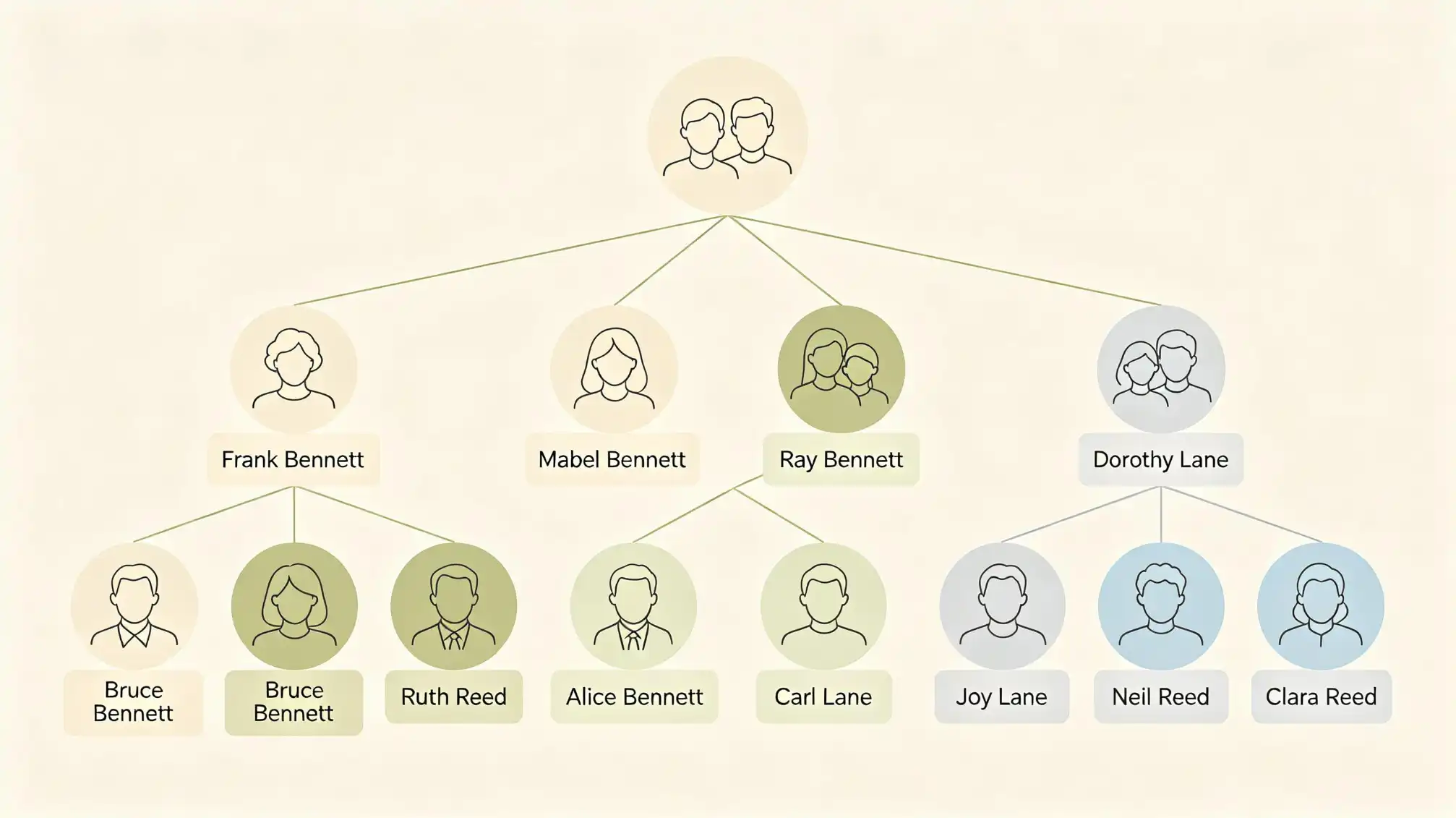
Once you have gathered those basics, you can begin organizing them. Many people use a simple notebook or spreadsheet at first. Others prefer dedicated genealogy software or an online tree. The tool matters less than the habit of writing down where each piece of information came from. When you are ready to bring relatives into the process, you can create a shared family page where everyone can add photos, dates, and memories in one place.
Family History and Genealogy: What Is the Difference?
The two terms are often used interchangeably, but they describe slightly different approaches. Genealogy is the study of kinship and lineage — the who, when, and where of your ancestors. Family history is broader. It asks how your ancestors lived: what they ate, how they celebrated, what they believed, and how their choices shaped your family’s path.
For beginners, the practical takeaway is simple: start with genealogy to build the structure, then add family history to bring it to life. A birth date tells you when someone arrived. A diary entry or a local newspaper article can tell you what kind of day it was.
Records That Move Your Family Tree Forward
As you move backward in time, you will rely on different types of records. Knowing what to look for keeps your research focused.
- Birth, marriage, and death records: These are the foundation. They often include parents’ names, occupations, and addresses.
- Census records: Depending on your country, censuses can place an entire household together every ten years, revealing siblings, ages, and migration patterns.
- Immigration and naturalization records: These can provide a place of origin, a ship name, and a date of arrival.
- Military records: Service files may include physical descriptions, next of kin, and places of residence.
- Land and probate records: Wills and property deeds can name heirs and confirm family relationships when other records are missing.
- Newspapers: Obituaries, wedding announcements, and local news columns are goldmines for family details.
Not every record will be available for every ancestor. Start with the most recent generations, where records are usually more complete, and work backward one step at a time.
Mistakes That Stall Beginners (and How to Avoid Them)
Most new researchers hit the same obstacles. Recognizing them early makes the journey smoother.
- Copying without checking. Another person’s tree is a hint, not proof. Always look for the original record.
- Skipping siblings. Collateral relatives often contain the clue that breaks a dead end.
- Ignoring women’s maiden names. A woman’s maiden name is essential for tracing her family line. Marriage records and children’s birth records often provide it.
- Assuming name spellings are fixed. Before standardized spelling, a single ancestor might appear as “McDonald,” “MacDonald,” and “Donnald” in different records.
- Forgetting to cite sources. Without a source, you cannot evaluate a fact later or share your research confidently.
Making Ancestors Feel Like People Again
Dates and places are the skeleton of a family tree, but stories are the flesh. As you research, collect the small details: a trade, a migration route, a family recipe, a nickname. These details turn a name into a person and help you understand why your family ended up where it did.
You do not need to be a professional historian. You just need curiosity and patience. Every document you find, every relative you interview, and every question you ask adds another branch to your tree. Over time, that tree becomes more than a chart. It becomes a record of lives that led to yours.