Why Grandparents’ Family History Feels Urgent Now
There is a particular kind of quiet in a room when a grandparent starts talking about the past. A name comes up that no one has said in decades. A kitchen smell returns. A journey across a border, a first job, a stubborn love story — all of it suddenly has a voice, a face, and a date attached. That is the power of grandparents’ family history: it turns a list of names into a living story your family can carry forward.
Many families mean to record these memories “someday.” Then school schedules, health concerns, and ordinary life push the project to the back burner. The trouble is that memories are not a filing cabinet. They are more like a fire that needs tending. The sooner you sit down with your grandparent — even for twenty minutes — the more you will catch while the details are still vivid and the storyteller still feels like talking.
Start with Curiosity, Not a Checklist
If you open with a printed list of family history questions and a stern expression, you may get answers, but you probably will not get stories. The goal is not to complete a form. It is to create enough ease that your grandparent wanders into the memories that matter most to them. Your questions are simply doors. Some will open wide. Others will stay shut for now, and that is okay.
A simple opening line
Before you begin, think about the mood you want to create. Choose a time of day when your grandparent is usually alert and comfortable. Put the phone on silent, but not out of sight if you are recording. Bring tea, a photo album, or a familiar object. Let them know you are not testing them. You are asking because you want to know them, not because you are checking facts for a history exam.
A warm opening can be as simple as: “I’ve been thinking about how much I don’t know about our family, and I’d love to hear whatever you feel like sharing.” That sentence gives permission. It says: your memories matter, and there is no wrong way to tell them.
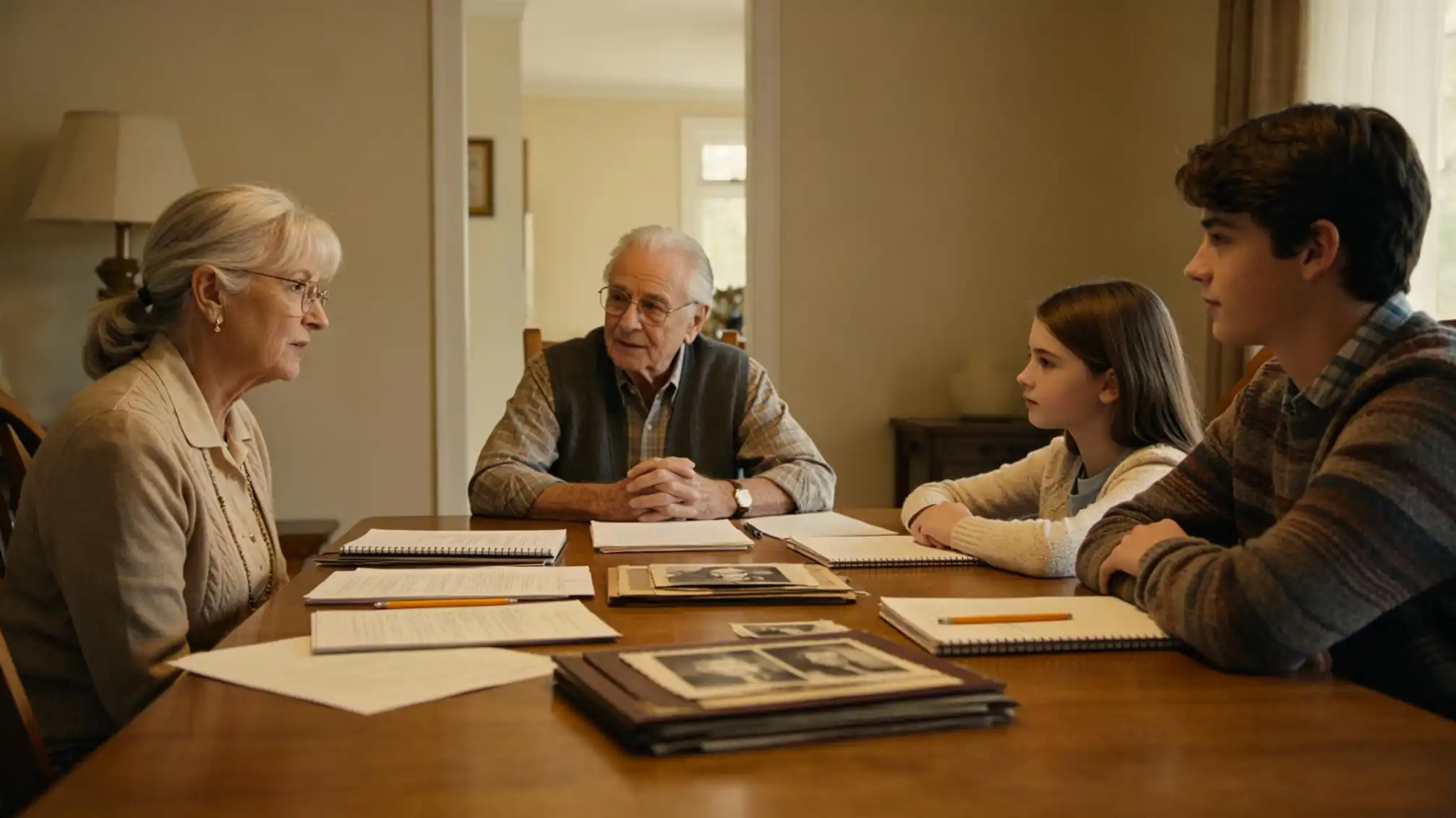
The Best Family History Questions Are Doorways
Good family history questions do not demand a single right answer. They invite a scene. Instead of asking, “When was Grandpa born?” try, “What was Grandpa like when you first met him?” Instead of “Where did you live?” ask, “What did your street sound like on a summer evening?” Specific sensory prompts help relatives recall details they might otherwise skip over.
Six prompts that open rich conversations
You do not need to ask them all at once. Pick one, follow the thread, and let silence do some of the work.
- “What did your parents teach you without ever saying it out loud?” This question often leads to values, habits, sayings, and family rules that shaped generations.
- “What is a family story that always got told at gatherings?” Recurring stories reveal what your family values, laughs about, and wants to remember.
- “Who was the person in your family everyone depended on?” This can surface aunts, uncles, neighbors, or grandparents who never got their due.
- “What was the hardest season of your life, and who helped you through it?” Ask this gently, and be ready to simply listen without fixing anything.
- “What did you believe your future would look like when you were my age?” The answer often uncovers dreams, fears, and cultural expectationsthat shaped choices.
- “What do you hope our family never forgets?” This is a beautiful way to close a conversation and often produces the most quotable line of the day.
How to Record Without Making It Feel Like an Interview
Recording is a gift to future relatives, but it can also make a grandparent self-conscious. The trick is to keep the setup simple and the focus on connection. A smartphone voice memo app is enough. Place the phone slightly off to the side, not directly between you. Say, “I’d love to record this so I don’t forget your words. Is that okay?” If they say no, respect it and take notes instead.
Keep the setup simple
If you want to see how other families shape these memories into shareable stories, browse the story collection at https://www.familylove.love/stories. Seeing finished pieces can help you imagine what your own family stories might become.
During the conversation, resist the urge to interrupt with corrections. If your grandparent misremembers a date, let it go for now. You can check records later. What matters in the moment is the feeling, the voice, the pause before a difficult memory, and the laughter that interrupts a sad one. Those are the parts a written timeline cannot capture.
Ask follow-up questions that begin with “Tell me more about…” or “What happened next?” These small nudges keep the story moving without taking over. If your grandparent says, “I don’t remember,” try a different door: “That’s okay. What do you remember about the house, or the weather, or who was there?”
What to Capture Beyond Names and Dates
Family history is more than genealogy. It is also the texture of daily life. As you listen, note the details that make your family unique: favorite meals, holiday traditions, superstitions, work routines, sayings, nicknames, and the way people showed love without saying it. These details are gold for relatives who never met the person you are describing.
Details that bring a timeline to life
- Voice and phrasing: Record the actual words and expressions your grandparent uses. A phrase like “we were poor but we didn’t know it” says more than a paragraph of explanation.
- Relationships: Ask who they were close to, who they argued with, and who they missed. Family stories live in relationships, not just surnames.
- Places: streets, churches, schools, shops, farms, and the routes they walked. Maps and addresses help future relatives picture the world.
- Objects: a recipe card, a tool, a quilt, a photograph, a letter. Ask for the story behind the object, not just what it is.
- Advice: What do they wish they had known? What would they tell their younger self? This is often the most moving part of grandparents’ family history.
Following Up Without Wearing Them Out
One long marathon interview is rarely the best approach. Memory works in layers. A first conversation may open a topic; a second conversation a week later may reveal the real story. Keep sessions short — thirty to forty-five minutes is plenty — and end while everyone still feels good. Say thank you, share one thing you learned, and ask if you can come back with a few more questions.
Short sessions, repeated over time
After each visit, write down your own impressions while they are fresh. What surprised you? What did your grandparent’s face do when they talked about a certain person? These notes become part of the family history too. If other relatives want to help, give them a specific role: one person can scan photos, another can transcribe audio, another can cook or drive. Many hands make the project lighter and more likely to continue.
Making the Stories Useful for the Whole Family
Once you have recordings and notes, do something with them. A private folder of files is better than nothing, but stories come alive when they are shared. Create a simple document with a few quotes and a photo. Label audio files with names and dates. Start a family email thread with one story a month. At the next reunion, play a two-minute clip and watch the room lean in.
Share one story at a time
You do not need a perfect archive. You need a beginning. The first recording, the first transcribed page, the first shared memory — each one makes the next step easier. And every time you choose curiosity over busyness, you tell your grandparents that their life is worth remembering.