Grandparents Family History: How to Gather the Stories Only They Can Tell
Every family carries a version of its history that never made it into any document. It's the reason your grandmother's voice changed when she mentioned her father. It's the year your grandfather turned twelve that he never talks about. It's the recipe nobody wrote down because everyone assumed someone else knew it by heart.
Grandparents family history work isn't really about archives and census records. It's about sitting across from someone you love and asking questions small enough that they can actually answer. The trouble is that most of us ask the wrong things. "Tell me about your childhood" is too big, and it usually gets you a shrug. "What do you remember about your mother?" sounds like a school assignment. The questions that work are specific, sensory, and easy — and they nearly always lead somewhere you didn't expect.
Start With Objects, Not Eras
Decades are abstract. Objects are not. Before you plan anything that resembles a formal interview, walk through your grandparent's home, or scroll through old photos together, and let the things in the room do the prompting.
- A chipped mixing bowl: "Who taught you to cook with this?"
- A black-and-white photo of strangers: "Who are these relatives, and how were they connected to us?"
- A battered tool in the garage: "What was the first thing you built with this?"
- A ring or watch: "Where did this come from, and who wore it before you?"
- A stack of letters in a drawer: "Who wrote these, and what were they saying?"
Objects bypass the "I don't remember" reflex because they're sensory. A smell or a texture goes straight to a scene, and a scene is where a real story lives.
Family History Questions That Actually Open Doors
The best prompts have a narrow frame and an emotional door left slightly ajar. Pick two or three per visit — not twenty. You're building a relationship with the past, not conducting an audit.
Childhood and the everyday
- What did your street sound like in the evening?
- What did your family eat on a completely normal Tuesday?
- Who was your closest friend, and what did the two of you get in trouble for?
- What was a rule your parents had that you thought was unfair at the time?
- What was your first job, and what did you spend that first paycheck on?
Love, work, and hard seasons
- How did you meet Grandma or Grandpa, and what did you notice first?
- What was the hardest year you lived through, and how did you get to the other side of it?
- What did your family do when money was tight?
- What were you afraid of that you did anyway?
- Which relative made you feel most understood when you were young?
Family stories and relatives
- Which relatives did we lose before I was born, and what should I know about them?
- Is there a story that gets retold at every family gathering? Where did it start?
- What's a family legend you secretly suspect isn't entirely true?
- What traditions did your family keep that we've quietly let go of?
- What do you hope we never forget about this family?
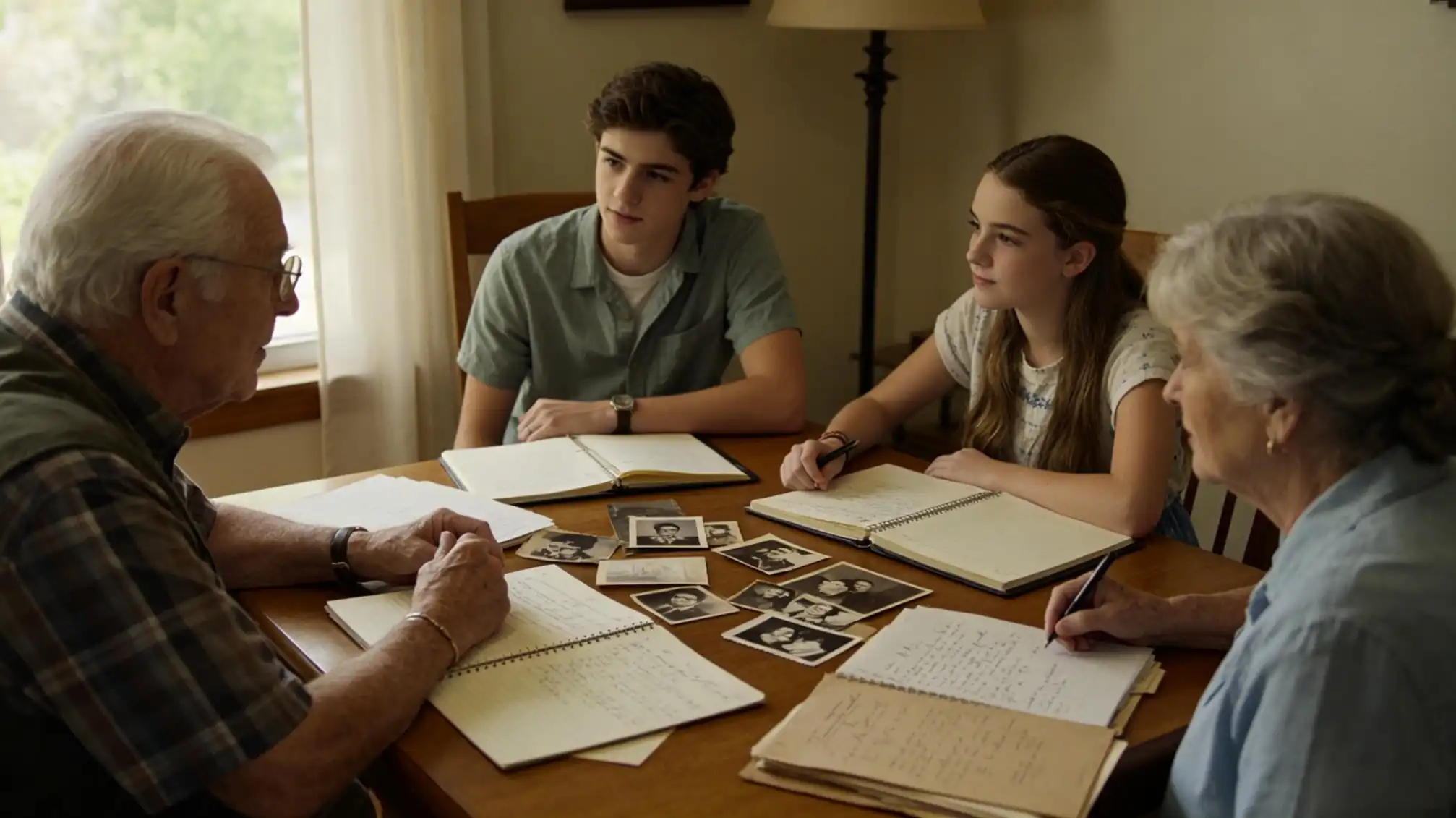
How to Record Without Turning It Into an Interrogation
The moment a conversation feels like a deposition, the good material disappears. Here's how to keep the warmth in it:
- Ask permission first. "Would it be okay if I recorded this so I don't get the details wrong?" Almost everyone says yes when you frame it as accuracy rather than surveillance.
- Put the phone on the table, face down. Don't stare at a screen. Don't stop the flow to check that it's still running.
- Let silences sit. The most valuable sentence usually arrives three seconds after the pause you were tempted to fill.
- Follow the tangent. If they wander from the question into a memory about a neighbour's dog, go with them. Tangents are where personality lives.
- Write down names as you hear them. Spell them back. Ask, "Was that Aunt Vera with a V, or Aunt Vira?" Names are the hardest thing to recover later.
Keep sessions short — thirty to forty minutes is plenty. End while they're still enjoying it, and you'll get a second visit.
Turn Every Answer Into a Follow-Up
The gold is almost never in the first answer. It's in the second question. When your grandmother says, "We moved a lot that year," don't move on. Ask, "How many times, and which place did you hate leaving?" When your grandfather says, "My father was strict," ask, "What did strict look like on a Saturday morning?"
Try echoing their own words back as a question. "You said the house felt quiet — quiet how?" This signals that you're listening, not just collecting, and it invites the detail that makes the memory worth keeping.
Keep the Thread Alive Between Visits
Oral history dies when it stays in a single recording. Label every file with the date, the speaker's full name, and where it was recorded. Write down the three names you hadn't heard before. Send a short note or message: "You mentioned your cousin Bernard — I looked him up and found a photo. Can I show you next time?"
Opening the next visit with something they told you last time tells them the stories mattered, and that's what keeps them coming. If you want to see how other families organise and share what they've gathered, browse the family stories collected here — it's a good reminder that this isn't an archive project, it's a family one.
Start with one grandparent, one recording, and three questions. That's enough to begin.