{
"title": "Grandparents Family History Is Not a Box of Dates—It Lives in Their Smallest Answers",
"metaTitle": "Grandparents Family History: Warm Questions to Open the Memory Box",
"metaDescription": "Gather grandparents family history with gentle memory prompts, follow-up listening techniques, and practical ways to keep their family stories alive.",
"summary": "A warm guide to collecting grandparents family history: start with objects, ask small sensory questions, follow tangents, and preserve what you hear in a family story archive.",
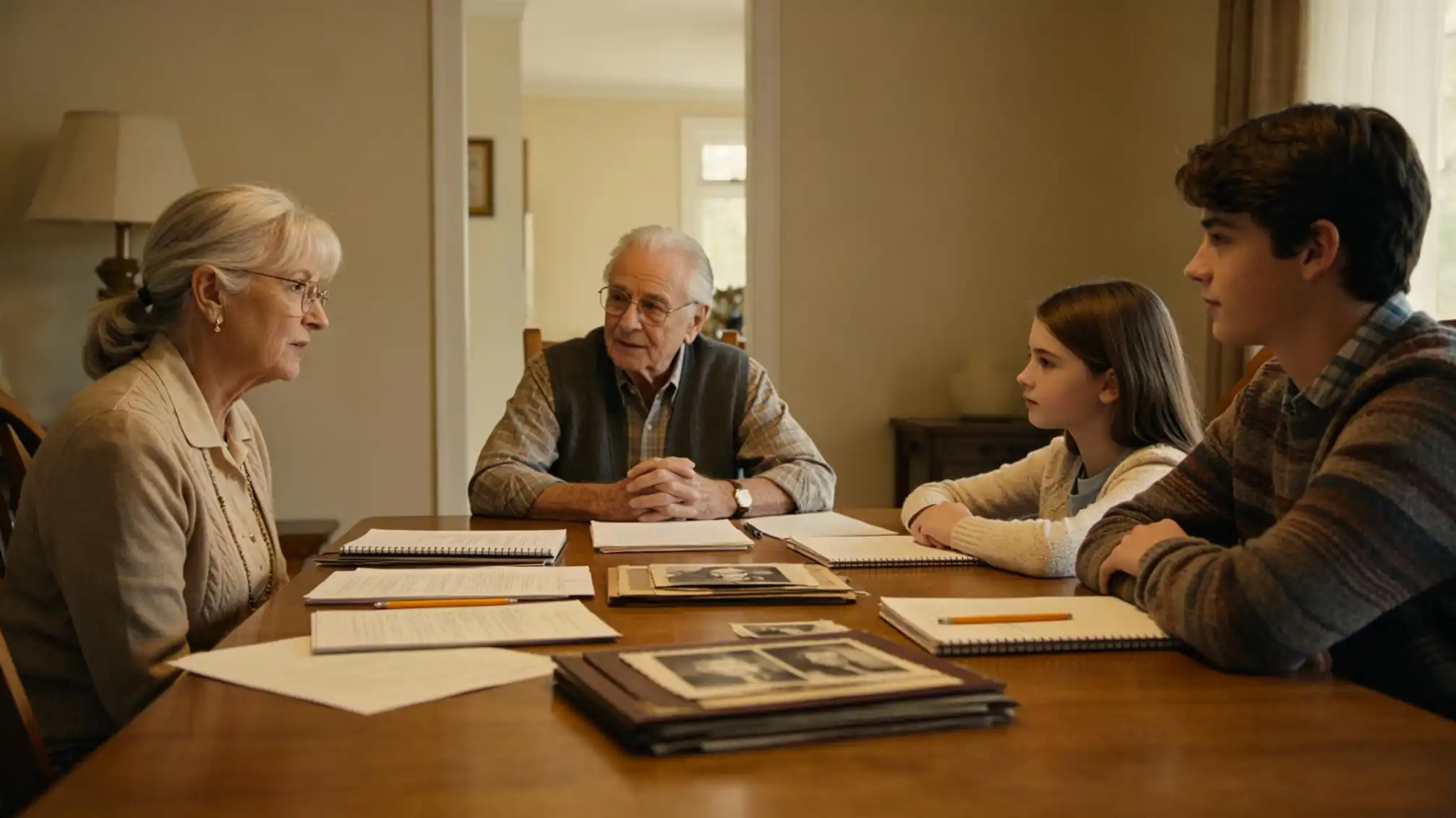
"contentHtml": "<p>Grandparents family history rarely arrives in chronological order. It arrives in the scent of burned toast, in the way your grandfather's voice softens around a certain name, or in a sudden silence after a question touches something sacred. The real challenge isn't finding questions; it'smaking room for the answers to breathe.</p><h2>Make the Room Feel Like Memory</h2><p>Before you ask a single thing, think about the setting. A formal living room with a hovering recorder can make your grandparents sit up like they're at a doctor's appointment. The kitchen table is better. Add tea, a half-finished jigsaw puzzle, or a box of old photographs. Put your phone where they can see it, but explain, "I just want to remember your voice. We can stop whenever you want." Start with something in your hands—a cracked ceramic bowl, a brass button, a fragile letter—and let that object carry the first question.</p><p>"What do you remember about the house where you grew up?" is fine, but try: "Who was sitting around the table the last time this bowl was used?" That kind of question gives your grandparent a place to stand inside the memory instead of at the beginning of a long timeline.</p><figure><img src='https://r2.familylove.love/static/seo/interviewscene3.webp' alt='Family member recording an older relative speaking about family history'/><figcaption>Let the first minutes be slow; your presence is more important than the perfect question.</figcaption></figure><h2>Small Family History Questions, Big Doors</h2><p>Family history questions can feel enormous if you ask about wars, migrations, and marriages too early. Start with the texture of daily life. Childhood memory lives in small sensory details, and grandparents often answer these with surprising color. Try one or two from these categories:</p><ul><li>"What sound meant it was time to come inside when you were little?"</li><li>"What smell made you feel like everything was going to be okay?"</li><li>"Who was the relative everyone wanted to sit beside at holidays, and why?"</li><li>"What did your parents do together on a free Saturday afternoon?"</li><li>"What was a secret you and your best friend promised never to tell?"</li><li>"If you closed your eyes and walked into your childhood kitchen right now, what would you touch first?"</li></ul><p>These prompts are so simple that they skip the "I don't remember" defense. Once a small door opens, you can ask more direct questions about your grandparents family history: Which school did you go to? How did your parents meet? Even then, follow the sound of the room. If a grandparent tells a story with slight sadness, let it rest before you jump to the next question.</p><p>Do not hurry from one question to the next either. Some of the greatest grandparents family history is buried in the long pause after a small question. Count to ten silently before opening your mouth. Often your grandmother will break the silence with the detail she has never said aloud.</p><h2>Go Deeper Without Making It Heavy</h2><p>Some of the richest grandparents family history sits in complicated places: money trouble, loss, responsibility, injustice. Most grandparents will not spill those memories unless they trust you. You can build trust by asking about how they coped rather than how much they suffered.</p><ul><li>"What was the hardest thing you had to understand about your parents when you were young?"</li><li>"When did you first realize life was not fair?"</li><li>"What did relatives do quietly to help one another when no one was keeping score?"</li><li>"What did you understand much later about a choice your grandparent made?"</li><li>"What do you wish someone had told you before you left home?"</li></ul><p>These questions can take your conversation deeper, because they invite values, not just events. They also work if you ask them gradually. If Grandma says, "I don't like to think about that," honor it. Memory has seasons. What she could not share last spring may appear through a window in autumn. Send her a note or a photo that seems connected to a story she told you; let her open the door again.</p><h2>When the Memory Drifts, Follow It</h2><p>The amateur genealogist tries to control the conversation. The memory keeper knows better. If Grandpa starts with his Army years and suddenly remembers the stray dog he fed near the fence, do not steer him back. The dog may lead to a friend, the friend may lead to a nickname, and the nickname may tell you more about the person than a military record ever could. Let tangents wander. Say "Wait—say that again slowly, I want to picture it." When you hear "I guess you had to be there," ask "Try me."</p><h2>Keep a Small Thread as You Go</h2><p>While you listen, you don't need to take frantic notes. Write down names, places, and vivid words after the visit. One useful habit: keep a small notebook titled with the date and your grandparent's name. Use one page for "names mentioned" and one for "unfinished stories." Unfinished stories become your best openings for the next visit.</p><p>If you want a simple place to keep those notes plus photographs and recordings as they grow, consider using a story archive. At the <a href='https://www.familylove.love/stories'>Family Love stories space</a>, you can gather what you've collected and share it gently with relatives you love—which is often exactly what grandparents hope will happen to their stories.</p><h2>A Closing Question for the Doorway</h2><p>At the end, ask something that gives your grandparents a chance to leave a message with you. "If you could sit with your twenty-five-year-old self for ten minutes, what would you whisper?" or "What part of your life did you never get asked about, but wish someone had wanted to know?" These can be surprisingly practical for family stories because they reveal personality, hope, and regret. Then thank them for something specific—not because the recording is done, but because they let you inhabit a world where your relatives were still young. That shared world is the truest part of grandparents family history.</p><h1>Practical Steps</h1><ul><li>Related link: <a href='https://www.familylove.love/stories'>Start by adding one captured story to your Family Love stories collection</a>.</li><li>Need more help and guidance for family history conversations? Visit <a href='https://www.familylove.love/docs'>Family Love docs</a>.</li></ul>",
"images": [
"https://r2.familylove.love/static/seo/interviewscene3.webp"
]
}