{
"title": "How to Turn My Family into a Family Tree Without Losing the Stories",
"metaTitle": "My Family History: Turn It into a Family Tree Without Losing the Stories",
"metaDescription": "Discover a warm, practical way to turn my family history into a family tree. Start with family stories, photos, and letters to build a tree that feels alive.",
"summary": "How to take scattered family stories and turn your personal my family history into a clear family tree, preserving the memories that make each branch meaningful.",
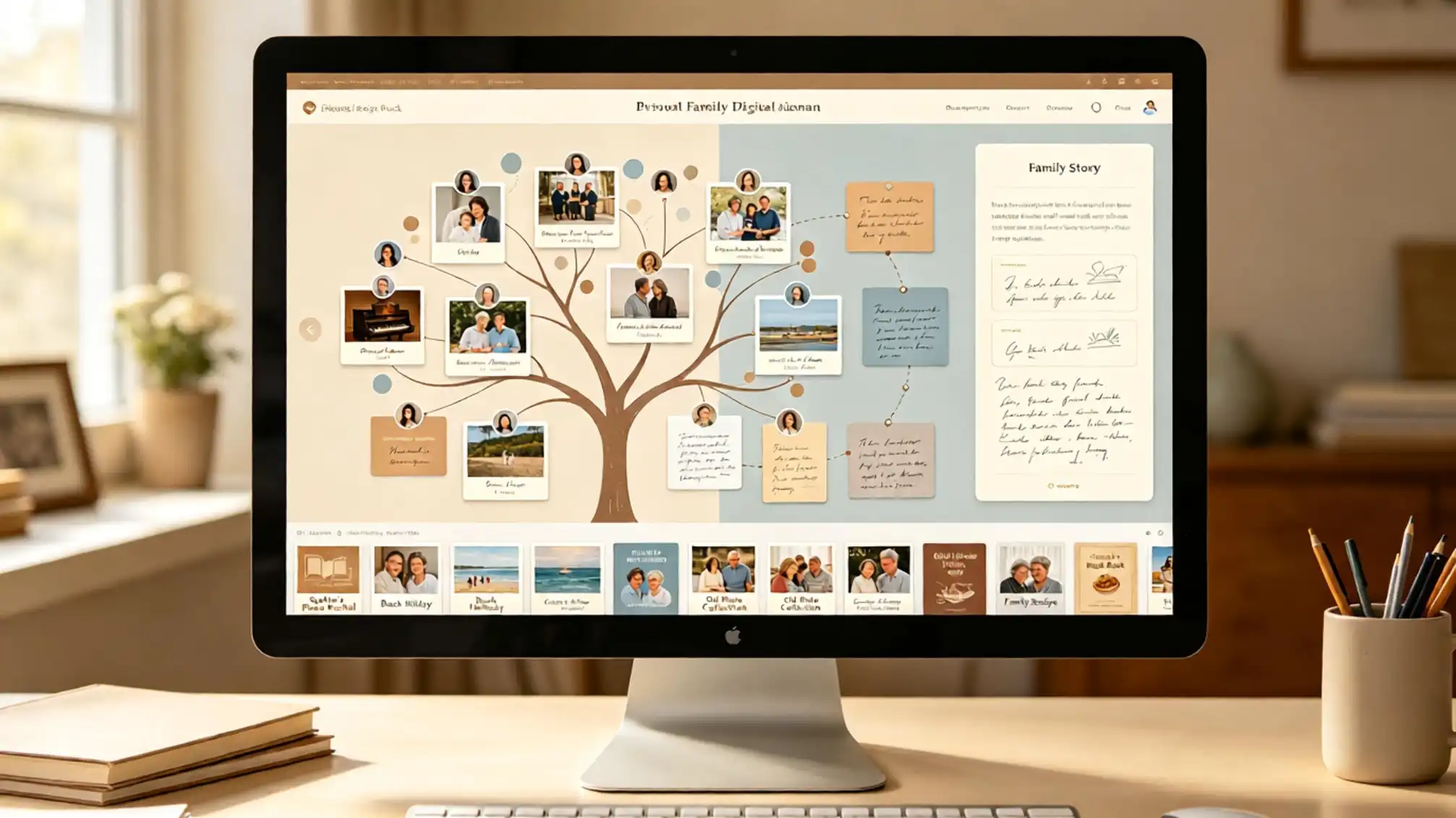
"contentHtml": "<p>Every family has a drawer where the past lives. A stack of faded photographs, a letter with a postmark from another decade, a recipe card written in your grandmother\u2019 hand. When you finally decide to organize that beloved chaos, the phrase \u201cmy family history\u201d can feel a little overwhelming. Where do you even begin? You don\u2019t need a genealogy degree, a paid database, or a pedigree chart. You need a few familiar voices, an open notebook, and a way to turn memory into structure without smoothing over messy, beautiful parts.</p>\n\n<figure>\n <img src=\"https://r2.familylove.l/static/seo/familyspace4.webp\" alt=\"Family members gathered around old photographs and keepsakes, sharing stories\" />\n <figcaption>Gathering the keepsakes together makes the family history feel real and shared.</figcaption>\</figure>\n\n<h2>Start with the Stories You Already Tell</h2>\n\n<p>The best family tree never begins with a birth certificate. It begins with the story your mother tells every Thanksgiving about the year your grandfather drove a borrowed car through a snowstorm. It begins with the joke your aunt repeats at weddings, or the way your father\u2019s voice softens when he talks about the small town he left behind. These stories are the heartbeat of your family history, and they already contain the names, places, and moments that belong on your tree.</p>\n\n<p>Sit down for an evening with the person who remembers the most. Keep it conversational. Ask questions that start with <em>\u201cTell me about the first time\u201d</em> or <>\u201cWho did you remind me of when you were young?\u201d</em> Record the conversation on your phone if everyone agrees, or simply take notes. You are not building a formal archive yet. You are collecting the emotional raw material, the stories that make your family history feel like yours.</p>\n\n<h>Sort the Scraps, Not the People</h2n\n<p>Once you have a stack of stories, back to those drawers and boxes. Sort the physical pieces by type first, not by person. Put all the photographs together, all the letters together, all the newspaper clippings together. This is counterintuitive and comforting at the same time. You are not trying to decide who matters most. You are just making the clutter manageable.</p>\n\n<p>As you sort, keep a little field notebook or a note-taking app open. Whenever a face triggers a memory, write it down. When a postmark reveals a place, pause and think about why someone was there. These tiny observations become the seeds of the family stories your tree will eventually tell. Do not force yourself to identify every person immediately. Let the mystery sit. Sometimes the quietest photograph eventually reveals the loudest story.</p>\n\n<h2>Build the Skeleton Around the Names You Love</h2>\n\n<p> that your stories are visible, you can begin to shape your family history into the structure of a tree. Start with yourself in the center or bottom of the page. Add your parents, then your grandparents, then each sibling, aunts, uncles, and. Do not worry about perfect software or fancy templates at first. A large sheet of paper, a whiteboard, or a simple digital drawing tool will do beautifully.</p>\n\n<p>Write down the dates and places you have collected from the stories. If all you know is \u201cGrandma was born in the spring around 1930,\u201d write exactly that. A family tree is not a test of memory; it is a living picture of what you know right now. Leave room for question marks. Those empty spaces are not failures. They are invitations for the next phone call, the next visit, the next discovery. For families, the act of drawing the tree together becomes a warm event of its own, with everyone leaning in to add a name or correct a date.</p>\\n<h2>Let the Tree Show You the Gaps</h2>\n\n>Here is the magical part. As you place names onto the branches, patterns begin to appear. You might notice that every few generations, the same first name comes into the family. Or that three siblings moved to the same city in different decades. Or that the dates in a great-grandmother\u2019s life contain a decade that nobody ever talks about. The family tree is not just a record; it becomes a quiet map of your family\u2019s joys, silences, and courage.</p>\n\n<p>When you spot a gap, bring it back to the people in your life. Say, \u201cI was putting together our family history and noticed I don\u2019t know where your parents met.\u201d People open up when they see a curious branch in front of them. They want to help fill it. This is also the moment to compare your tree with old family bibles, church booklets, or the back of a framed photograph. Little clues turn into dates, and dates turn into new questions.</p>\n\n<p>If you and your relatives live in different places, you can still work together. The family space here can be an action reference for gathering these discoveries in one comforting, shared place. Use it to exchange a scanned photo, ask a question, or celebrate the moment someone finally remembers the name of that elusive uncle. A family tree grows faster when it is not a solo project.</p>\n\n<h2>Keep the Stories Attached to the Names</h2>\n\n<p>Once rows of names, dates, and locations are arranged on your tree, guard the stories that made you start this project. A tree with bare names and dates tells the family history, but it does not always show why that history matters. The reason your great-grandparents chose a certain street, the reason your mother named her daughter after a woman she never met, the reason a faded letter from 1943 says only <em>\u201cI will be home soon\u201d</em> \u2014 those details are the soul of your family tree.</p>\n\n<p>You can make the tree visual in a simple way. Below each name, write a single phrase that captures something special: \u201cthe baker who sang in Italian,\u201du201calways carried a pocket watch,\u201d \u201cbravest in a quiet way.\u201d Create family stories on a separate page and link them to the names. Record a short audio clip of your uncle laughing as he tells an old memory. This is how my family history turns from a chart into a presence in your home.</p>\n\n<p>Even if you are using an online tool, download a simple printable version. Show it to the older members of your family. Ask them, \u201cDoes this feel right to you?\u201d Sometimes they will say, \u201cNo, that not what happened,\u201d and that correction is a gift. It means you are listening, not just filling boxes. The tree should always remain soft enough to hold new versions of the truth.</p>\n\n<p>Eventually you will realize that the real project was never only the dates or the names. It was the way a child can look at a branch and see themselves standing inside a long chain of love, survival, and ordinary wonder. Your family history, drawn as a tree, becomes a shared language for everyone who comes after.</p>\n\n<h1>Practical Steps</h1>\n\n<ul>\n <li><>Start your family hub:</strong> When you are ready to bring all your people together, begin with the <a href=\"https://www.familylove.love/family\">family page</a> and collect the hand-me-down stories before you design the tree.</li>\n <li><strong>Ask for gentle guidance:</strong> If you need help keeping the family stories honest and the family tree clear, visit <a href=\"https://www.familylove.love/docs\">https://www.familylove.love/docs</a> for help and guidance to make the process feel supported.</li>\n</ul>",
"images": [
"https://r2.familylove.love/static/seo/familyspace4.webp ]
}