Most genealogy projects fail not because records are missing, but because the researcher has no clear sequence for making decisions. If you want to trace your ancestors step by step, use a simple method: ask, collect, verify, connect, and retell. The system below is built around the habits of professional family historians rather than a random tour through websites.
Begin With Oral History Before You Open a Database
Sit down with the oldest relatives who are willing to talk. Ask for full names, dates, places, and for the relationship between each person they mention. Do not argue with a memory during the interview. Note every detail and ask for the story around it. A phrase like “she came over when she was sixteen” is a clue; a comment about a farm or a war can point to a whole set of records. With permission, record the conversation and save the file with a clear title: surname, date, and place. Transcribe the interview soon after, because hearing your own questions again can reveal gaps you missed.
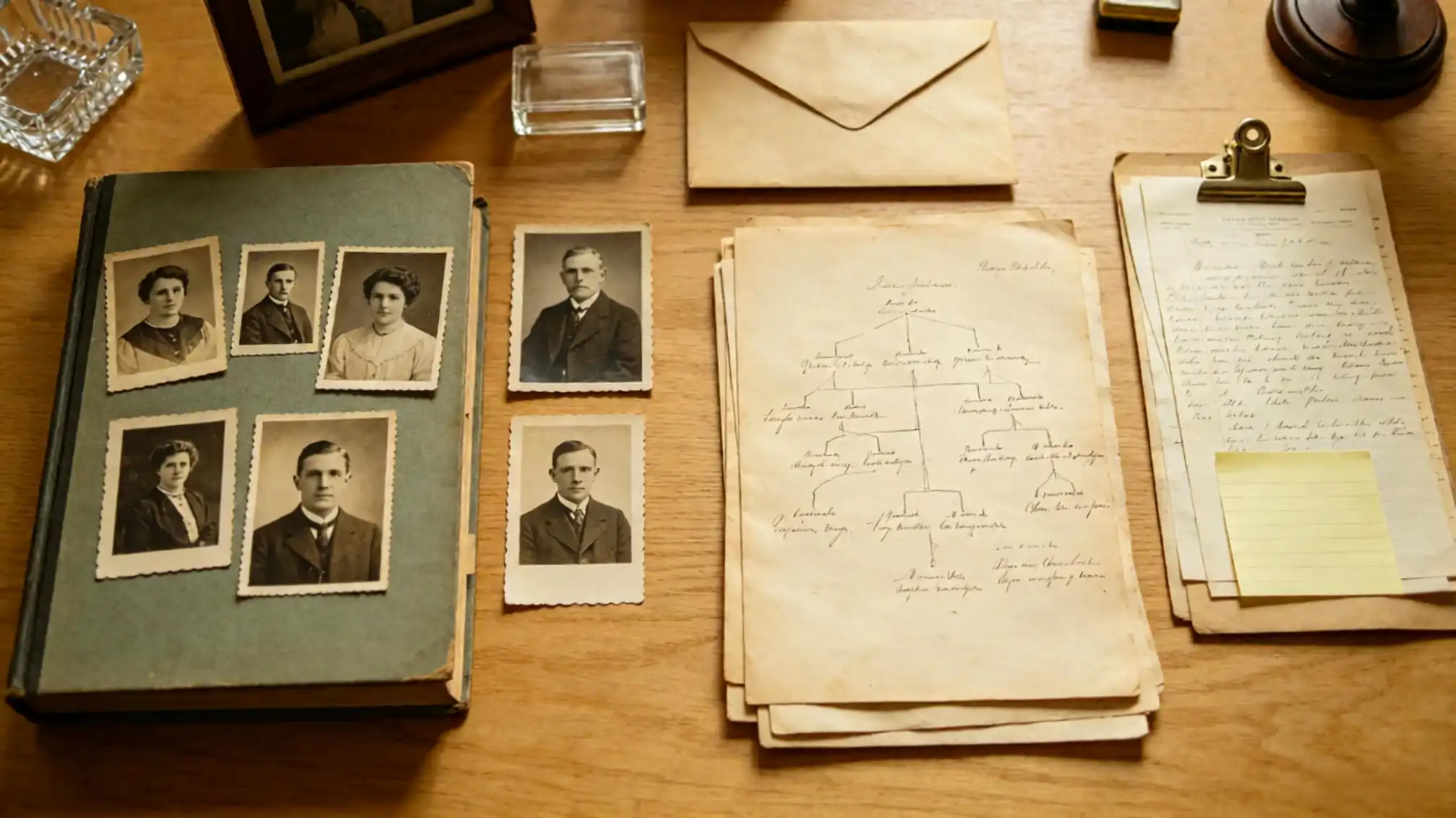
Draft a Four-Generation Family Tree
Your family tree should start as a working document, not a polished chart. Fill in your own name, then your parents, grandparents, and great-grandparents. For each person write birth, marriage, and death dates plus the town or county where the event happened. If a fact feels uncertain, put a question mark beside it. This draft is valuable because it shows exactly which ancestors are missing and what you are trying to prove.
Use a spreadsheet, genealogy software, or paper. The format matters less than consistency. Later, every source you find will attach to one box on this tree. If you keep that connection clear from day one, you will never waste time searching for a fact you already found.
Verify Documents One Generation at a Time
The easiest mistake in family history research is jumping to great-grandparents before you have proof for the previous generation. Move backward one step at a time. Start with civil records: birth certificates, marriage licenses, and death certificates. Then use church registers, census records, wills, land deeds, military papers, and newspaper obituaries to fill in the spaces between official events.
For every source, record a citation that answers four questions: who, what,when, and where the information was found. This does not mean copying a screenshot. It means writing down the repository, the collection title, the volume or film number, and the page. When you trace your ancestors step by step, these citations become the evidence chain that keeps distant branches from collapsing later.
Keep a Research Log That Records Failure Too
A research log is not the same as a family tree. It is a dated list of every search you complete. Include the database or archive, the name you searched, the event you hoped to document, and what came back. When a record does not exist or a name produces no match, write that down as well. Negative results are useful because they stop you from repeating dead ends a few months later.
Once your log is in place, you can follow your own research path again when a new record set becomes available. That is often how family historians solve old problems: not by guessing harder, but by noticing a missing piece in a search they ran before.
Give Equal Attention to Female Lines and Maiden Names
Female ancestors are often the reason a family tree reaches a dead end. When you interview relatives, ask for women’s full birth names, including middle names and nicknames. Marriage records give one clue, but obituaries and gravestones may reveal the maiden name if the husband died first. Search a woman’s brothers as well; their guardianship records, military files, or land sales can name a mother whose surname was erased by marriage. Tracing ancestors step by step means actively recovering those lost names.
Use Local Records When National Indexes Fail
Do not stop at global genealogy websites. County histories, poorhouse registers, naturalization papers, city directories, and church anniversary booklets may be digitized in small archives. Land records are especially powerful because they list neighbors and witnesses. Add old maps to your process: a property map can place an ancestor in a specific community and separate your family from another family with the same surname. Local librarians and historical societies often know which records have survived, and they are usually generous about responding to a focused request.
Use DNA Matches as One More Source
Genetic genealogy has changed how we trace ancestors, but it works best after the paper trail gives you a question. Build a reliable family tree, then compare your DNA matches against that tree. A shared segment may confirm a suspected ancestor, or it may point toward another line entirely. Treat ethnicity estimates as an idea, not a conclusion; surnames and locations from matches matter more than broad percentages. When you combine DNA results with probate files, land records, and census pages, you end up with a stronger family history than any single source could provide.
Break Through Brick Walls by Studying the Neighbors
When an ancestor seems invisible, stop searching for the surname and search the whole community. Genealogists call this the FAN method: friends, associates, and neighbors. A woman’s parents may be missing from her marriage record, but her sister could be the witness. A family may not appear in the 1860 census, but the family next door may have married into the same line. Look for godparents, guardians, taxpayers, and estate executors. Their names can unlock records that belong to your ancestor under a different spelling or legal situation.
When you find a candidate with the same name, treat it as a hypothesis. Use ages, family members, locations, and occupations to separate your ancestor from someone of the same name in another county. Keep a note about why you think the match is correct.
Writethe Family Story Before It Feels Complete
Genealogy research becomes family history only when you turn facts into narrative. Do not wait until every branch is perfect. Write a one-page profile for one ancestor each month, stating what you know and how you know it. Mention a specific date or place that connects the ancestor’s personal story to larger history. These profiles can sit in a binder, a personal website, or a shared family archive. Before you publish your profile, browse the family stories collection to see how other people balance hard facts and personal memory.