What Genealogy Really Offers You
Genealogy is often mistaken for a dry list of names and dates. In truth, it is a journey into the lives behind those names. When you begin studying your family history, you become a detective, a storyteller, and a keeper of memory. You also become a connector, linking your children, nephews, grandchildren, and even distant cousins to the ancestors who shaped them.
If you are new to the topic, start where you are. Genealogy can feel huge because every family tree branches in a hundred directions. Yet the first branch is always close: your own home, your own relatives, and the small fragments of memory that already exist in your family. The real skill of a beginning genealogist isn't knowing every record system at once. It's learning to listen, observe, and capture.
Begin at Home: Your Family's First Archive
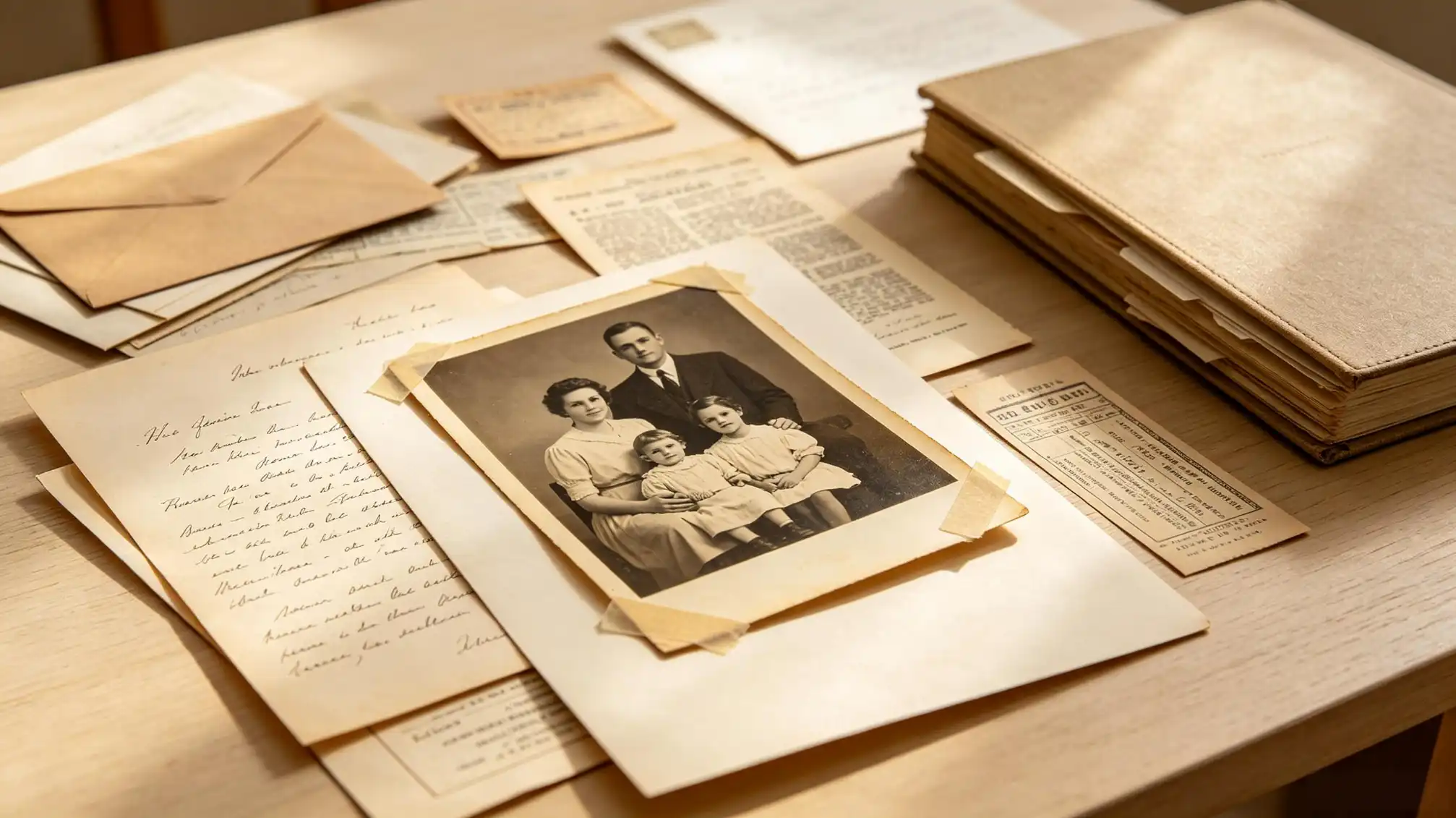
Your house is an accidental archive. Before worrying about ancestry websites and distant records, look for evidence that is already overlooked. Old boxes in a closet, drawers full of greeting cards, a Bible with handwritten birth dates, envelopes with postmarks, and letters tucked inside cookbooks can all become the foundation of your genealogy research.
These items are not just sentimental clutter. They tell you the everyday routines, occupations, and fears of your ancestors. For example, a soldier's letter home reveals more than a military record ever could. A handwritten recipe passed across generations is as valuable as a census entry for understanding your family traditions.
If you want to organize this early work, take a simple step: place everything together in a single box or folder. Then handle each item one at a time. Write down who it belongs to, where it was found, and the approximate date. Later, those small notes will become the clues that let you verify names, relationships, and migrations through official records.
Interview the Living Before They Leave Us
Early in the genealogy research process, make an appointment with the oldest living members of your family. Your grandmother, great aunt, or a family friend may not be online, but their memory is a library that will soon disappear if you don't ask questions. This step is far easier than navigating archives, so new family historians should do it first.
Prepare a list of open-ended questions, not just "what year were you born?" Instead, ask: "What do you remember about your grandparents' house?" or "How did your parents meet?" These questions reveal more than facts. They unlock the personality of ancestors and expose connections you would never find in a database. Take notes, but also ask for permission to record the conversation on your phone. Audio adds emotion, rhythm, and accents that take you into the past.
Ask to see photographs while you talk. You can then ask the most powerful genealogy question in the world: "Who is that standing beside your mother, and what did you do together that day?" A single snapshot can produce a whole chapter of family history. When you have collected a handful of stories, it becomes so much easier to shape them into a narrative. If you are ready to see how others do this, browse the personal narrator articles at FamilyLove Stories for inspiration.
Build a Simple Family Tree Without Overcomplicating It
After you have gathered home sources and family memories, you can place them into a basic family tree structure. You do not need special software at this stage. A sheet of paper or a simple table will do. Start with yourself, then move up to parents, grandparents, and great-grandparents.
Do not be afraid of blank spaces. A blank part of the tree is not a failure; it is an invitation to observe. Write what you know and what you need to prove. Keep a separate line for relationships that family members tell you about but that you have not yet confirmed. The job of the genealogist is to separate memory from evidence, while still respecting that memory often leads us to evidence.
Choose a Smarter Approach for Every Person
When you begin adding sources to your family tree, create one folder, digital or physical, for each surname or family unit. A small note might say: "Interview with Aunt Mary, July 14, 2024. She said that her father's family moved from Greenfield in 1902." This note is directly helpful later when you browse census records or city directories.
Remember that one generation often connects to another through a witness, a neighbor, or a marriage. The city you thought was unimportant may be the missing link between two branches. Therefore, keep your mind flexible and your research log honest.
Expand Your Research Without Losing Ground
Once your starting facts are organized, you are ready to move into public records. For genealogy basics, beginners need to learn the most common sources: birth and marriage certificates, census returns, land deeds, deportation sheets, passenger lists, and newspaper clippings. The trick is not to search randomly across the entire internet but to choose one ancestor and one event at a time.
As you find documents, always ask three questions: Who created this record? Why did they create it? And what else was going on at that time? A census taker may have spelled the surname wrongly, but a neighboring family listed with the same odd spelling may actually be a relative. Never assume a document is correct just because it is old. Cross-check every key fact with at least one other source.
Modern DNA testing can offer fascinating clues, but treat it as a supplement, not a replacement for documentary genealogy. DNA matches give you statistical probabilities and connections to genetic cousins, but the paper trail will give you names, places, and reasons. Combine both methods while remaining humble: your ancestors were real human beings, not categories on a screen.
Preserve Your Work So It Becomes Your Family's Story
Genealogy is not complete when you find the final ancestor. The true goal is preservation. Old papers yellow, photo albums fade, and digital files can be lost in a single broken device. As a beginner, establish simple preservation habits from day one.
Scan paper documents at a high resolution, at least 300 DPI, and save multiple copies. Use plain, descriptive filenames such as "Smith_Family_1950_Photo_Back.jpg" instead of "IMG_2033.jpg." Then follow the golden rule of memory: keep it in more than one place. One copy on your computer, one on an external drive, and one in secure cloud storage. The cloud is convenient, but physical copies still matter for family events.
Preservation is also about stories, not only images and records. After an interview, type out a short narrative and attach it to the audio file. Write down little details like the way your great-grandfather trimmed his beard or the special way your grandmother folded lace napkins. Those details do not appear in any archive, but they are the soul of family history.
When your own story becomes part of the archive, you will understand what your descendants will one day value. If you are looking for a way to share your narrative and invite others to add their memories, the FamilyLove Stories page is an excellent place to build a living story around your research. Photographs, anecdotes, and family traditions belong together, not sealed in a binder on a shelf.