When people begin exploring their family history, the phrase family tree often conjures up an image of an old parchment chart with elegant lines connecting generations. That image is true as far as it goes, but it misses the living quality behind the term. A family tree is not just a document you fill in; it is a way of seeing how you and your relatives belong to a much larger story. It is a map of belonging, memory, and identity that grows richer the closer you look.
More Than Names on a Chart
At first glance, a family tree looks like a simple diagram: you at the bottom or center, your parents above or beside you, then grandparents, great-grandparents, and so on. But every name on that chart stands for a real person with a birthplace, a trade, a marriage, a journey, and a set of hopes. When you begin filling in those details, the tree stops being abstract. It becomes a network of relationships and life events that explain why your family tells the stories it tells.
In genealogy, the family tree is often used as an organizational tool. You can record births, deaths, marriages, and other events in a way that shows lineage across generations. Yet the deeper value is interpretive. Once you see that your grandmother was the third child of immigrants, that your great-uncle served in a particular war, or that a family branch settled in the same valley for two hundred years, you start to understand patterns. Those patterns are your family history in its most human form.
What a Family Tree Can Show You
A well-built family tree reveals more than direct lines. It opens a window onto ancestors who made decisions under circumstances very different from your own. You may discover names that repeat across generations, or notice how certain occupations stayed in the family. You might trace why your ancestors moved from one country to another, how they survived difficult seasons, or what values they passed down without ever writing them in a journal.
This is why beginners are often encouraged to treat the family tree as a research tool, not a final product. Every ancestor is a doorway to another set of records, another neighborhood, another chapter of social history. As you add siblings, cousins, in-laws, and other relatives, you begin to see the shape of a community. That community is your own family history waiting to be told.
Start With What You Know
Beginners often worry that they need to know a great deal before they can start. The opposite is true. The best way to build a family tree is to begin with yourself and work outward. Write down your own full name, date and place of birth, and any important life events. Then add your parents, their siblings if you know them, and your grandparents. This small starting point gives you a foundation you can verify and expand.
Next, gather the evidence that already exists inside your home. Letters, photo albums, birth certificates, marriage licenses, old address books, and family Bibles can all contain valuable clues. Many of these records include names and dates that may surprise you. Interview older relatives while you still can. Ask open-ended questions about their childhood, their parents, and the places they remember. These conversations create a kind of oral family history that no database can replace.
Turning Fragments Into a Coherent Family History
As you collect fragments, you will notice gaps. That is normal. The real work of genealogy is responsible reconstruction. When you find a record, note where it came from and how confident you are in its accuracy. Official documents are usually more reliable than memory, but even official records can contain mistakes. Compare sources, look for patterns, and keep track of unresolved questions.
This careful approach gives your family tree credibility. It also makes the process more meaningful. Instead of simply gathering names, you are constructing a family history based on evidence and careful reasoning. Each time you connect one ancestor to another with confidence, you strengthen the whole tree. Over the months and years, those small connections add up to a lasting record you can share with the next generation.
Your Tree Is Part of a Wider Family Story
A family tree is personal, but it is rarely isolated. Your relatives may hold pieces of the same puzzle. A cousin may have a photograph you have never seen. An aunt may know the maiden name of a great-grandmother you have been unable to trace. That is why shared family spaces matter. As you begin building your tree, consider turning it into a collaborative effort. When you ask relatives to contribute, you are not just gathering data; you are strengthening the family itself. If you would like to see how your family members fit into a living, shared space, take a look at our family page and use it as an action reference for conversations you can start today.
How to Read a Family Tree
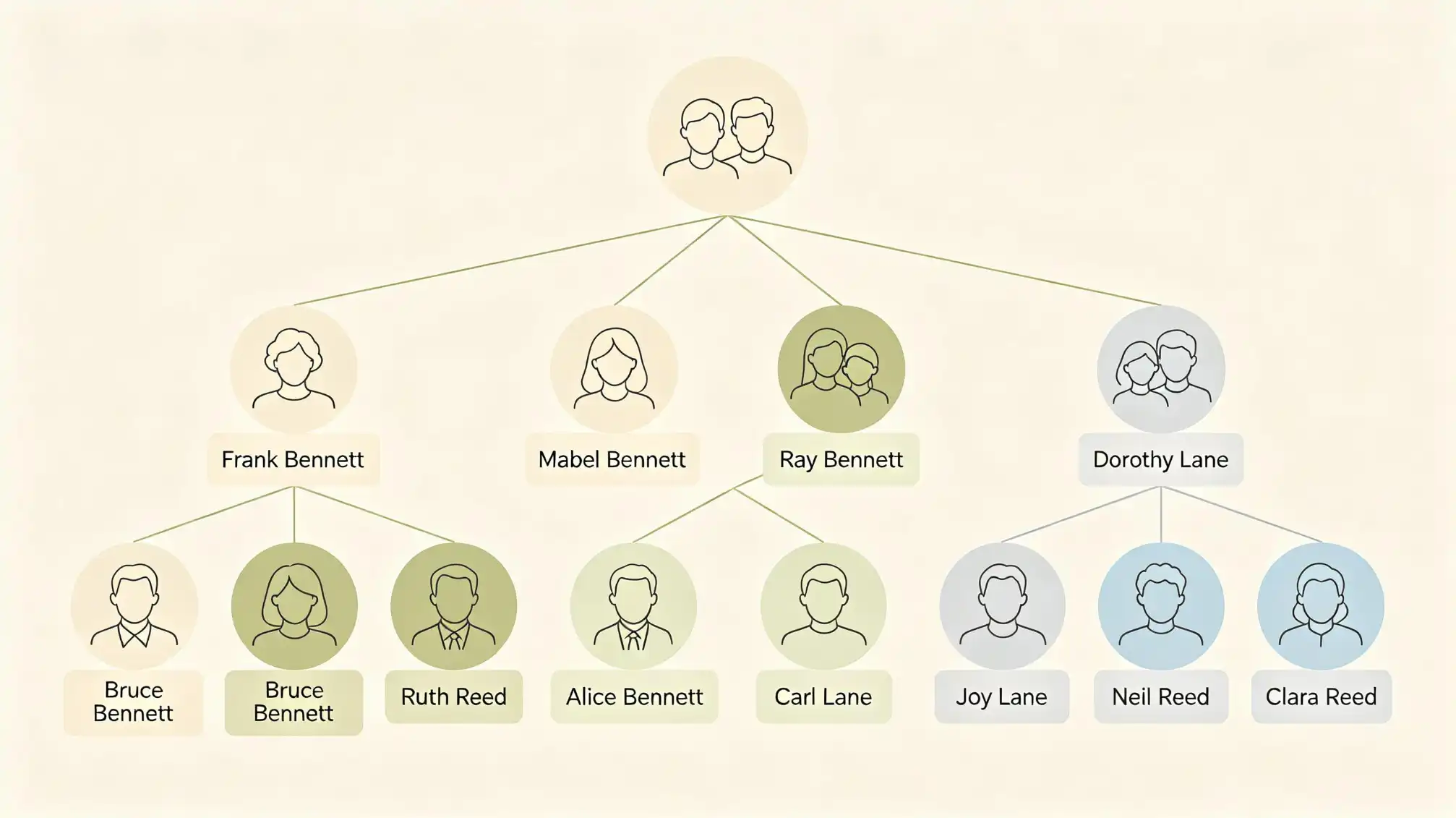
Once your tree has a few generations, you may want to understand its structure more fully. Most family trees show descendants from a common ancestor, which is called a descendant chart. Others show one person and their direct ancestors, which is called a pedigree chart. Both are useful. If you are trying to trace a grandmother’s maternal line, you may want a pedigree view. If you are curious about all the branches that flow from a great-grandparent, a descendant tree will serve you better.
As you read your tree, look for patterns in names and locations. Many families recycle first names, so do not assume a name belongs to one generation only. Also, remember that women’s surnames may change due to marriage, and that spelling variations were common before standardized record keeping. These small nuances are part of the challenge and the pleasure of genealogy. They turn a simple family tree into a detective story about your ancestors.
For beginners, the important thing is not perfection. It is curiosity and consistency. You do not need to trace your lineage back to royalty or claim a famous relative. The most rewarding family history is the one that honors the people who actually lived and loved before you. A family tree gives you a place to hold their memory with respect.