Tracing your ancestors can feel like a project with no clear finish line. You may worry that you will start in the wrong place and have to redo years of work. The good news is that genealogy is not about memorizing every record type before acting. It is about following a sequence that always begins inside your own home.
Use this guide as a calm, evidence-first route through family history. You will see exactly when to gather papers, when to talk to relatives, and when to open a census index.
Begin With What You Already Own
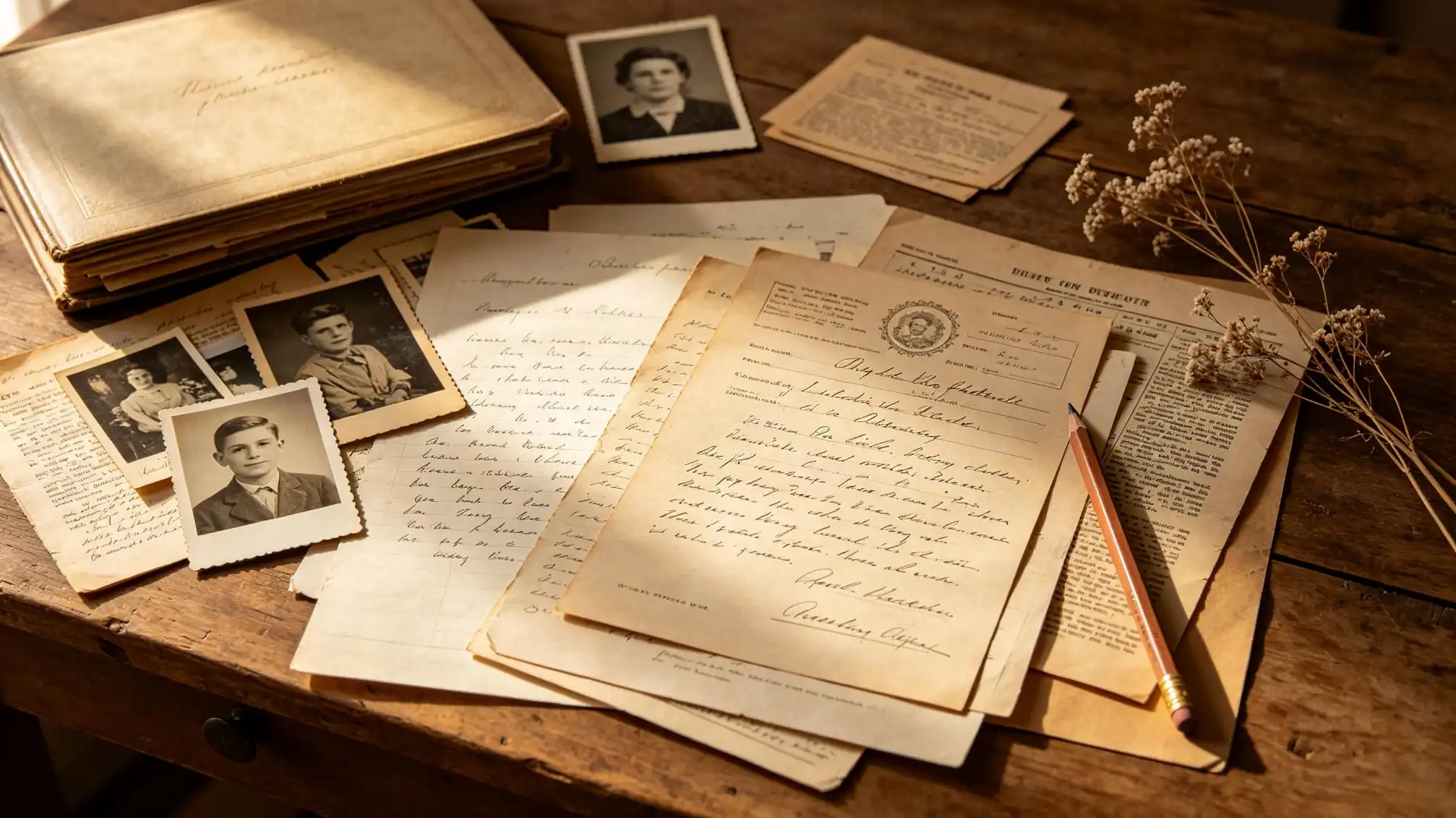
Your home is a private archive. Before you buy expensive subscriptions or contact an archive, search every drawer, shoebox, Bible, and inherited address book. Old family papers do not have to be official. A handwritten note, a returned envelope, or a pension letter can carry a birthplace that no other document will ever give you.
Create two piles. In the first pile, place every paper that mentions a name, date, or city. In the second pile, place photographs. Use a soft pencil to note only what someone can confirm, such as the year or location, on the back of each photo. Photographs help you hold a family tree in your mind while the documents become the evidence.
Build the Skeleton of a Family Tree
Open a notebook or a simple spreadsheet and enter only what you know for certain about your parents, grandparents, and great-grandparents. For each ancestor, record full name, birth date, birth location, marriage date, death date, and the names of parents if those appear anywhere in your collection.
A family tree grows best when you work one family unit at a time. Do not try to fill every branch in a single afternoon. Start with the line that has the strongest documents, then let that success pull you into more difficult branches. Keep each family unit on its own page so you can compare dates without confusion.
Interview the Eldest Relatives You Can Reach
Use the notes you have just made. Ask a relative to sit with you over coffee or to speak with you by phone. Your goal is not to prove what you already think you know. Your goal is to collect details that only living memory can supply.
Ask open-ended questions. What do you remember about your grandmother’s kitchen? When did your mother first mention living somewhere else? Who stands next to the man in that photograph from the picnic? Write down every phrase you hear, including jokes and references you do not yet understand. Label the conversation with the speaker’s name and the date, and keep it with your family history notes.
Reach out to older relatives first. They may be the only people who can identify faces in the photo pile. Confirm the spelling of maiden names and places by repeating them out loud. These interviews often reveal second marriages, adopted children, and migrations that official records hide.
Move to Civil Records With New Patience
Once you know the country, province, or county where your ancestor likely lived, search for civil records. Birth, marriage, and death certificates are the backbone of documented family history. Start with the most recent ancestor you have, then move backward year by year. This keeps your search legal, inexpensive, and organized.
Keep in mind how records are filed. In the United States, vital records are usually held by the county or state office that registered the event, not by one national archive. In Europe and many other places, the parish or local civil registrar may hold the earlier registers. Write a brief, polite letter to each office and include the date ranges you are looking for. Places with understaffed archives often answer faster when the request is specific.
Use Census and Probate Records for Daily Details
Census records help you trace your ancestors decade by decade. Once you locate a household in one census year, search for them ten years before and ten years after. Notice the neighbors listed nearby. Families frequently moved together with cousins or former church members, and those neighbors can lead you to a missing surname.
Probate records deserve your full attention. A will is only the first page of an estate file. The full packet may include receipts, land descriptions, and letters that describe the exact season your ancestor died. If you only search a surname index, you may miss this rich material. Ask at the courthouse or archive whether a probate packet has more pages beyond the original will.
Test DNA Only as a Complement, Not a Shortcut
The popularity of DNA kits makes some researchers think they can skip the record search. In practice, DNA works best after you have built a family tree with ordinary documents. A DNA match can confirm a suspected parent or connect you to a cousin who owns original letters, but it cannot replace a birth certificate or a death record.
If you decide to take a test, ask the oldest willing relative to donate the sample. That person carries more of your ancestor’s genetic material than any younger relative. Once the results arrive, attach them only to the family tree you have already documented. Treat every new matching cousin as a lead to test with evidence, not as a final answer.
Handle Dead Ends Without Throwing Away Evidence
Every genealogist eventually meets an ancestor who seems to appear from nothing. Before you surrender, search for the mother’s surname transformed into a child’s middle name, the surname recorded with a different spelling, or the baptismal record from a nearby parish. People rarely lived without a network of witnesses, neighbors, and godparents.
Try searching the people around your ancestor. Write down every surname that appears on the same page or in the same court case. Those people may have traveled with your family from an old country or another state. When a direct match is impossible, the cluster gives you a path to the next generation.
Share What You Find and Ask for Corrections
Family history is strongest when it is shared. Once you write short profile pages for each ancestor, send them to the relatives who helped you. Ask them to correct dates and identify people in the photographs. Every correction usually unlocks one new memory, which in turn reveals a new record to pursue.
If you have a family story that deserves a wider audience, post it on your family stories page and invite relatives to comment. A shared family history is easier to fact-check, and it draws out quiet relatives who would never offer information unless someone else starts the conversation.