Genealogy has a beautiful way of turning old photographs, forgotten names, and scattered dates into a continuous family story. If you are new to the study of your ancestors, you might feel pulled in many directions: online databases, DNA tests, surname lists, and archival records. The secret is to slow down. Beginner genealogy is not about knowing every detail before you begin; it is about learning one name, one date, and one story at a time. This guide walks you through a calm and achievable way to start your own family history.
Start with What You Already Know
Before you search for ancestors in any record collection, collect the facts that are already shared in your home. Your family tree begins with you. Write down your full birth name, birth date, birth place, and then add the same details for your parents, grandparents, and anyone else who has been part of your everyday life.
Search through drawers, boxes, closets, and old Bibles. Look for birth announcements, wedding invitations, school reports, military papers, naturalization records, and funeral programs. Read the backs of photographs, because someone may have written a name, a date, or a place in careful cursive. These small clues are often the starting point for locating official records later.
- Create a simple document called 'Names I Know' and fill it in without worrying about mistakes.
- Ask older relatives if you can copy their documents and keep the originals in their hands.
- Scan each item right away or save it in a family folder so you do not lose track of what you find.
Talk with Relatives Before the Stories Fade
Your relatives are living libraries. An aunt may remember the name of your great-grandmother's favorite song; a grandfather may know the town his father left behind. Set up a visit or video call and record the conversation with their permission. You are not conducting an interrogation; you are having a guided chat over tea, coffee, or old photo albums.
Use questions that invite stories. Ask about childhood friends, parents' work, holiday traditions, and the way the family traveled from one home to another. Ask about one person at a time, and let the conversation wander. The best genealogy often comes from an unexpected laugh or memory.
Build a Simple Family Tree
After you have collected names and stories, arrange what you know visually. A traditional family tree shows you, your parents, your grandparents, and sometimes your great-grandparents. You can use paper, a whiteboard, or a simple computer file. The goal is not to make the chart beautiful on day one; it is to reveal blank spaces you still want to fill.
Start with three generations. Put yourself at the bottom, add your parents above you, and then add all four grandparents above them. Add birth and death dates, birthplaces, and surname changes. If you run out of space, create a separate page for each grandparent line. You will soon see why genealogy researchers are so careful with middle names and spellings.
Pick One Branch and Follow It
A common mistake is trying to trace every branch of the family at the same time. After a few joyful weeks, you may end up with a tangle of people. Instead, choose one great-grandparent or one surname and study that line first. Use the family tree you built to identify auseful research question such as 'Where did my mother's grandparents grow up?' or 'What ship brought my father's family to the United States?'
Having one focus helps you learn the local record system, place names, and church boundaries. You can always return to the other branches later. For many beginners, following a single person from birth to marriage to death is the simplest way to understand genealogy.
Use Everyday Records as a Roadmap
As you move beyond memory, you will rely on records created by everyday life. Birth, marriage, and death certificates often confirm the names and dates you heard in an oral story. Census records can place your ancestors in a specific house and reveal neighbors, occupations, and children you might not have known existed.
Do not limit yourself to official records. Look for city directories, naturalization papers, draft cards, church membership lists, obituaries, and local newspaper items. Public libraries, historical societies, and state archives often have free databases that are easier to search than national collections because they focus on one county or region.
Write Down Where You Found Every Fact
In genealogy, an answer without a source is only a clue. Every time you discover a date or a family story, record where it came from. The source may be an interview with your uncle, a scanned letter, a census page, or a cemetery marker. Creating a source note for each person is not busywork; it helps you avoid repeating someone else's mistakes and makes it easier to verify your family history later.
You do not need complicated software. Use a spreadsheet with columns for surname, given name, event, date, place, and source. Save copies of the actual document or photograph next to your note, and name the files with enough context, such as Smith_John_1900_Census_Ohio.jpg.
Preserve and Share as You Learn
At some point your genealogy becomes more than a collection of facts: it becomes a responsibility to the next generation. Scan fragile documents and photographs before they fade. Store originals in acid-free folders and keep backup copies of your digital files in a separate place. A simple memory box can be more powerful than a wall full of names if it contains objects and their stories.
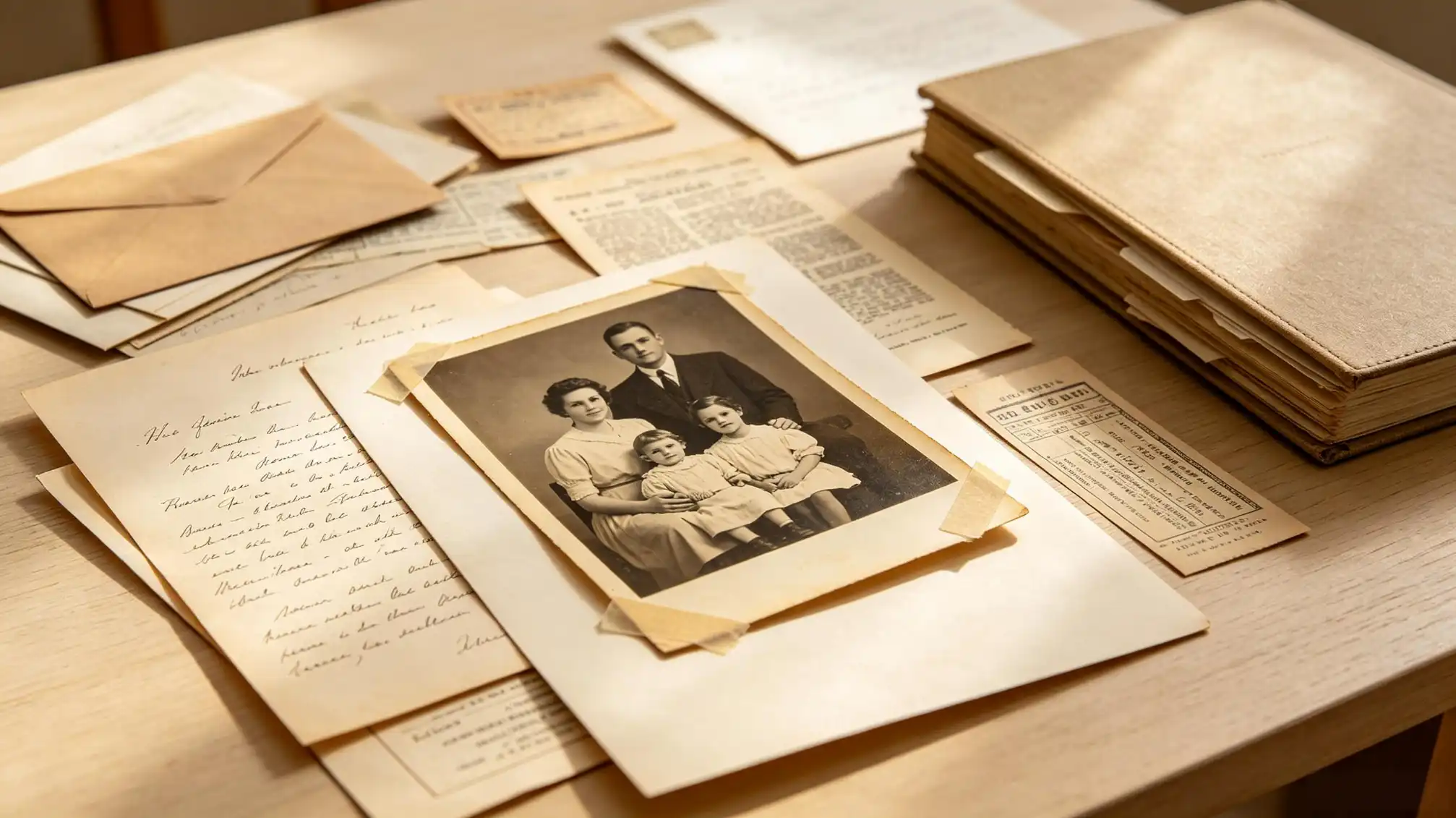
Sharing your research is also part of preservation. Relatives may be more willing to help when they can see the project taking shape. Consider scanning a few letters and photographs and sharing them on the FamilyLove stories page, where family members can add their own comments, correct small details, and enjoy the memory together. That page is a thoughtful place to keep the human side of your genealogy alive.
Avoid These Common Beginner Traps
Keeping your research healthy is easier when you know where beginners usually stumble. Pause before you become attached to a fact and recall that many online family trees are copied without proof. Original documents are better than someone else's interpretation of original documents. Watch for name changes, phonetic spelling, and migrated neighbors who may be confused with family. When you cannot find a person, look for a sister, brother, or aunt listed nearby; families often moved together.
- Do not copy entire online trees without checking at least one original source.
- Do not assume a surname keeps the same spelling across generations.
- Do not force a child into a set of parents just because the date could match.
- Do not skip local community records when a national database turns up nothing.
Make Gene Quiet Family Habit
You do not have to spend every weekend in a research room. Dedicate twenty minutes each week to one task: call an aunt, scan a photo, organize a folder, or follow one record lead. Write down the question you want to answer next time, and keep it beside your family tree. Over the year, these small actions create a surprising amount of family history.